Blog

  • 07. Conicals

    Infosheets

    07. Conicals

    Download the PDF – English

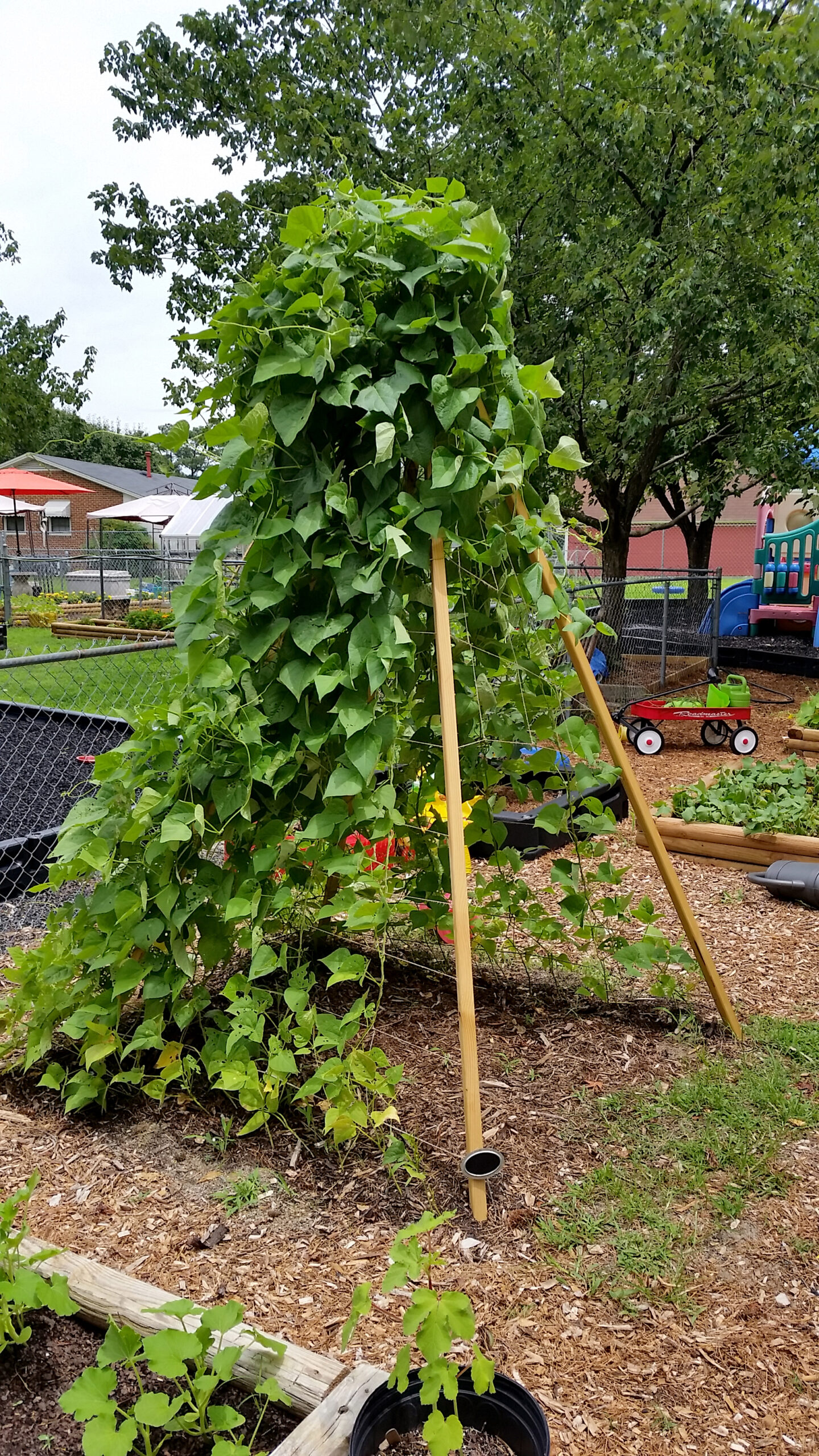
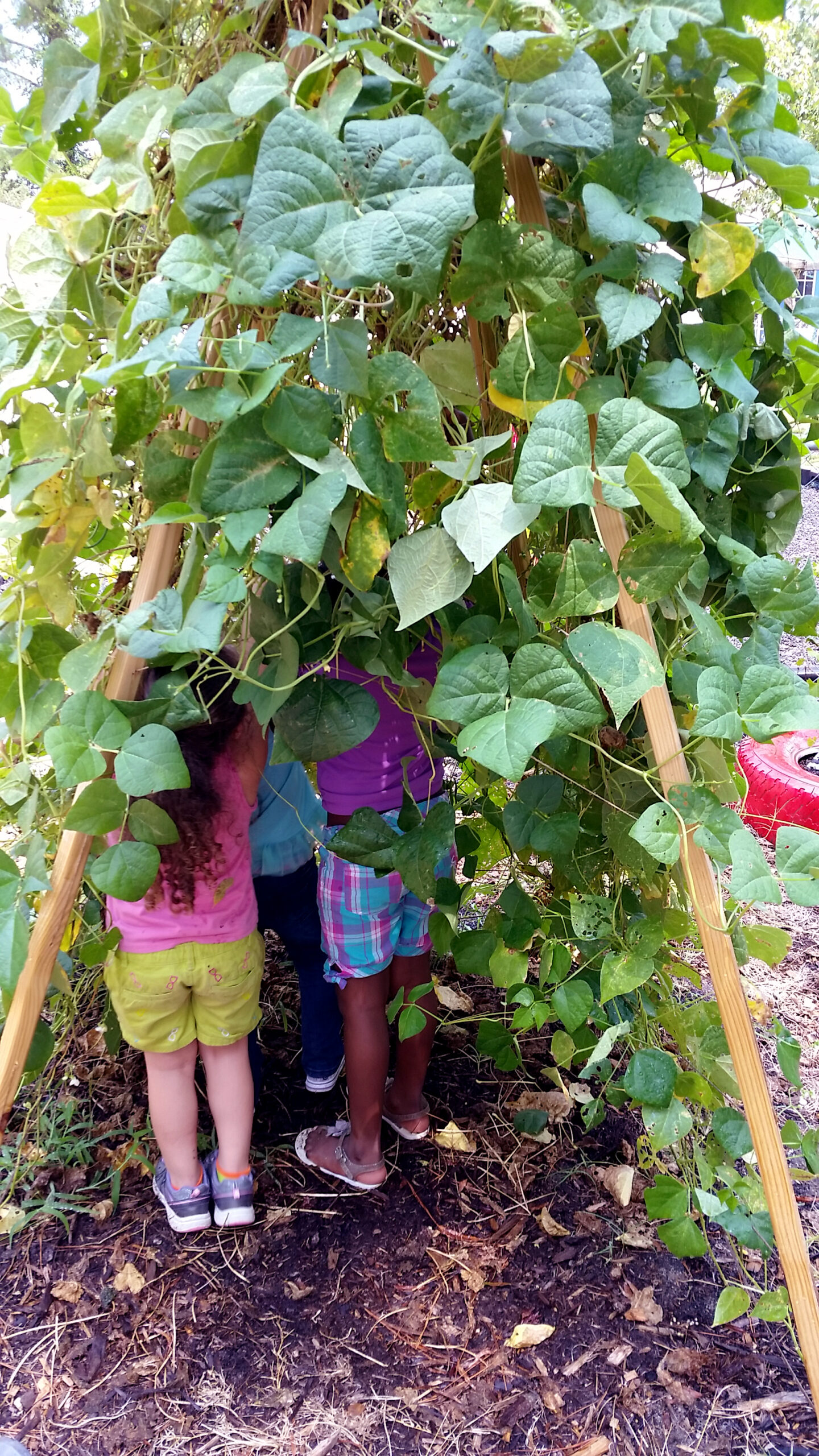
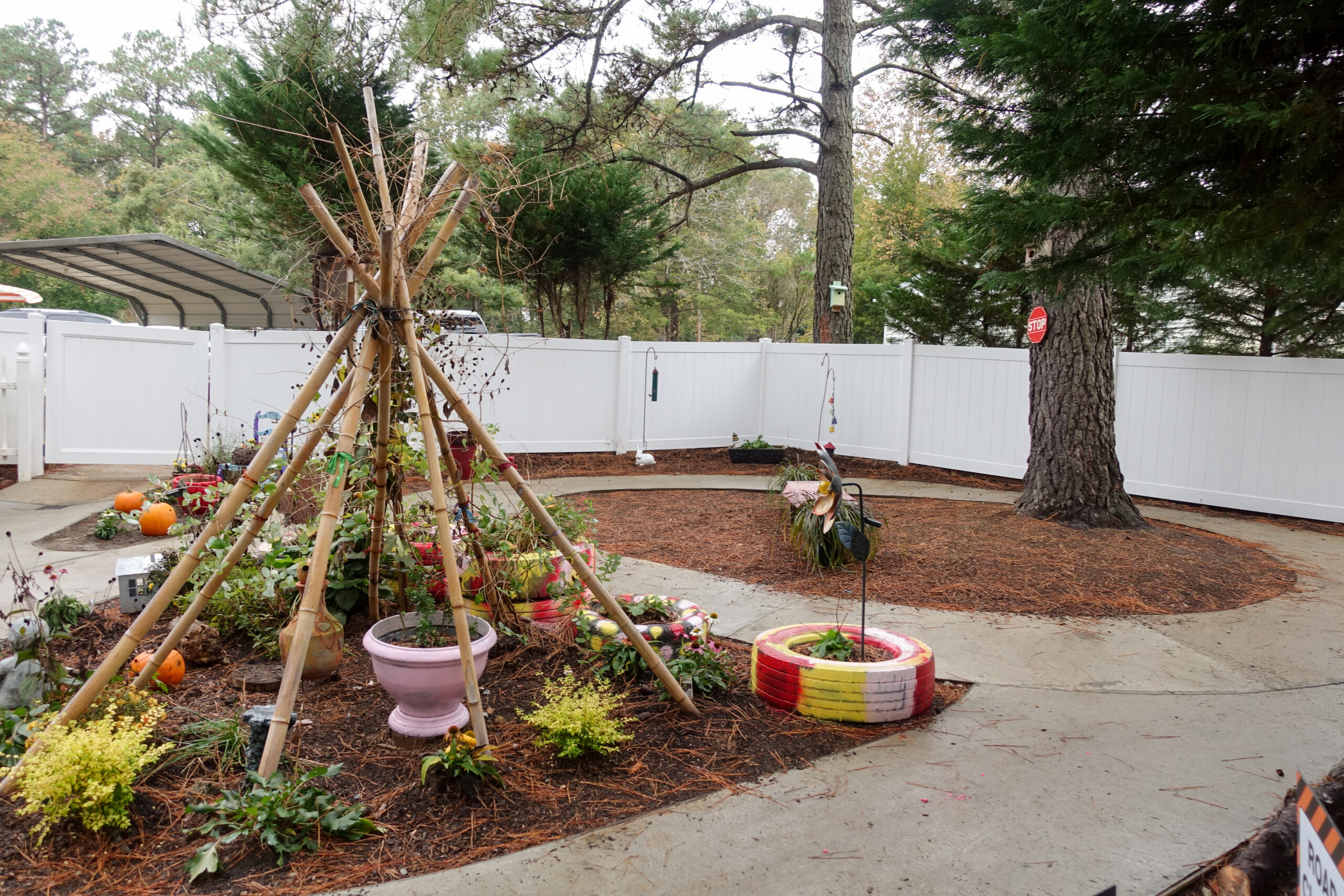
    Conicals provide a permanent, pyramidal form of nook for gathering and dramatic play. Constructed from geometrically arranged poles converging at their upper ends, conicals can be created from metal, dimensioned lumber, harvested tree branches, PVC, or bamboo. Sizes range from a small structure for two or three children to a space large enough for a group of ten. Covering can be light fabric or edible vines which provide an attractive “green gathering nook.” Perennial, fragrant vines add sensory stimulation. For detailed installation instructions, see the Vine Conical Installation Guide.

    Materials

    Structure. A variety of materials can be used for the structure of an outdoor conical. Consider cost and durability when selecting materials. Bamboo is a light-weight, abundant material that can be found for free or at low cost. Felled tree branches are similarly easy to acquire, but will need replacing as the wood decomposes. PVC is another light-weight material that can be easily found at home improvement stores. 1/2-inch rebar and steel are more expensive but will last longer than degradable materials.

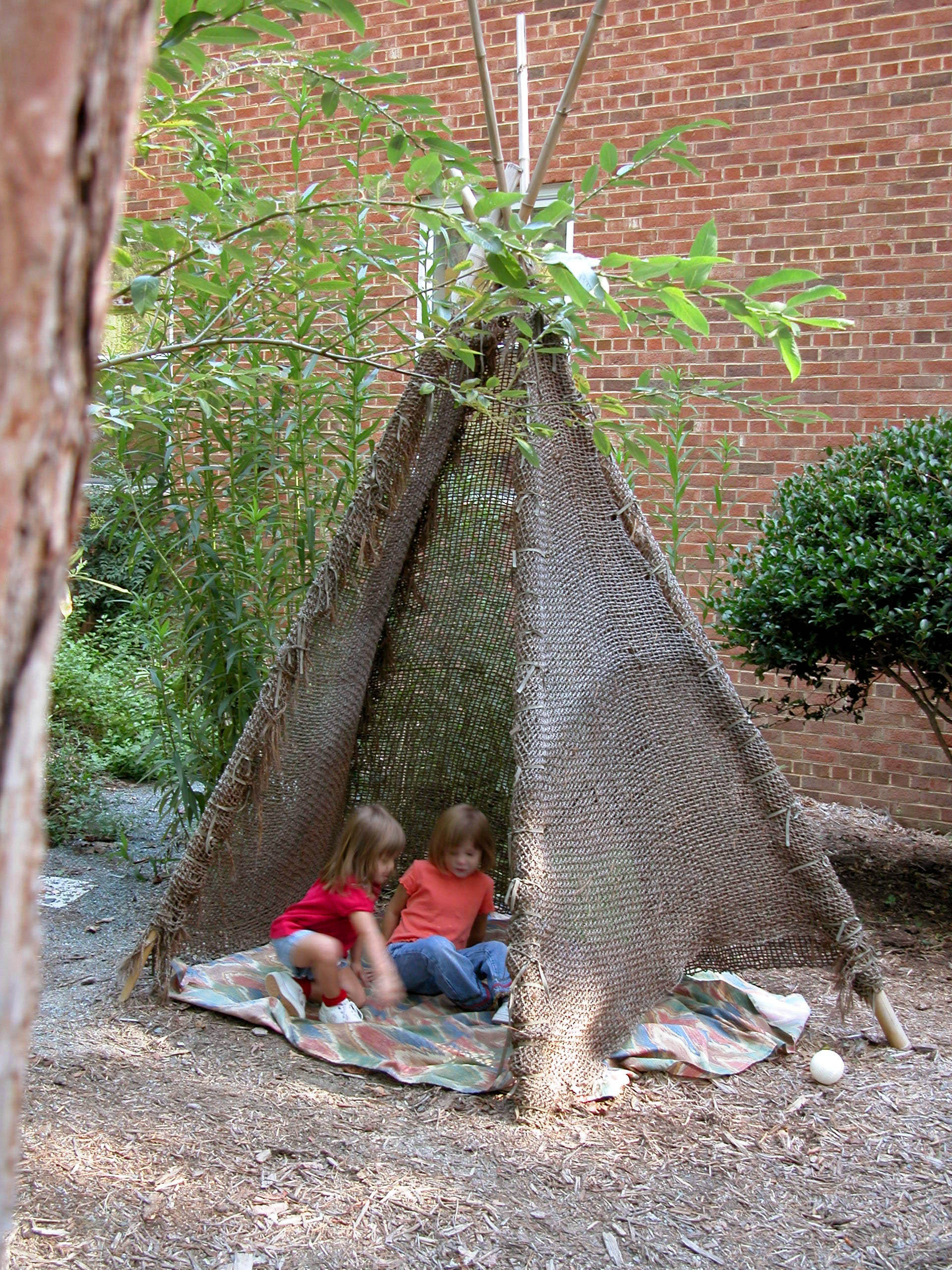
    Covering. Materials such as burlap or canvas are recommended because they resist weather changes and will show little wear and tear. Weaving colorful, patterned strips of fabric between supporting poles can be a creative and collaborative activity for children to complete a conical. Ensure the covering provides sufficient shade for extended play. Natural materials, such as edible or flowering vines, connect children with nature and add sensory play stimulation.

    Location

    For a conical covered in climbing vines, select a sunny location with well-draining soil. Locate the conical away from high-activity settings and primary pathways to create a sense of privacy for children.

    Size

    To create a space that 2–4 children can inhabit, the conical should be approximately 8 feet across and 8 feet tall inside. Structural poles should be 10 feet tall to accommodate an 8-foot wide structure. When building a conical of this size, the entrance should be 24–30 inches wide.

    Interior Components

    Interior components such as sitting logs, sitting stones, and outdoor blankets create an inviting hide-away for children. Painted rocks, toadstools, garden gnomes, hanging bells, and other decorations enhance play and learning opportunities. Be creative with interior decorations and explore possible themes such as “fairy garden” or “wild jungle” to create an immersive experience. Involve the children in making and implementing decisions.

    Supporting Vine Growth

    Support is needed for vines to climb and grow around the conical. Once the structure is created, use twine, jute, or a similar string material to weave a “zig-zag” pattern between adjacent conical poles. Plant vine plants at midpoints between poles and add mulch around plants and conical floor. Vines should be trained on the woven twine and poles as they grow. Use “twist ties” to anchor them.

    Recommended Vines

    Below is a list of popular vines for naturalizing outdoor conical. Annual vines need to be replanted each year, while perennial vines go dormant for the winter and bloom again the following season. Consider desired maintenance plan, available sunlight, and soil quality when choosing conical vines. Runner beans are a popular choice because they grow quickly, have beautiful blooms, and add an edible component to the outdoor learning environment.

    Annuals:
    Bottle gourd, Lagenaria siceraria
    Climbing nasturtium, Tropaeolum majus
    Cucumber ‘Mexican sour gherkin’, Melothria scabra
    Hyacinth bean ‘Ruby Moon’,Dolichos lablab

    Perennials:
    Coral honeysuckle, Lonicera sempervirens
    Chocolate vine, Akebia quinata
    Cross vine, Bignonia capreolata
    Hardy kiwi, Actinidia arguta
    Passionflower, Passiflora incarnata
    Scarlet runner bean, Phaseolus coccineus
    Yellow star jasmine, Trachelospermum asiaticum

    Resources:
    1. Infosheet: Vine Conical Installation
    conical structure covered in vines

    A small conical structure constructed using wooden poles and covered in vines makes a lush, green retreat.
    children in a conical structure covered in fabric

    A conical strucutre covered in woven jute fabric provides a cozy, social reading nook.
    large conical structure with open sides

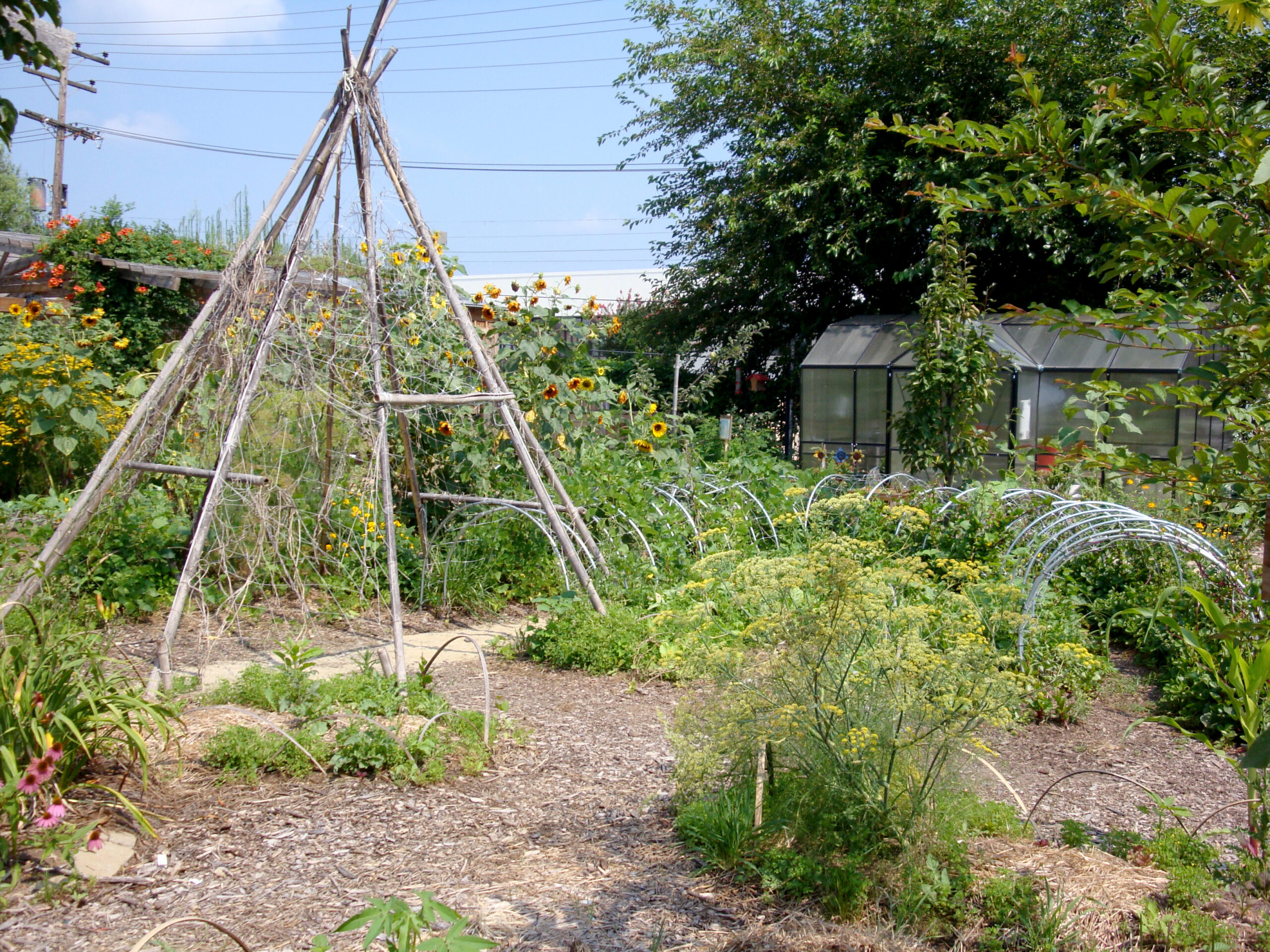
    A large conical structure with multiple openings covers a section of a path.
    conical structure made our of corn stalks

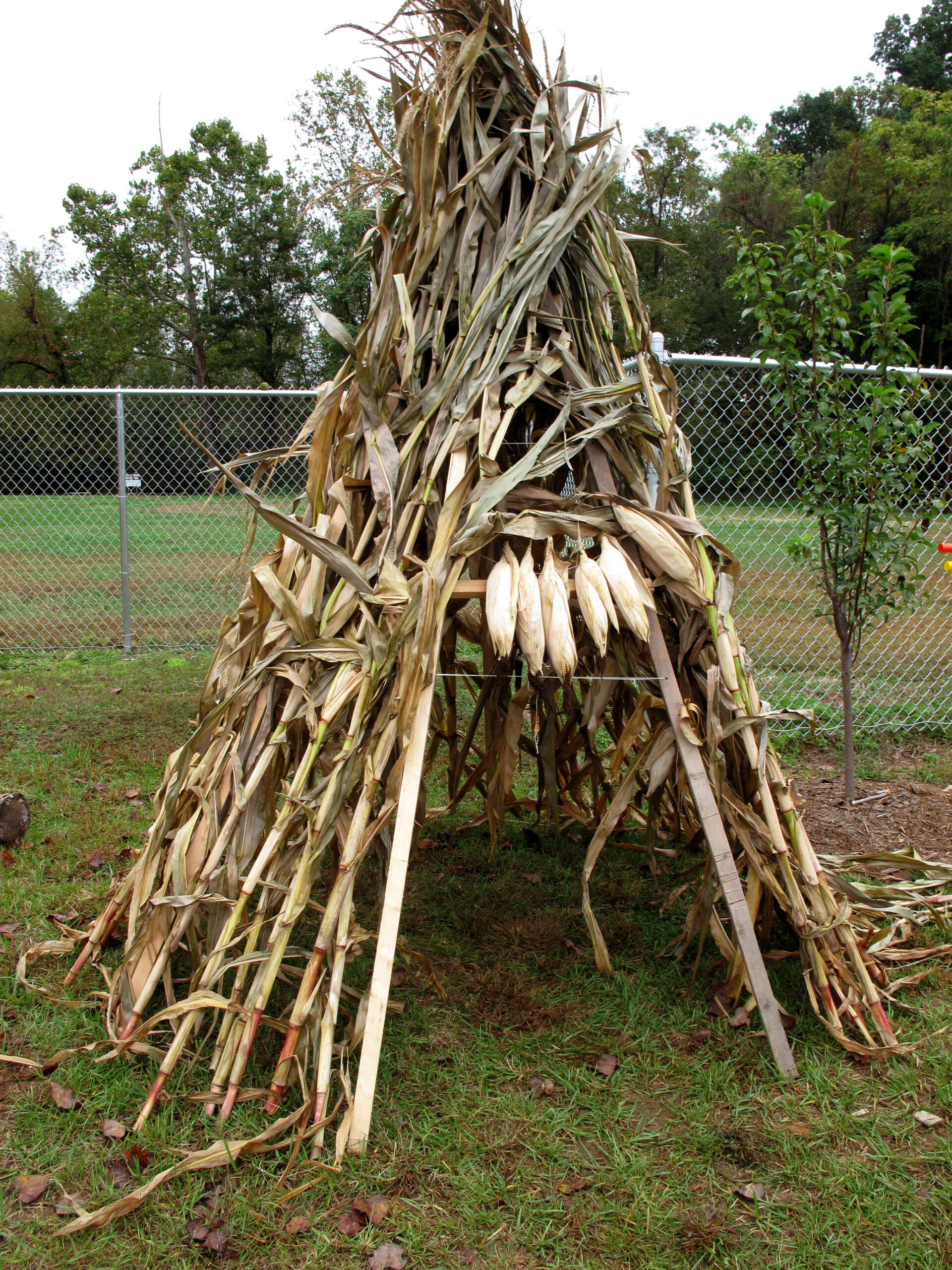
    A temporary conical structure covered in corn stalks marks the fall season.
    children inside a conical structure

    Children picking snacks off of edible conical structure vines!
    bamboo conical structure

    An open bamboo conical structure installed as a decorative feature in a garden bed.

  • NLI Sponsors a Creative Studio Experience

    NLI Sponsors a Creative Studio Experience

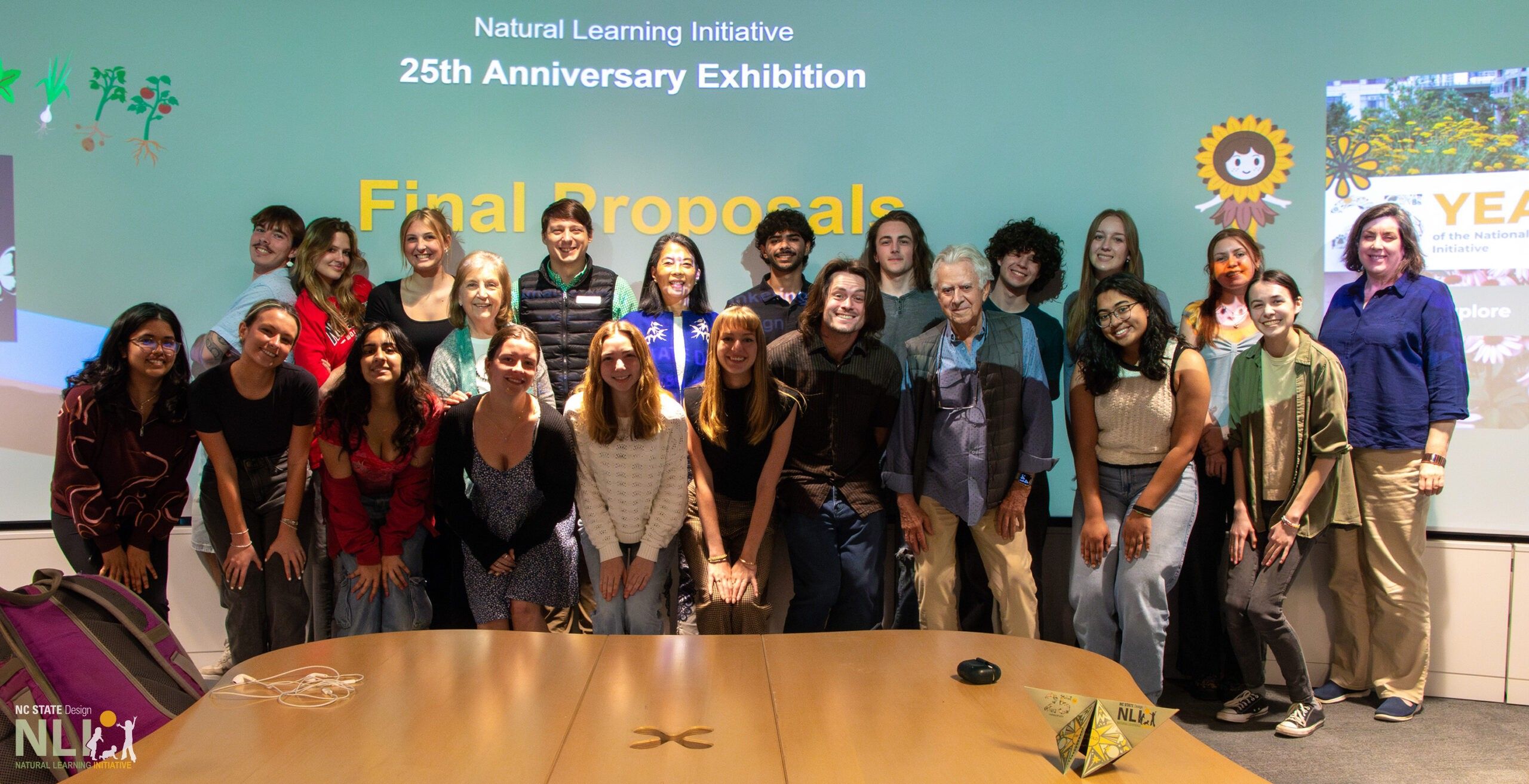
    Natural Learning Initiative 25th Anniversary Exhibition: Group celebrates final proposals for outdoor play and nature-based child environments.

    Group photo in the Hunt Library visualization lab after successful proposal presentations

    This semester, Victoria Chi’s freshman studio course (GD210 Image & Tech Tinkering) partnered with the Natural Learning Initiative (NLI) to create an immersive and educational experience for students, celebrating NLI’s 25th Anniversary with the support of the George B. Storer Foundation. Sponsored by NLI, the studio provided students with a real-world design challenge enriched by thoughtful pedagogy and professional mentorship. NLI’s Matt Babb and Professor Victoria Chi developed the rubric, group structure, and project timeline, allowing students to engage in a robust learning experience. A pivotal visit to a Raleigh school that showcases NLI’s outdoor play and learning environments offered students firsthand insight into how nature-based play and learning can be seamlessly integrated across age ranges. Throughout the course, check-ins and feedback sessions included insights from Victoria Chi and the NLI team, including Matt Babb, Adam Noel, Nilda Cosco, and Robin Moore, allowing students to continuously refine their ideas ahead of their final presentations and public exhibition.

    As part of their final deliverables, students were tasked with designing key elements for NLI’s large, fall 25th Anniversary Exhibition, exploring how spatial design, lighting, and interactivity can bring NLI’s mission to life. Projects addressed complex challenges such as wayfinding systems that are inclusive and accessible, immersive strategies that evoke emotional responses, and tech-enhanced storytelling tools that connect audiences intellectually, emotionally, and physically. From interactive signage to evolving timelines and nature-integrated visual installations, students celebrated NLI’s 25-year legacy with compelling design solutions that not only honored the past but envisioned the future of outdoor learning. This collaboration stands as a testament to the power of education, design, and environmental stewardship working in harmony across both the Landscape Architecture and Environmental Planning and Graphic & Experience Design Departments.

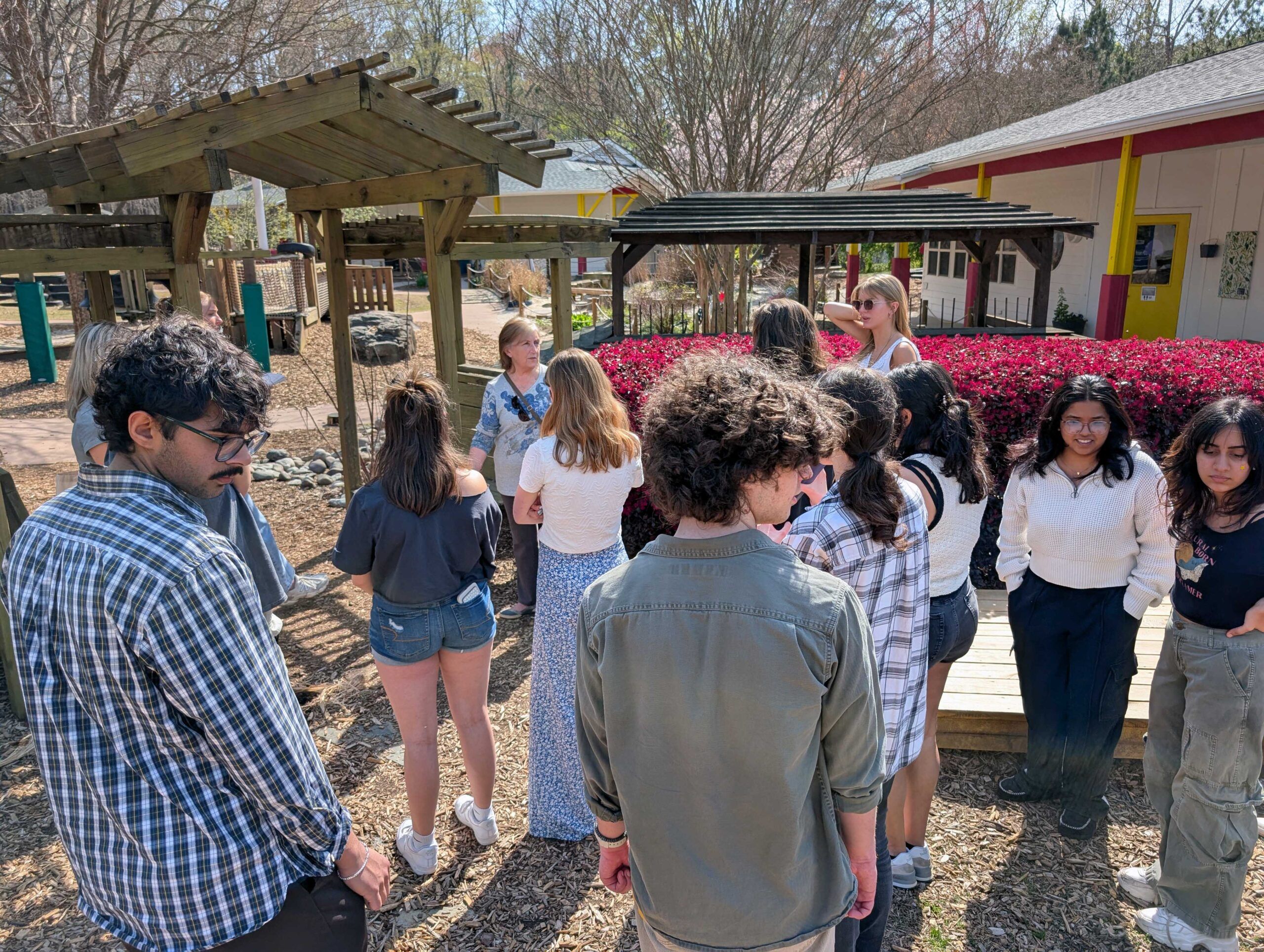
    Students gather around a wooden play structure, exploring an outdoor learning environment at The Raleigh School, showcasing NLI's nature-based design.

    Students start with a visit to The Raleigh School to see an example of NLI work in person

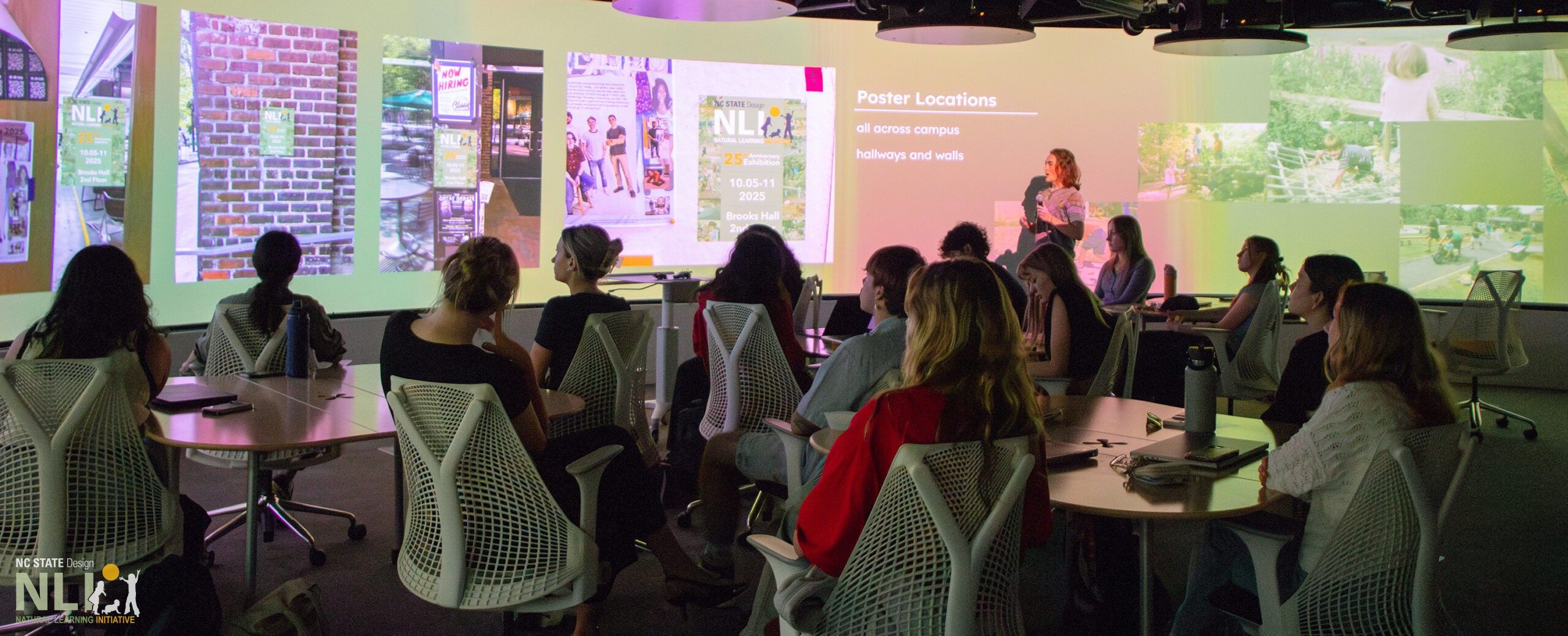
    Students present design concepts in Hunt Library visualization lab, showcasing outdoor play and nature-based child environments.

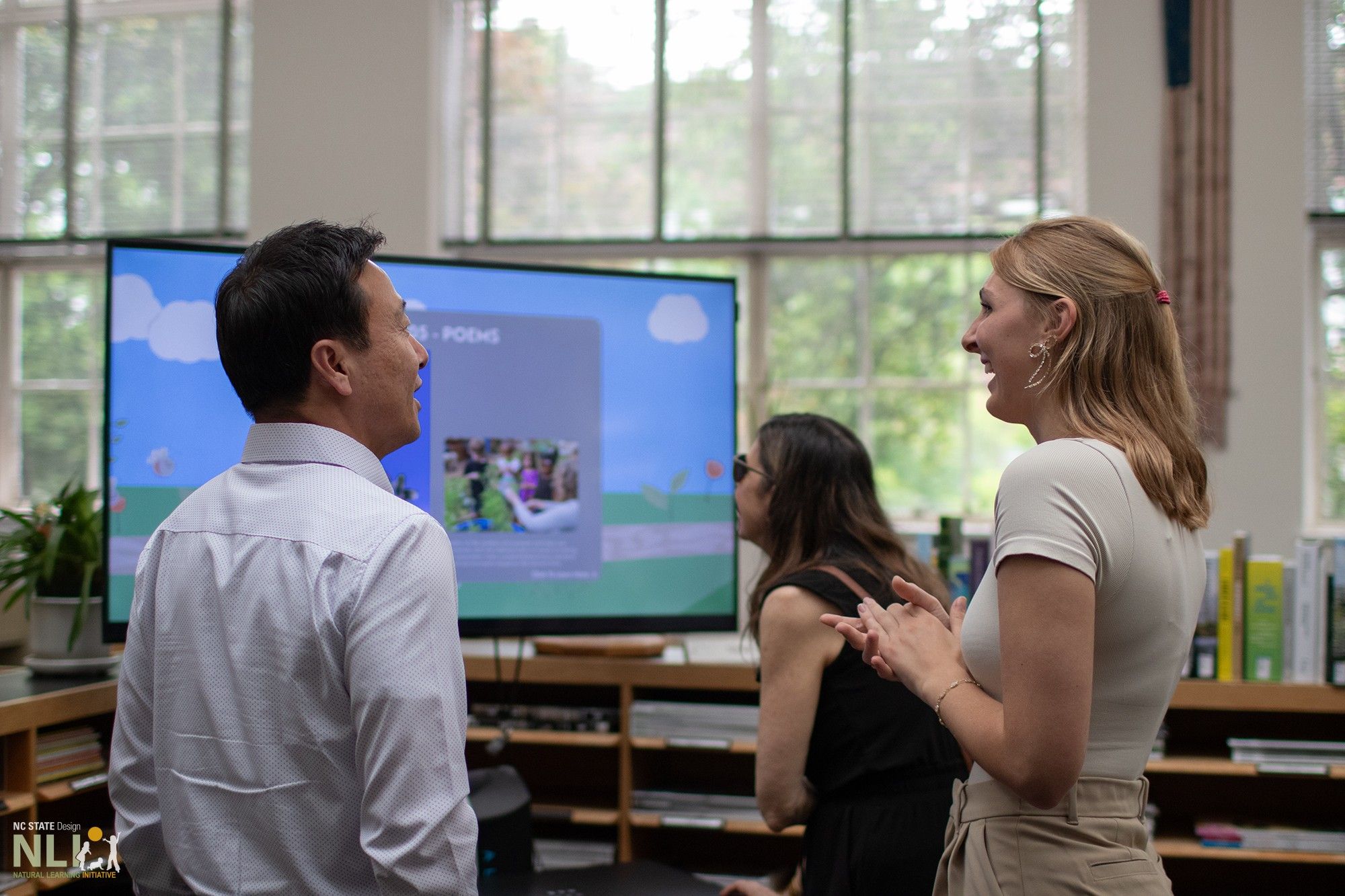
    Students present design concepts in the Hunt Library visualization lab

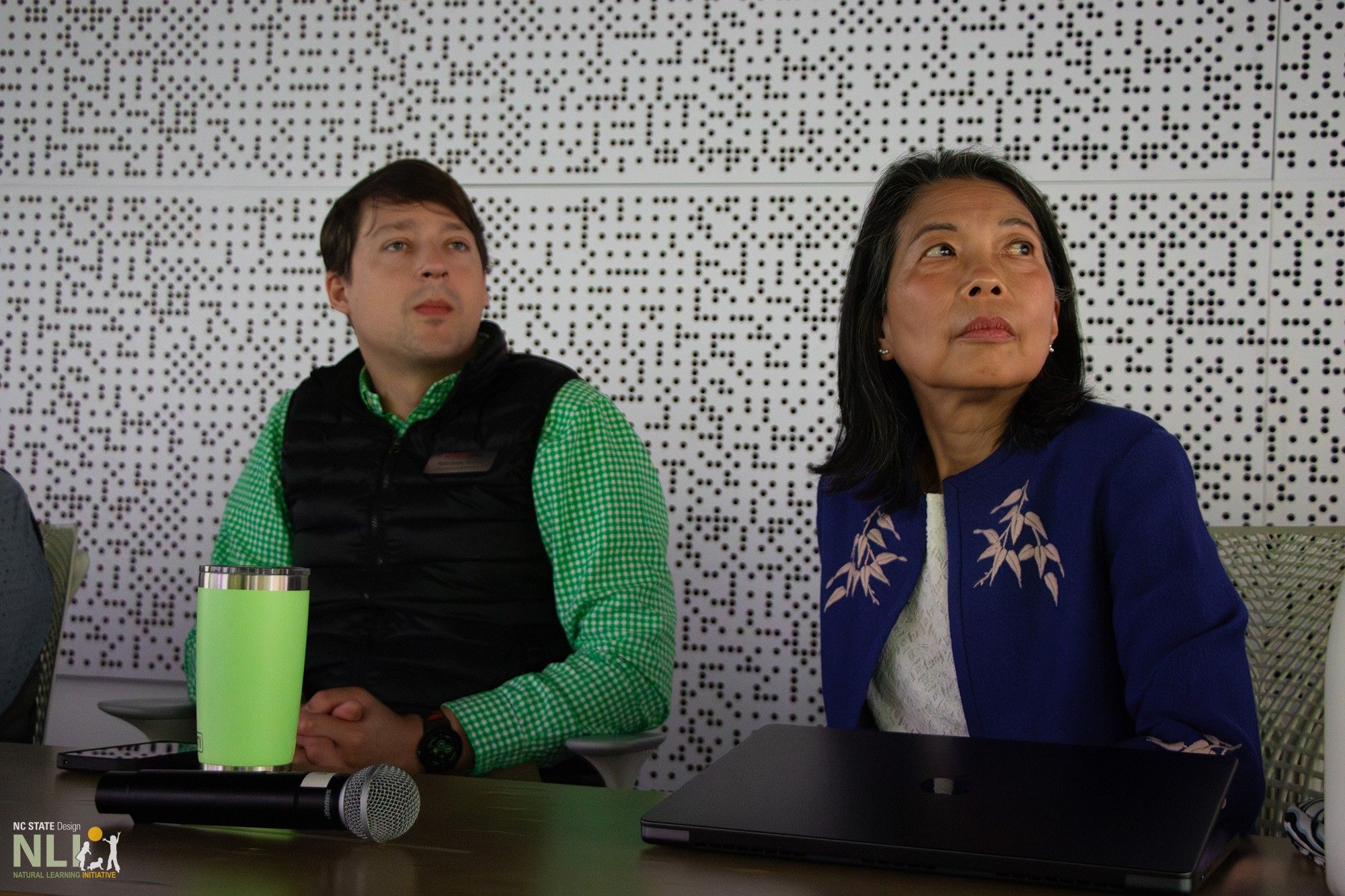
    Two adults at a table with a laptop, discussing final proposal presentations.

    Matt Babb, Communications Lead at NLI, and Professor Victoria Chi provide detailed feedback to students during final proposal presentations

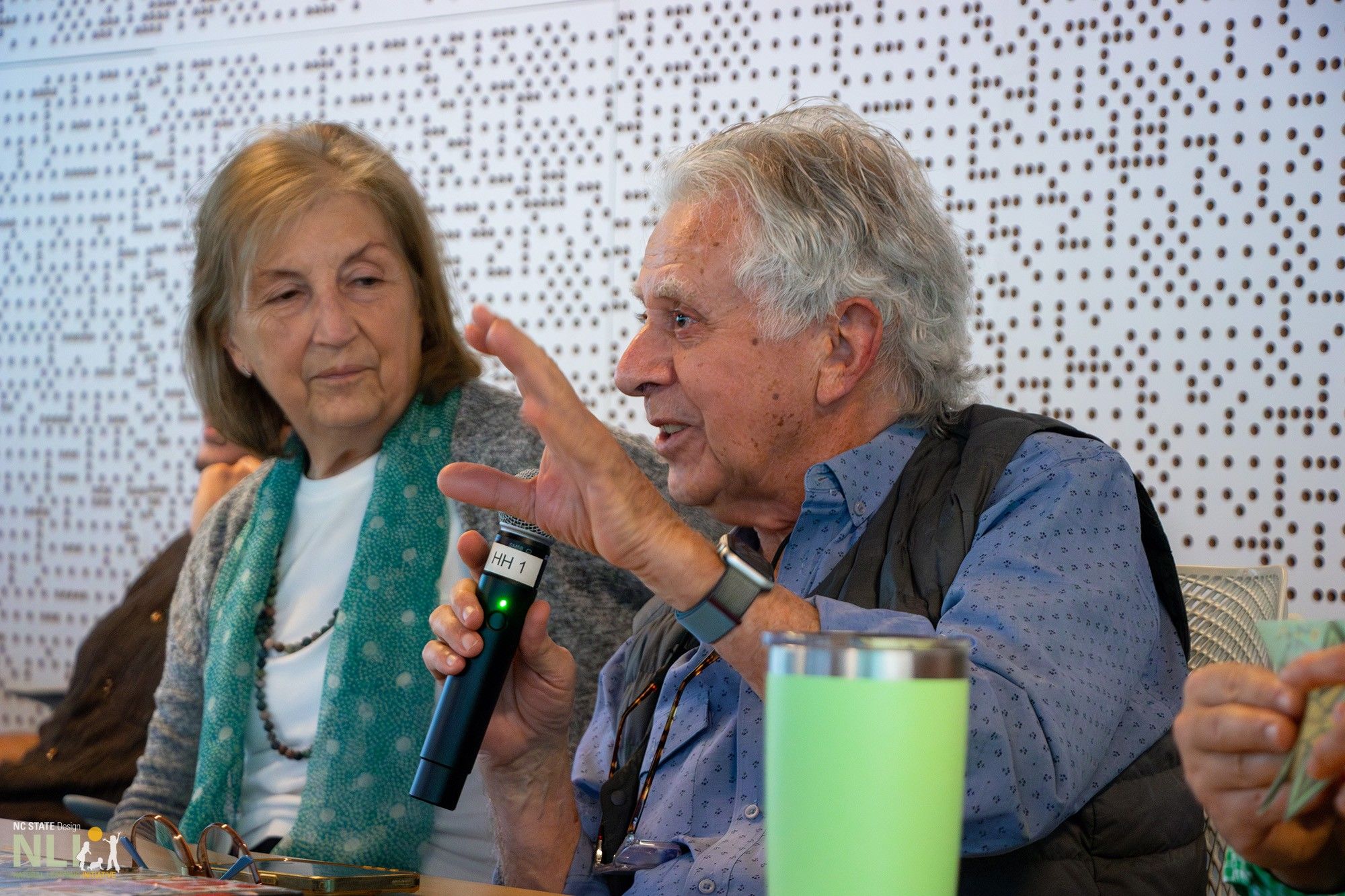
    NLI founders Nilda Cosco and Robin Moore discuss student achievements, with a microphone and green drink visible.

    Nilda Cosco, PhD, and Robin Moore, co-founders and research professors at NLI, express their appreciation for the students’ exceptional work

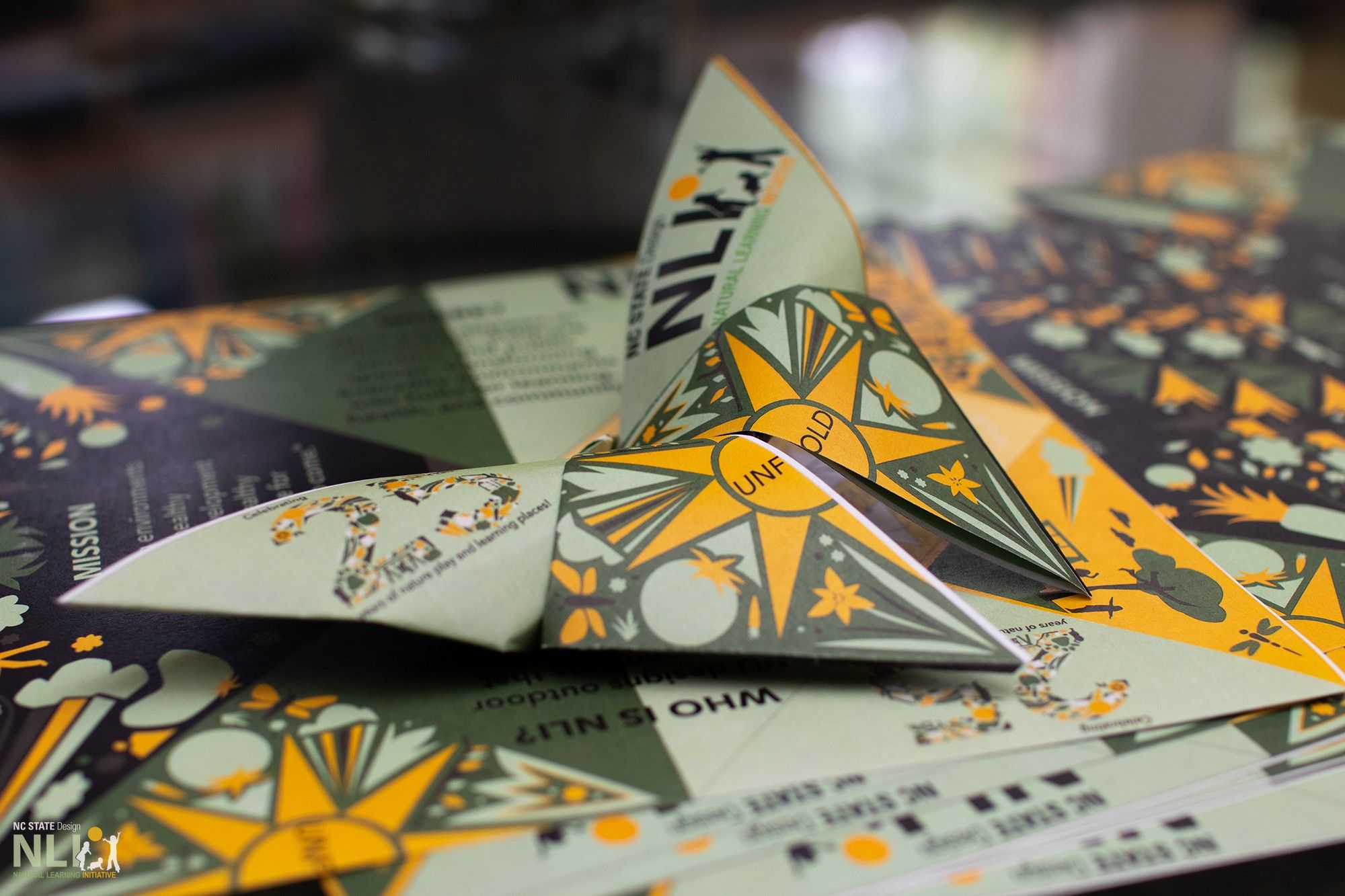
    Origami paper with "UNFOLD" and "NLI" text, promoting outdoor play and nature-based learning.

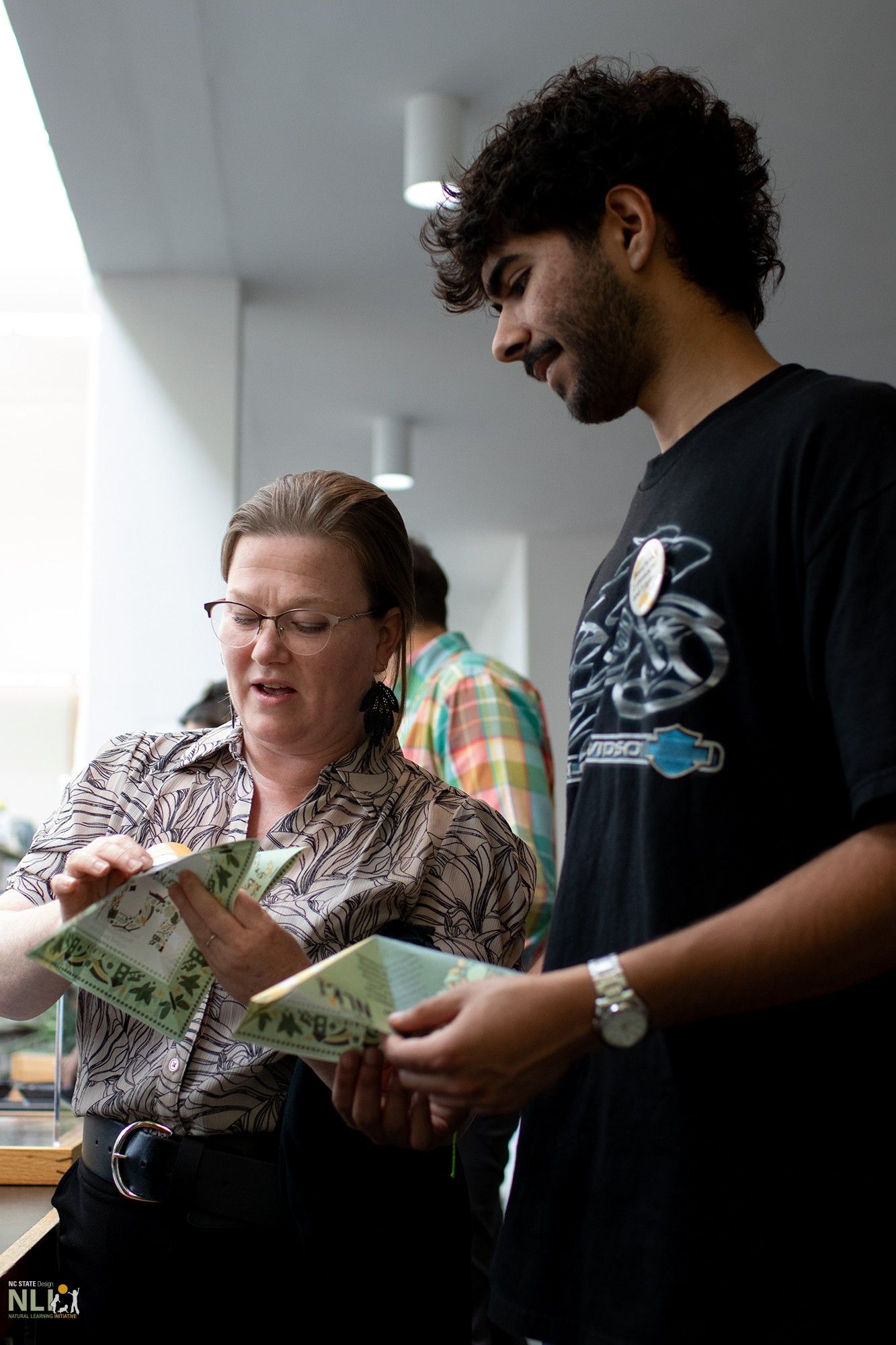
    Information sheets are designed to have a second life as origami takeaways

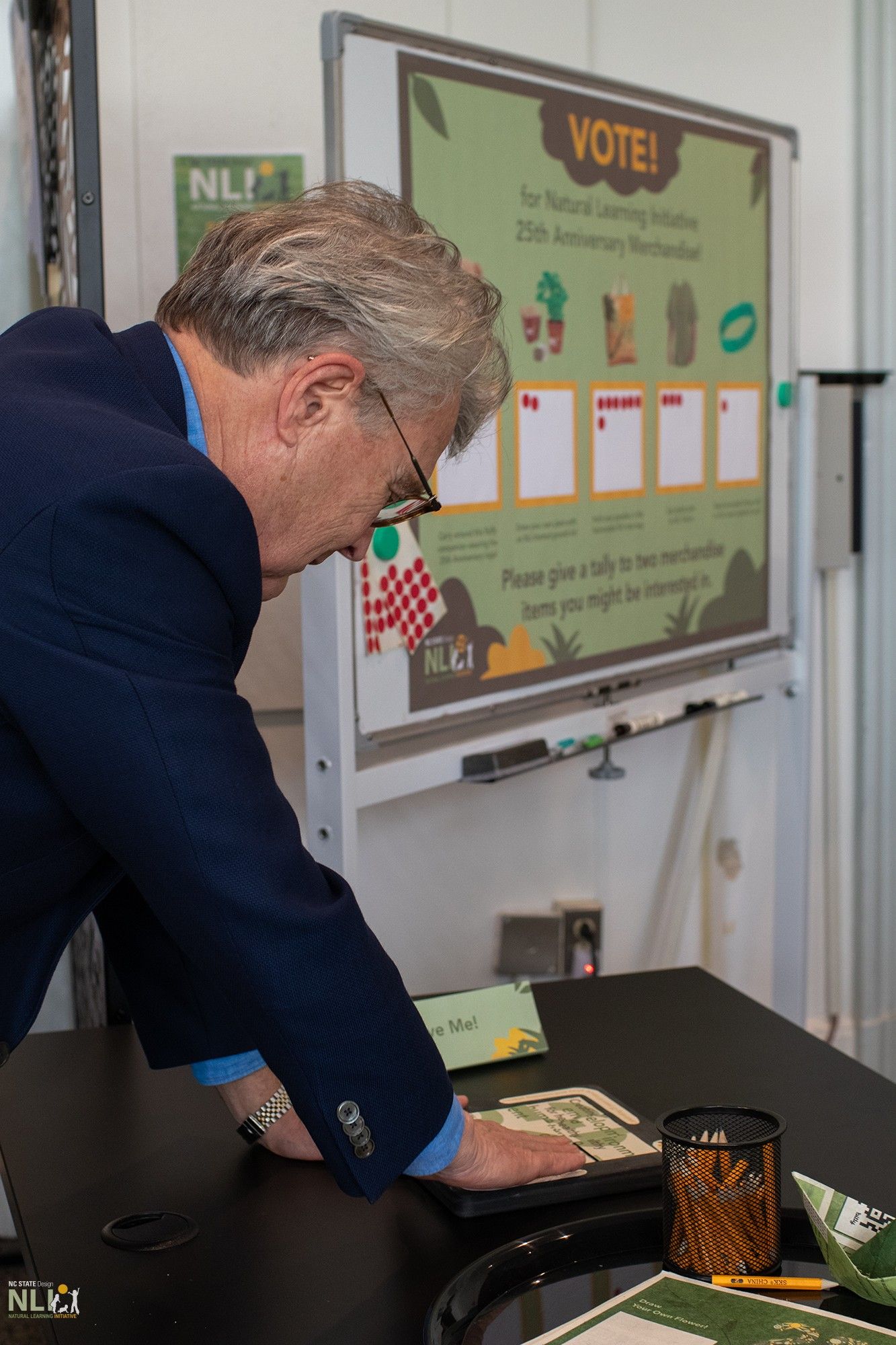
    Dean Hoversten explores a student-designed slide puzzle, promoting outdoor play and nature-based learning.

    Mark Hoversten, PhD, Dean of the College of Design, explores a student-created slide puzzle

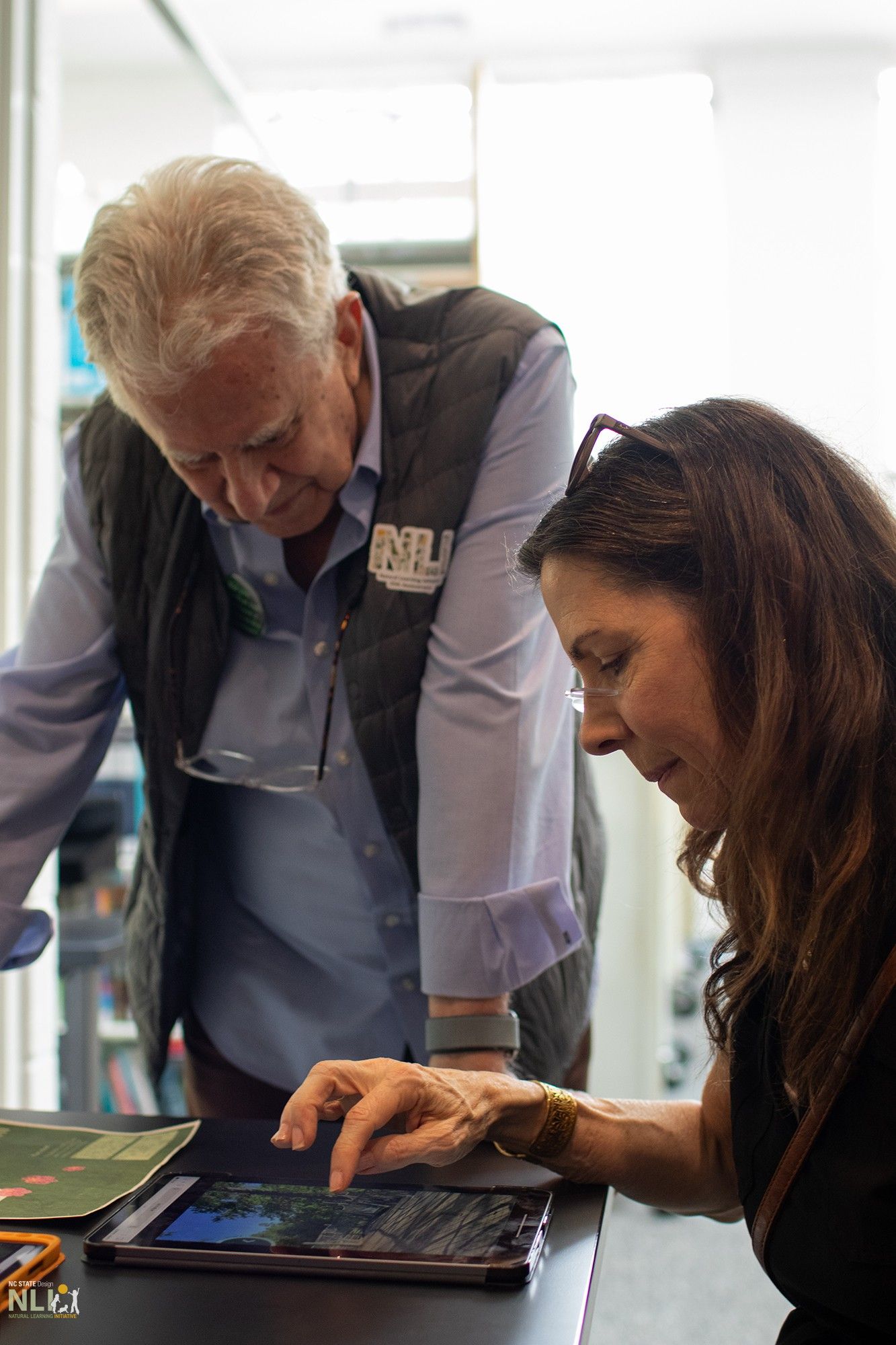
    Two educators explore a virtual tour on a tablet, highlighting outdoor play and nature-based learning.

    Robin Moore and Elizabeth Gilleland, Preschool Director of The Raleigh School, exploring a virtual tour of the school created by the students

    Audrey Barnes, graphic and industrial design expert, assists student with origami, promoting hands-on learning and nature-based play.

    Audrey Barnes, Department Head of Graphic & Experience Design and Industrial Design, folds origami with a student after viewing the exhibit

    People gather in a classroom, engaging with a digital timeline celebrating outdoor play and nature-based learning environments.

    Soolyeon Cho, PhD, Interim Director of the NLI, appreciates the affordances of a digital timeline celebrating the initiative’s rich history

  • The NLI Website Becomes Multilingual

    The NLI Website Becomes Multilingual

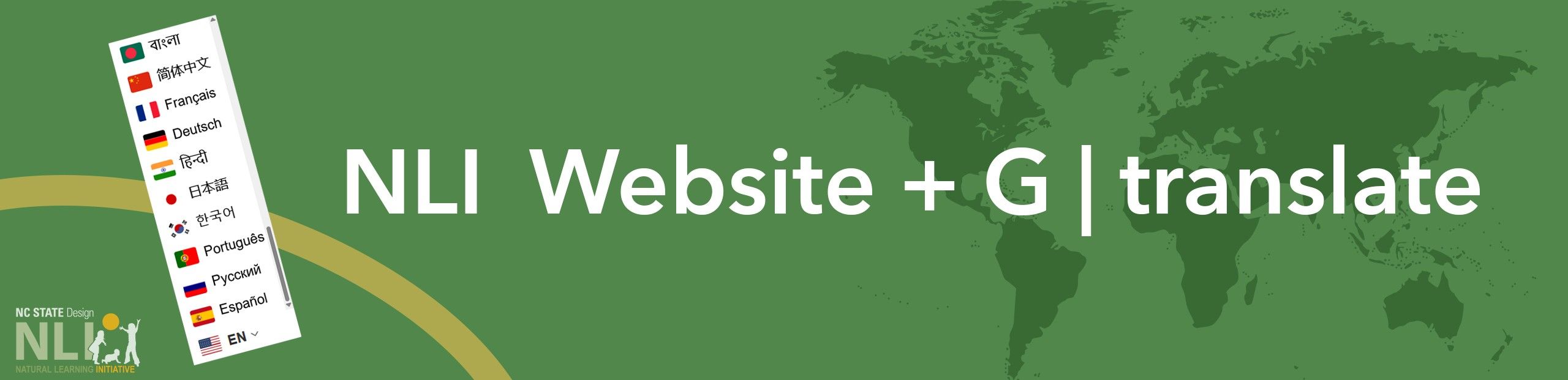
    NLI Website + G | translate; world map, flags, outdoor play, nature-based child environments, educational playground design.

    We’re thrilled to expand our global reach and make our resources more accessible than ever with the new GTranslate plugin on our website! As part of our mission to connect children and families with nature through outdoor learning environments, we’ve integrated this powerful tool to ensure that our content can be enjoyed by a worldwide audience.
    GTranslate uses Google Translate to dynamically translate our entire website into over 100 languages, helping us break down language barriers and bring our resources to a broader, more diverse community. You’ll find the GTranslate language picker—a small flag icon—at the bottom left corner of the site, where you can easily switch between the most popular languages among our users:

    • English
    • Spanish
    • Chinese
    • Hindi
    • French
    • Arabic
    • Bengali
    • Portuguese
    • Russian

    English Original

    Outdoor play area with children exploring nature, educational signage, and interactive learning activities.

    Spanish Translation

    Children play and learn in a natural environment, emphasizing outdoor play and nature-based education.

    If your preferred language isn’t listed, we’d love to hear from you! Simply email [email protected] with your suggestions.

    With this tool, you can explore all of our site’s content—including articles, research, and professional development resources—in your preferred language, ensuring that everyone, regardless of where they are, can access our work and join us in promoting nature-based learning environments.

    Resources:
    GTranslate:https://gtranslate.io/

  • The NLI Resource Hub: A New Tool for Educational Resources

    The NLI Resource Hub: A New Tool for Educational Resources

    NLI Resource Hub: Outdoor Play, Nature-Based Environments, Educational Playgrounds

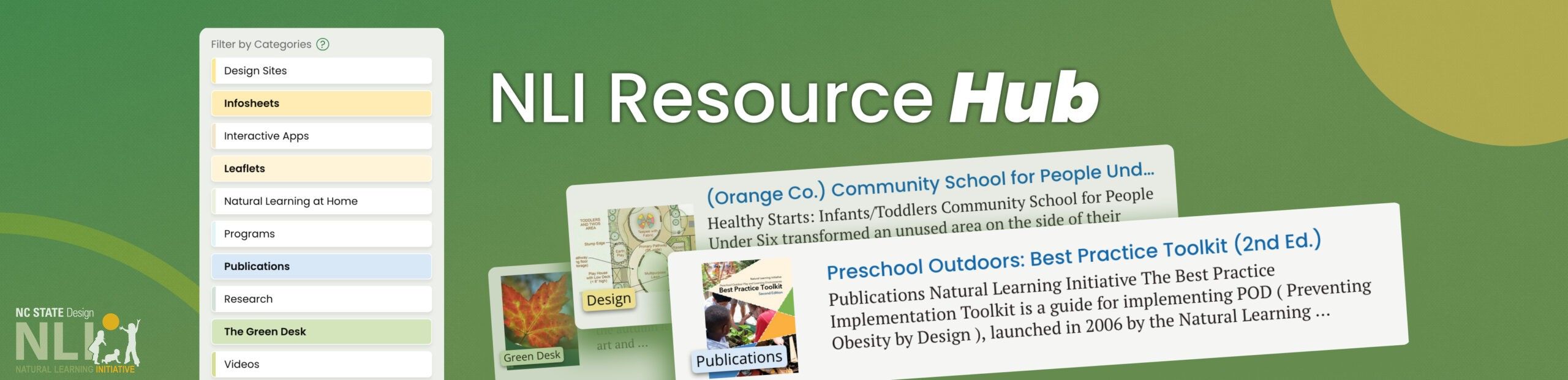
    In an ongoing effort to enhance the accessibility and impact of our educational materials, the Natural Learning Initiative (NLI) has launched the NLI Resource Hub, a user-friendly, filterable search engine designed to streamline access to our extensive collection of free online resources. This development was made possible through the 2023-2024 DELTA Exploratory Grant, alongside the creation of the Kids Together Playground Matterport Tour.

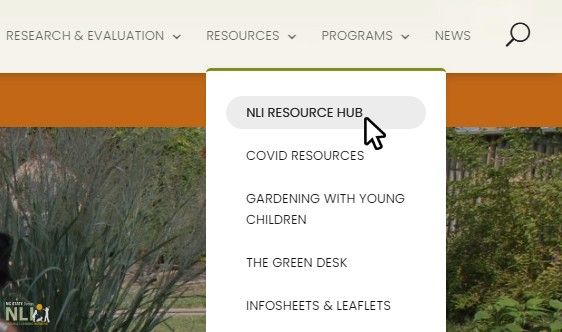
    Natural Learning Initiative (naturalearning.org) resources menu highlighting 'Covid Resources' and 'Gardening with Young Children' for outdoor play and nature-based environments.

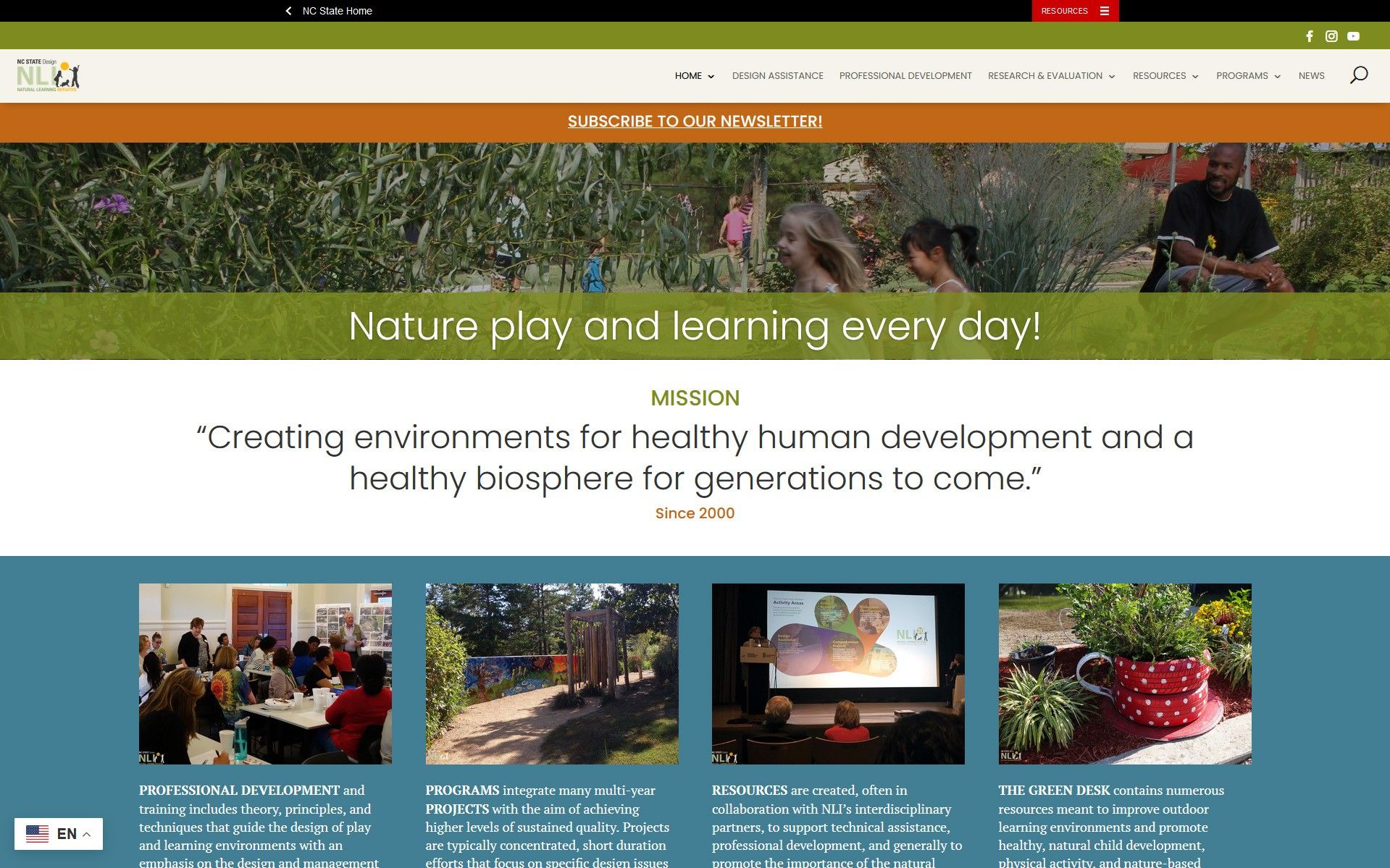
    Find the Hub under our “RESOURCES” tab!

    Driven by insights gathered from user research, which analyzed data from over 45,000 visitors to the NLI website, we identified a pressing need to improve the connection between visitors and the specific resources they seek. The NLI Resource Hub was developed to meet this need, integrating our most popular resources—such as The Green Desk[]=477&filters_initial=0&filters_changed=1&qtranslate_lang=0&current_page_id=54078&asp_s=], Infosheets[]=477&filters_initial=0&filters_changed=1&qtranslate_lang=0&current_page_id=54078&asp_s=], and Leaflets[]=483&filters_initial=0&filters_changed=1&qtranslate_lang=0&current_page_id=54078&asp_s=]—alongside design site case studies[]=480&filters_initial=0&filters_changed=1&qtranslate_lang=0&current_page_id=54078&asp_s=], instructional videos[]=468&filters_initial=0&filters_changed=1&qtranslate_lang=0&current_page_id=54078&asp_s=], research publications[]=490&filters_initial=0&filters_changed=1&qtranslate_lang=0&current_page_id=54078&asp_s=], and more.

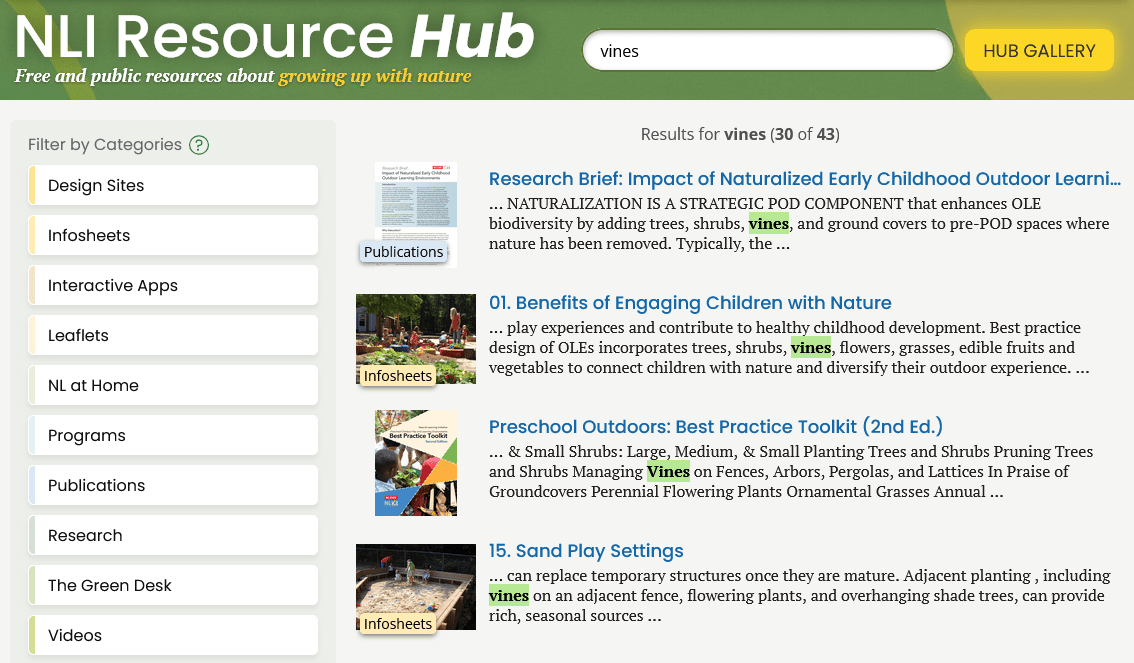
    Screenshot of NLI Resource Hub showcasing outdoor play resources, nature-based environments, and educational playground design.

    A search for vines highlights the Hub’s contextualized search results, displaying excerpts of the resource content alongside thumbnail and category.

    The NLI Resource Hub is now live and ready to serve as a powerful tool in connecting users with the resources they need to support outdoor play and learning initiatives.

    Explore the NLI Resource Hub today:NLI Resource Hub.

    Check out the Hub!

    NLI Resource Hub

    Learn about NCSU DELTA:

    2023-2024 DELTA Exploratory Grant

  • Early Childhood Outdoor Play and Learning Spaces (ECOPALS) – Train the Trainer

    Early Childhood Outdoor Play and Learning Spaces (ECOPALS) – Train the Trainer

    ECOPALS Train the Trainer: Early Childhood Outdoor Play & Learning Spaces, educators training, nature-based environments.

    Early Childhood Outdoor Play and Learning Spaces (ECOPALS): Train the Trainer (TtT) equips participants with knowledge, skills, practical examples, and content resources to support their confidence to train others and promote the creation of healthy outdoor environments and programs in early care and education settings.

    Participants learn about the key elements that contribute to a high-quality outdoor children’s environment including best practice indicators, play and learning programming, gardening for healthy eating and physical activity, and strategies to engage early childhood educators in implementing outdoor play and learning environments. Participants receive materials and resources to deliver engaging sessions that promote the adoption of healthy outdoors play and learning environments.

    This Course Aims To:

    • Train future instructors/trainers and subject matter experts on the importance of early childhood outdoor play and learning spaces.
    • Train existing instructors and subject matter experts to increase their knowledge repertoire to include early childhood outdoor play and learning spaces.
    • Support future trainers to empower their organizations and/or communities to promote, develop, implement, manage, and evaluate high-quality outdoor spaces for young children.
    • Equip future trainers with knowledge, skills, and resources readily transferred to practitioners in multiple fields as strategic tools to achieve long-term, sustainable change in their contexts.

    This Course Contains 8 Modules

    1. TtT Overview. Course Aims, Structure, Learning Objectives, and Resources
    2. Environment and Behavior Approach to Outdoor Play and Learning Spaces, Creation and Management
    3. Outdoor Play and Learning Environments Best Practice Indicators for Infants, Toddlers, and Preschoolers
    4. Preventing Obesity by Design (POD) Strategy
    5. Fruit and Vegetable Gardening: Preparing, Caring, Harvesting & Eating
    6. Family Engagement
    7. Project Implementation
    8. Capstone Project

    Learning Outcome:

    By completing the online Train the Trainer (TtT) course participants will be able to transfer knowledge and encourage implementation of naturalized outdoor play and learning environments to increase the well-being of young children.

    Who is the Course for?

    • Highly Qualified Professionals
    • Experienced Trainers
    • College Instructors

    * focus on early childhood education, public health, horticulture, and landscape design, working with/for children

    Pre-requisite

    NLI Outdoor Learning Environments Certificate or other course of similar rigor and content.

    Delivery

    Online access is required. The distance education course is delivered online, with optional online interactive sessions (live chats and video calls).

    Subscribe to our newsletter to get alerts when the next course will be offered.

    FAQ

    NC State logo for outdoor play and nature-based child environments.
  • Supporting Naturalized Outdoor Play and Learning Environments in North Carolina Child Care Facilities

    Supporting Naturalized Outdoor Play and Learning Environments in North Carolina Child Care Facilities

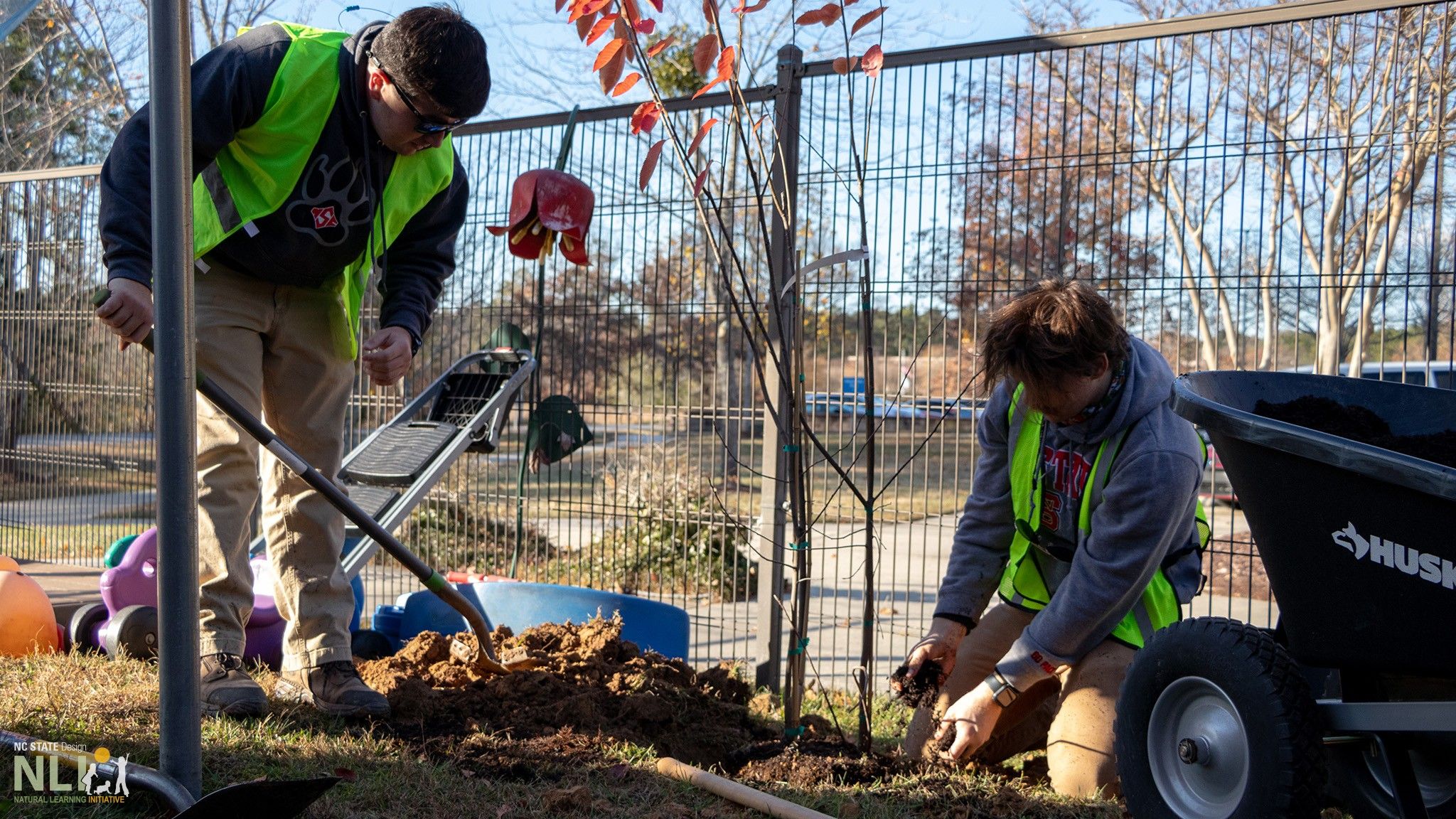
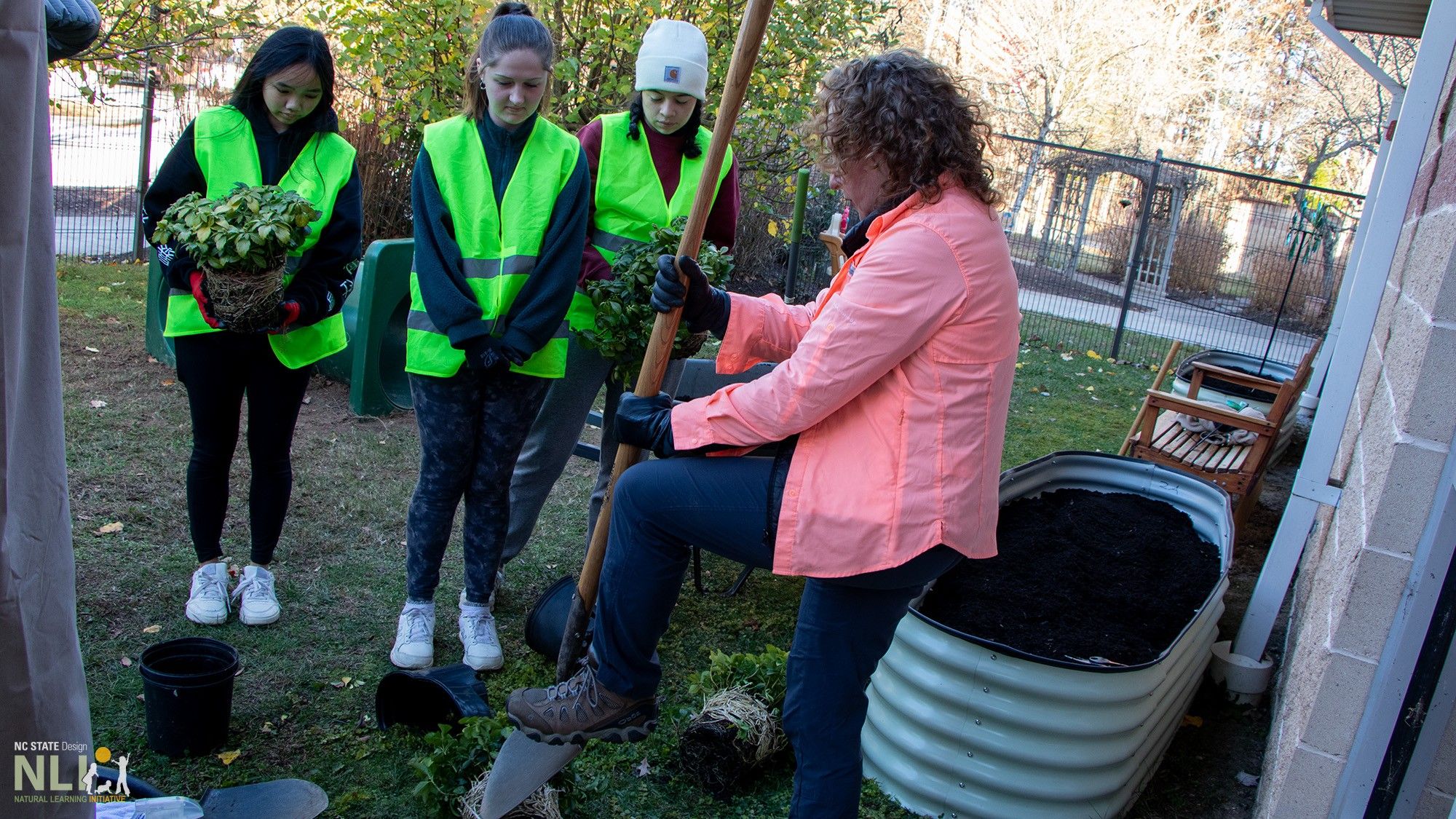
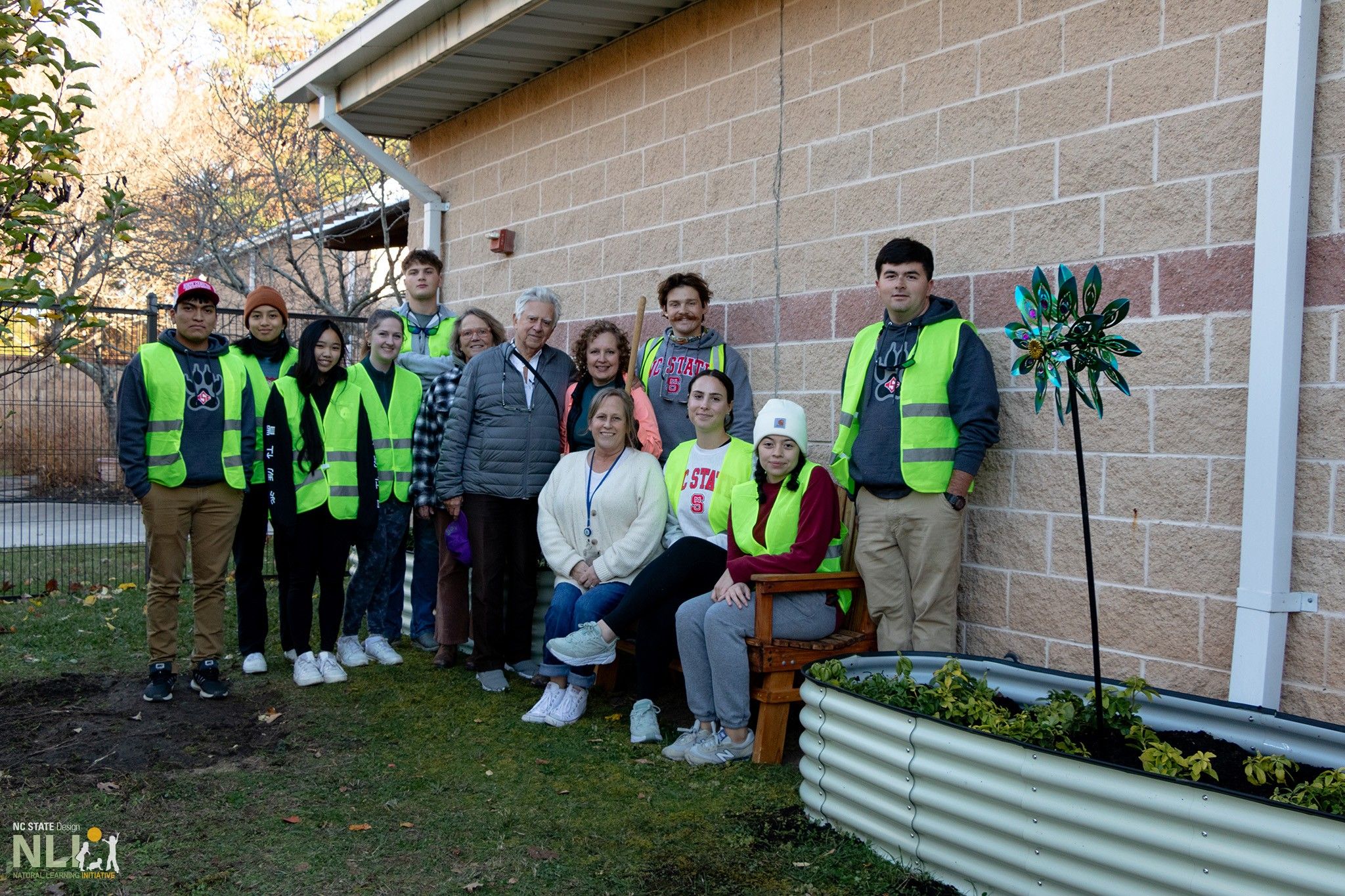
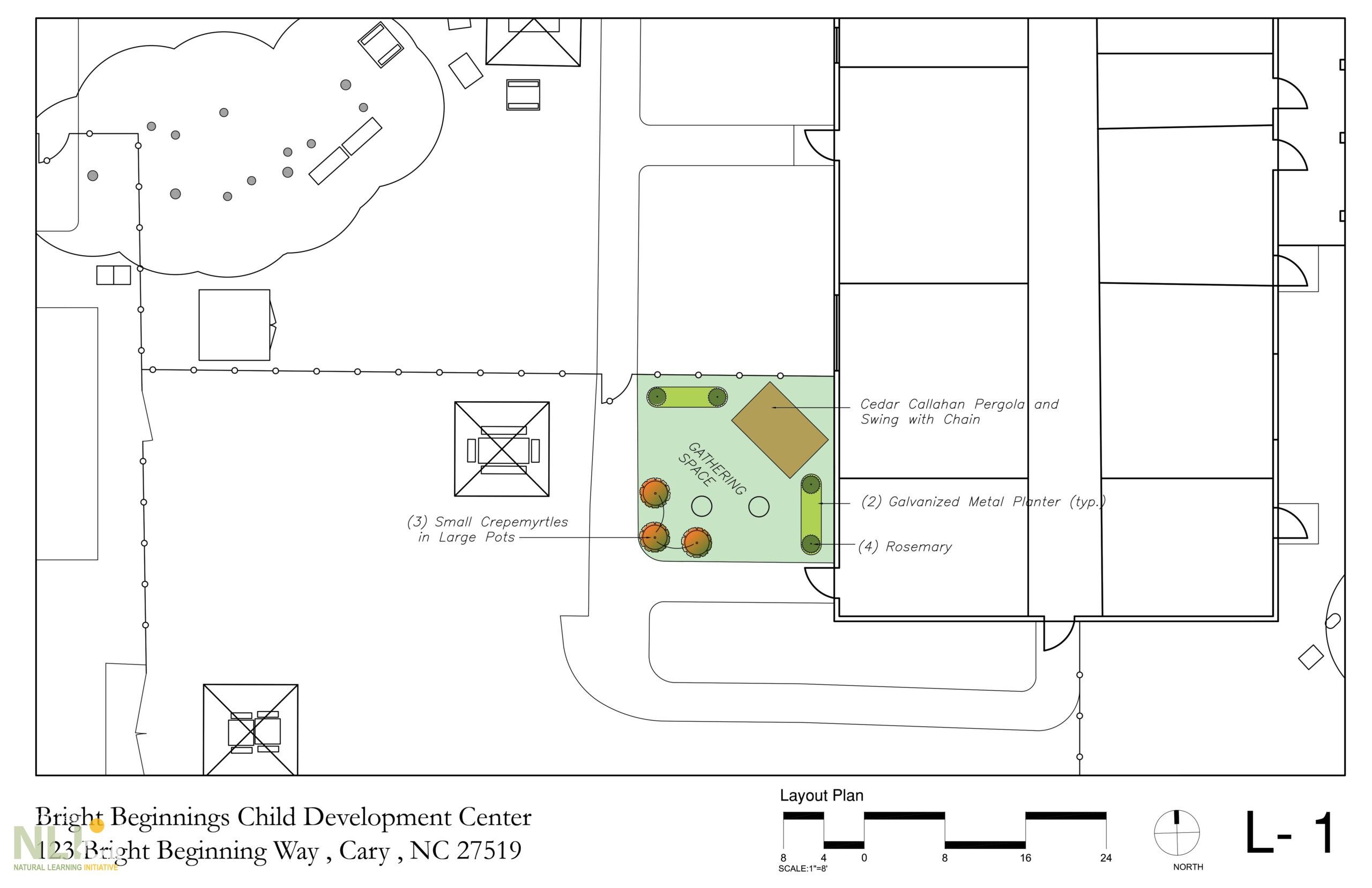
    During the Fall of 2023, NLI collaborated with Horticultural Science, NC State, to implement nature-based design interventions in two North Carolina child-care facilities: First Environments Early Learning Center in the Research Triangle Park, Du, NC, and Bright Beginnings Child Development Center in Cary, NC. The design-build studio, HS 272, was led by Professor Julie Sherk.

    In 2011 the DCDEE conducted a collaborative project with Natural Learning Initiative (NLI) titled Creating a Supportive Network. Over a decade later we are excited to relaunch the project with the hopes of increasing the awareness of health and social-emotional benefits of nature-based learning.

    The COVID-19 pandemic highlighted child care facilities as a critical economic resource and a place where young children feel safe and secure while families work. The Centers for Disease Control (CDC) promoted the idea and early educators discovered that time outdoors reduced disease transmission and increased physical activity. Children were happier and freer to be themselves, which improved social-emotional learning. Time outdoors became more widely acknowledged as a critical support for mental and physical health.

    The partnership between DCDEE and NLI will bring the many benefits of healthy outdoor environments to the whole child, increase the time outdoors for children playing and learning in NC child care facilities, and allow NC to explore nature-based child care. Time outdoors is a critical tool for supporting mental and physical health in young children. Adoption of best practices for outdoor play and learning spaces is a critical component of increasing daily time spent outside.

    NLI Short from Bright Beginnings Site Visit:

    Project Resources:

    Download the 2023 DCDEE One-Pager

    Visit the DCDEE Website

    Learn About the 2011 DCDEE Project

    Visit Childcare Center Websites:

    First Environments Early Learning Center

    Bright Beginnings

    First Environments Early Learning Center

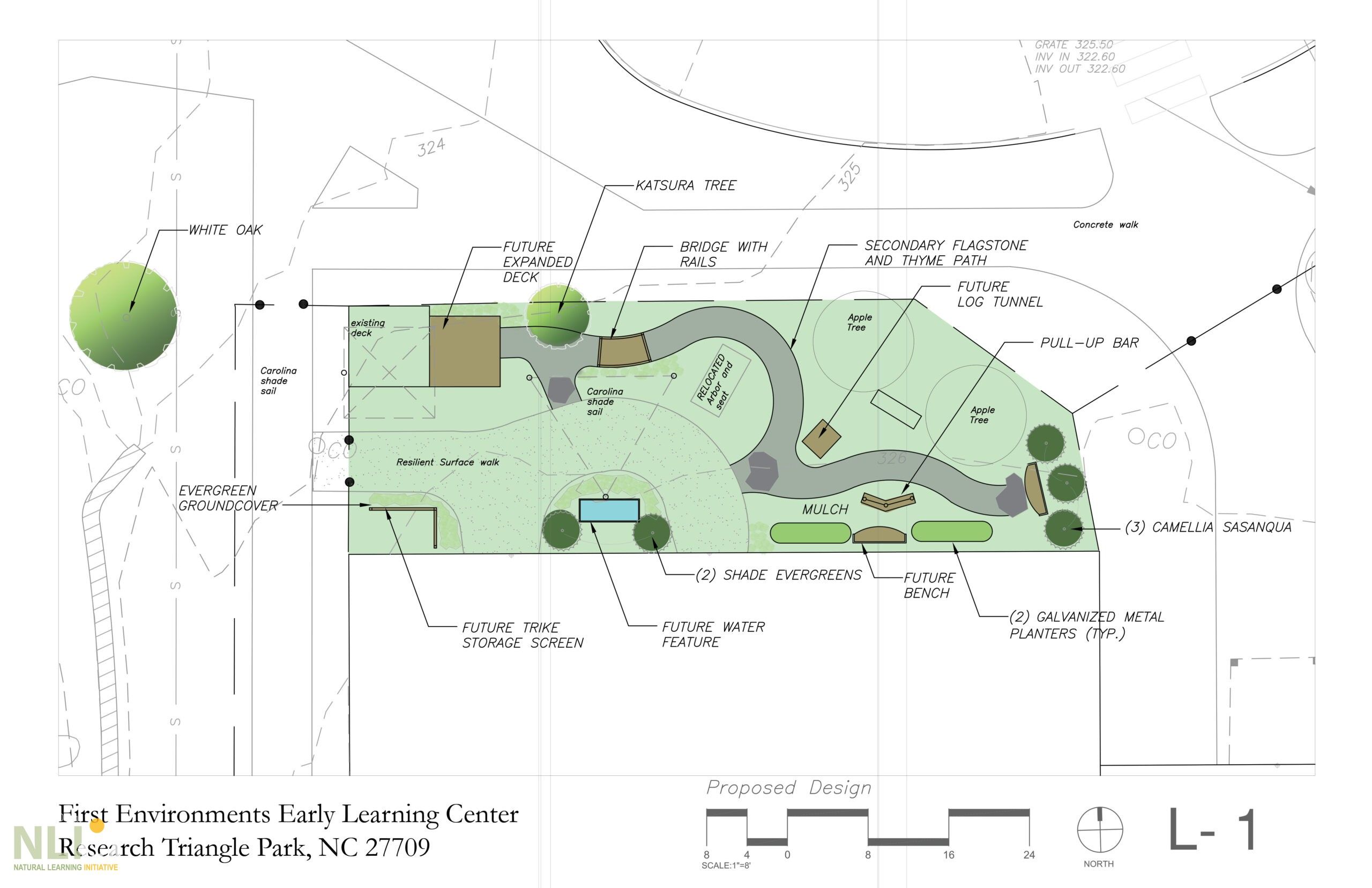
    First environments early learning center design plan
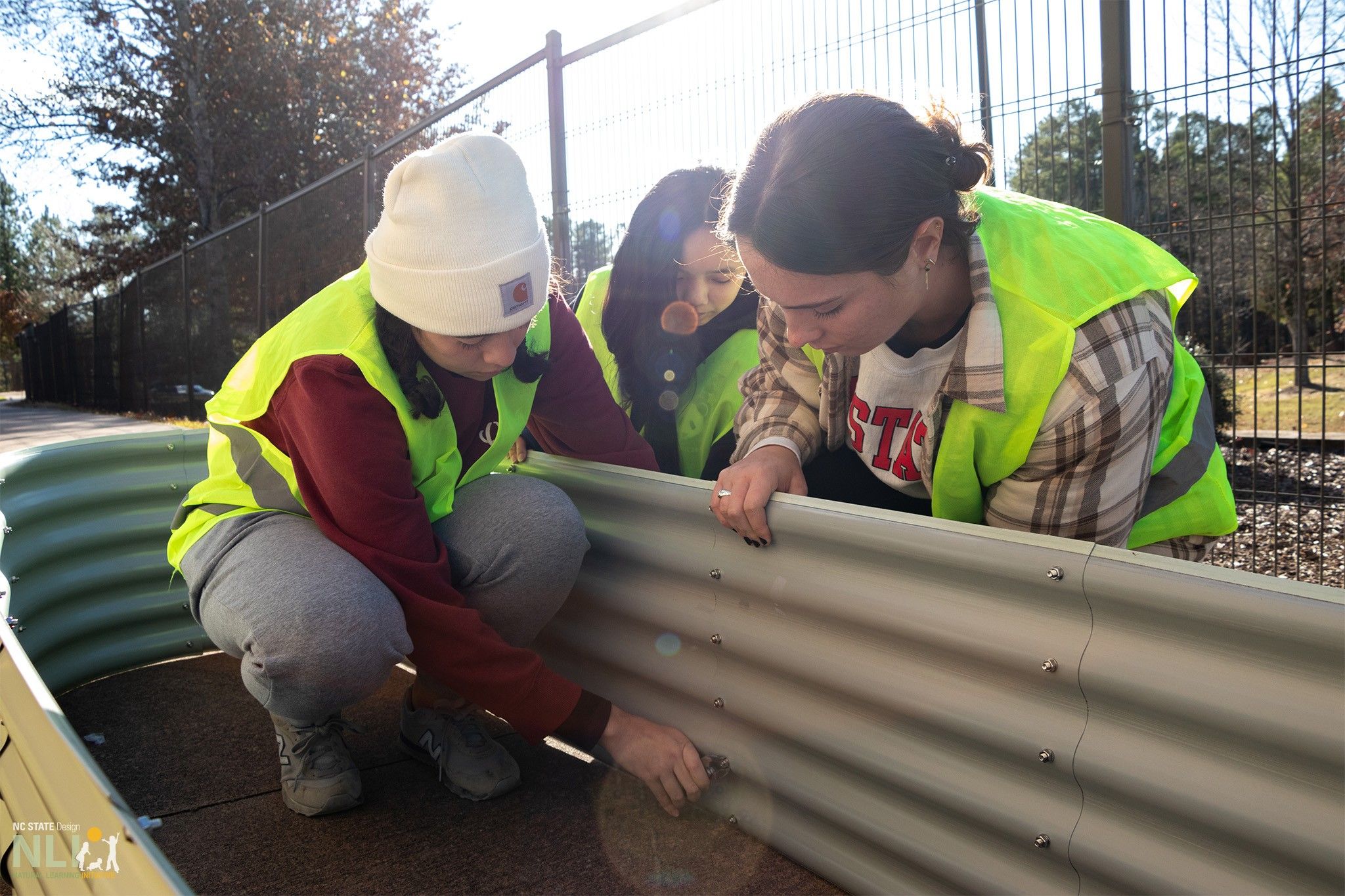
    students assembling planters

    Assembling the corrugated metal raised planters.

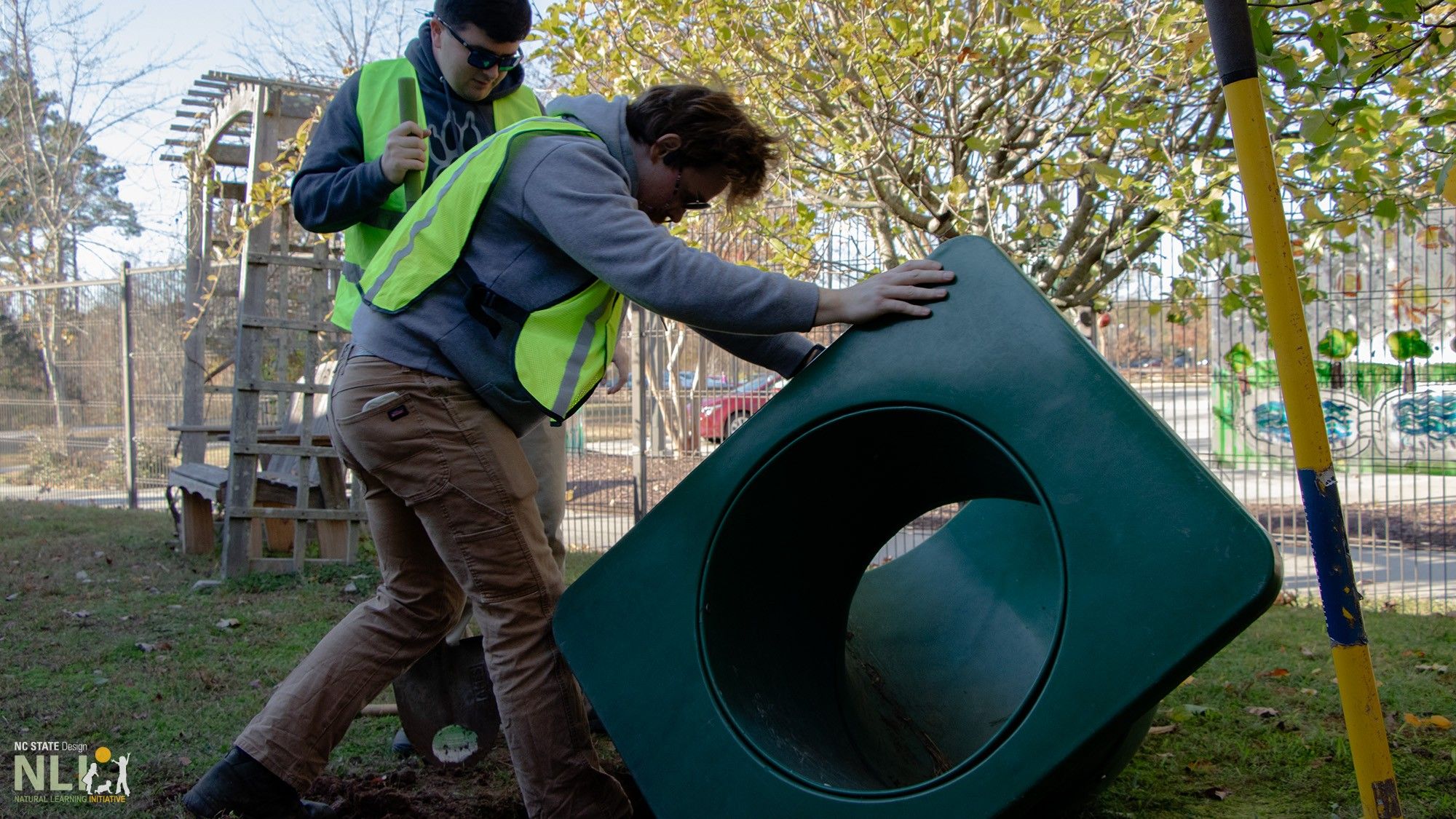
    students installing infant tunnel

    Installing infant tunnel.

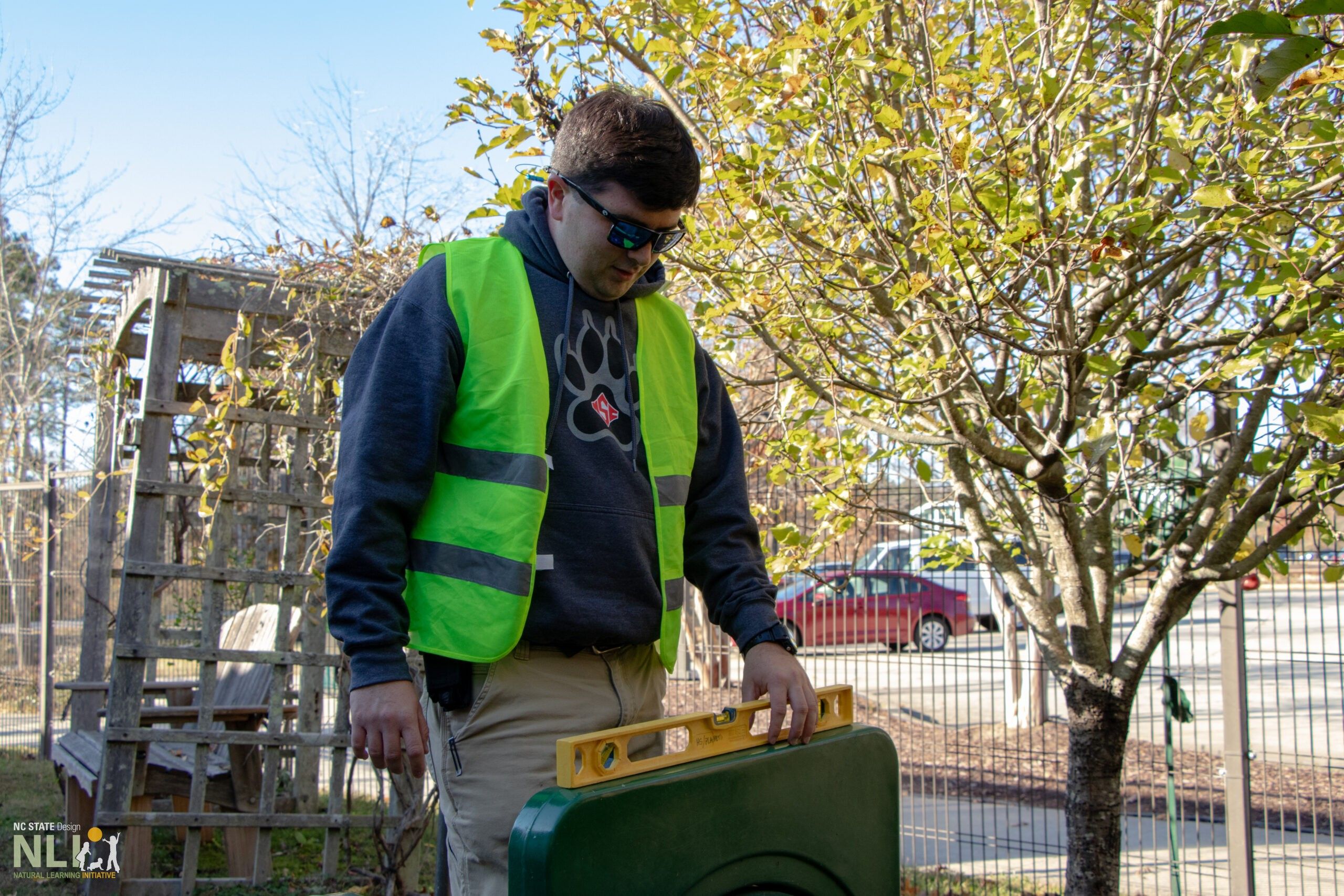
    student checking the level on the infant tunnel

    Levelling tunnel.

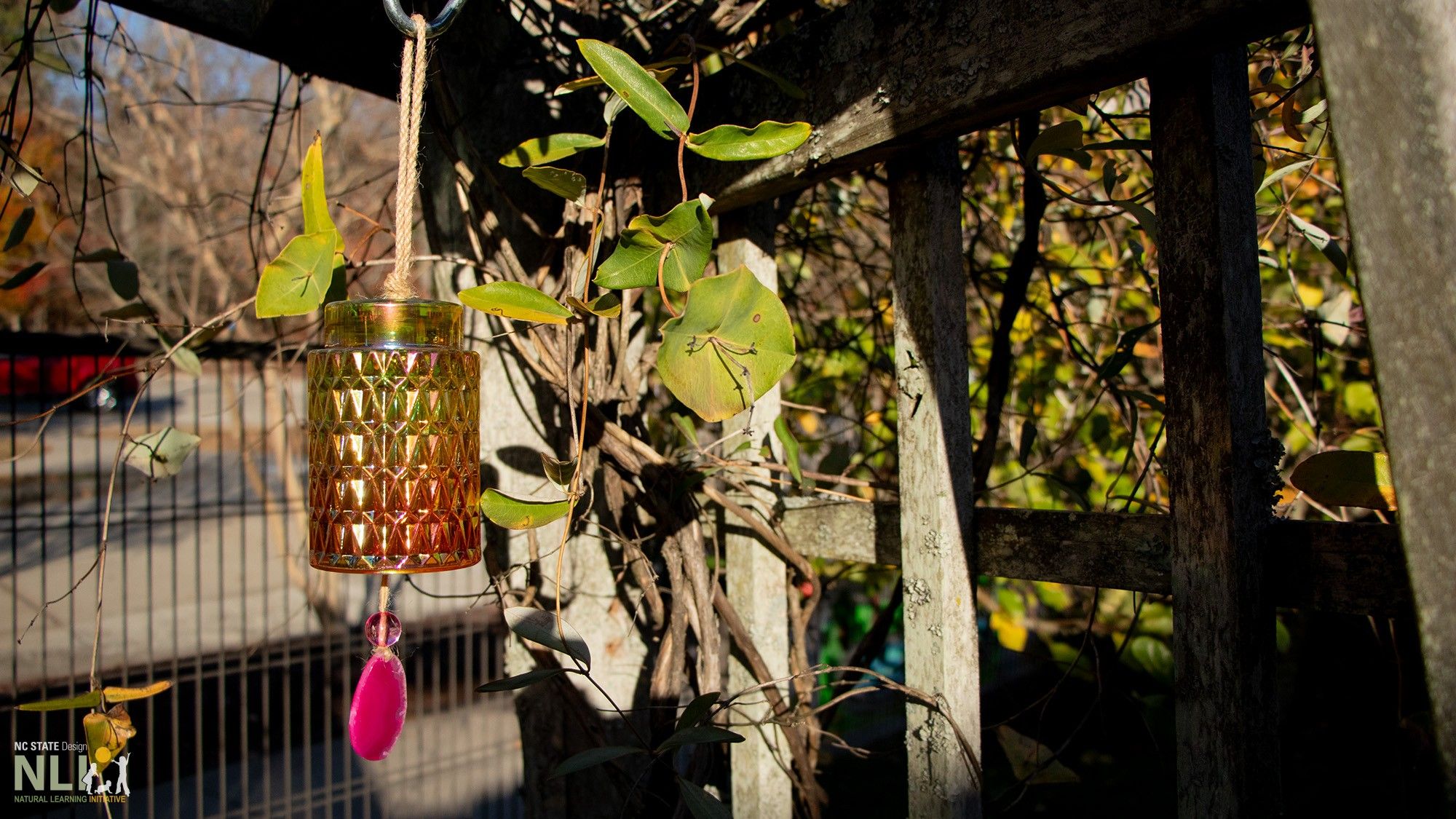
    chimes hanging in an arbor

    Arbor chimes glinting in the sunlight.

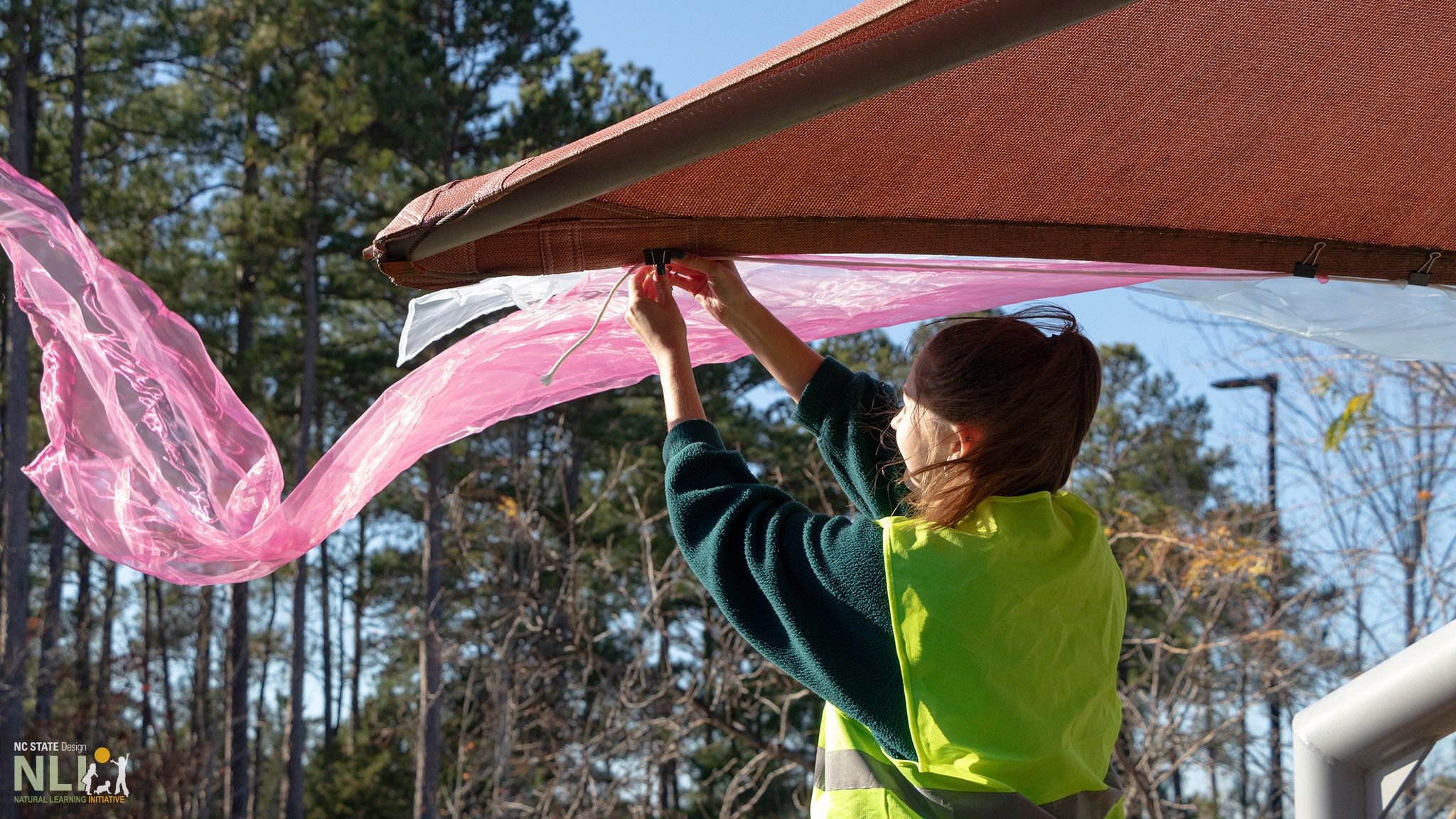
    student installing wind catcher

    Installing translucent “wind catcher” on shade structure edges.

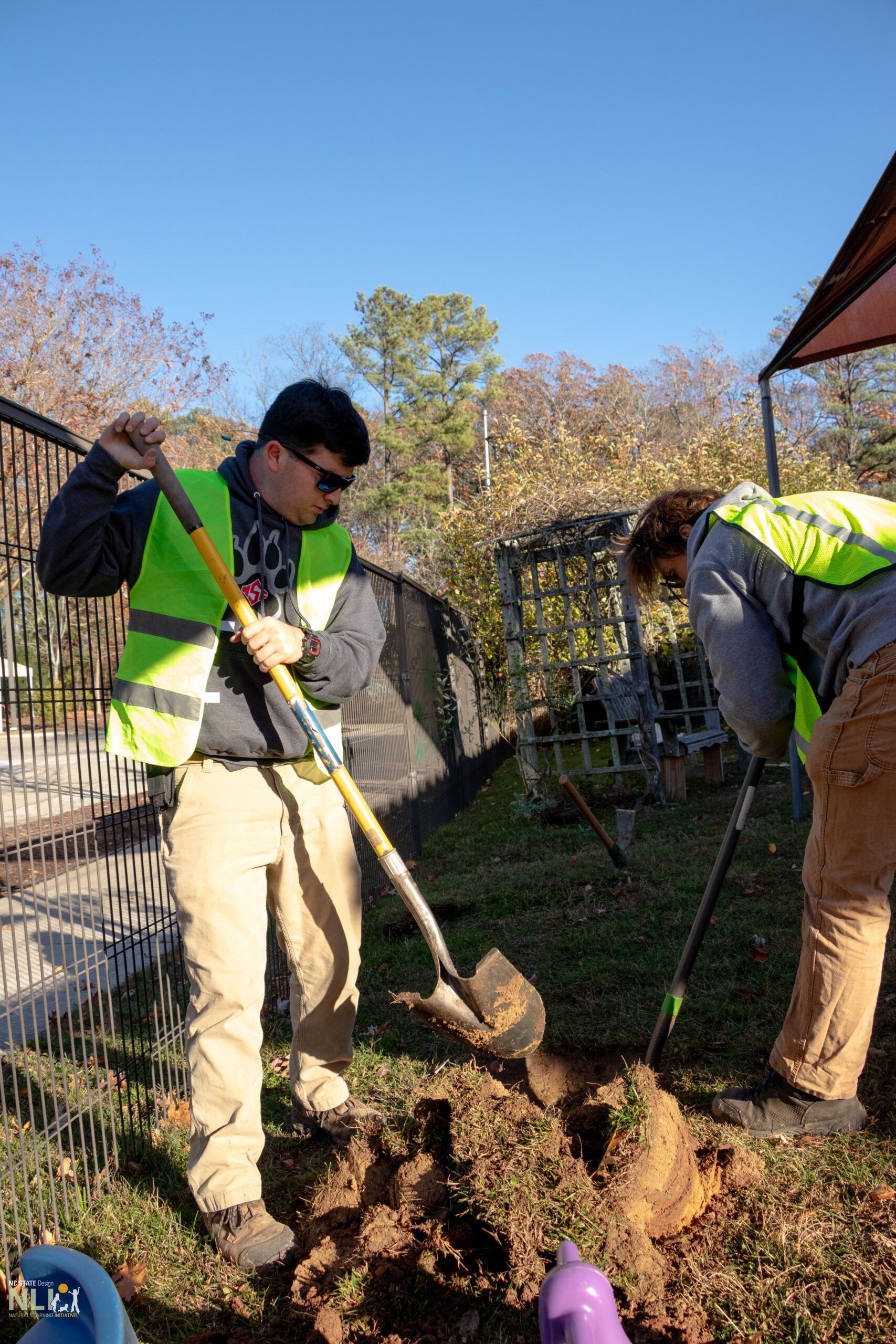
    students digging a hole to plant a tree

    Digging tree pits – large enough for planting.

    students planting a young tree

    Planting a young, native tree – acclimates during winter months.

    Showing students how to aerate roots

    Subdividing rootbound shade-loving plants – multiplying quantity.

    group shot of students and staff

    Installation crew with happy FEELC staff. – and colorful whirligig.

    Bright Beginnings Child Development Center

    Bright beginnings child development center design plan
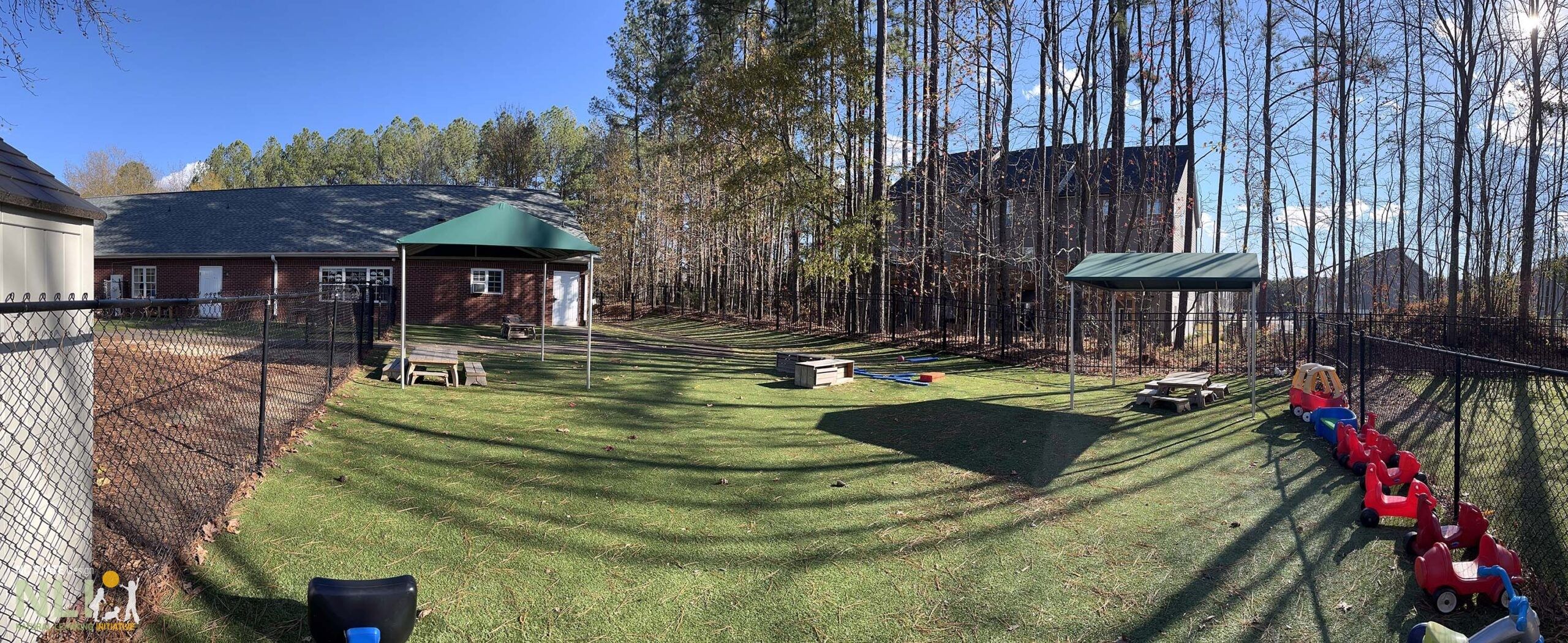
    panorama of bright beginnings before student installations 1
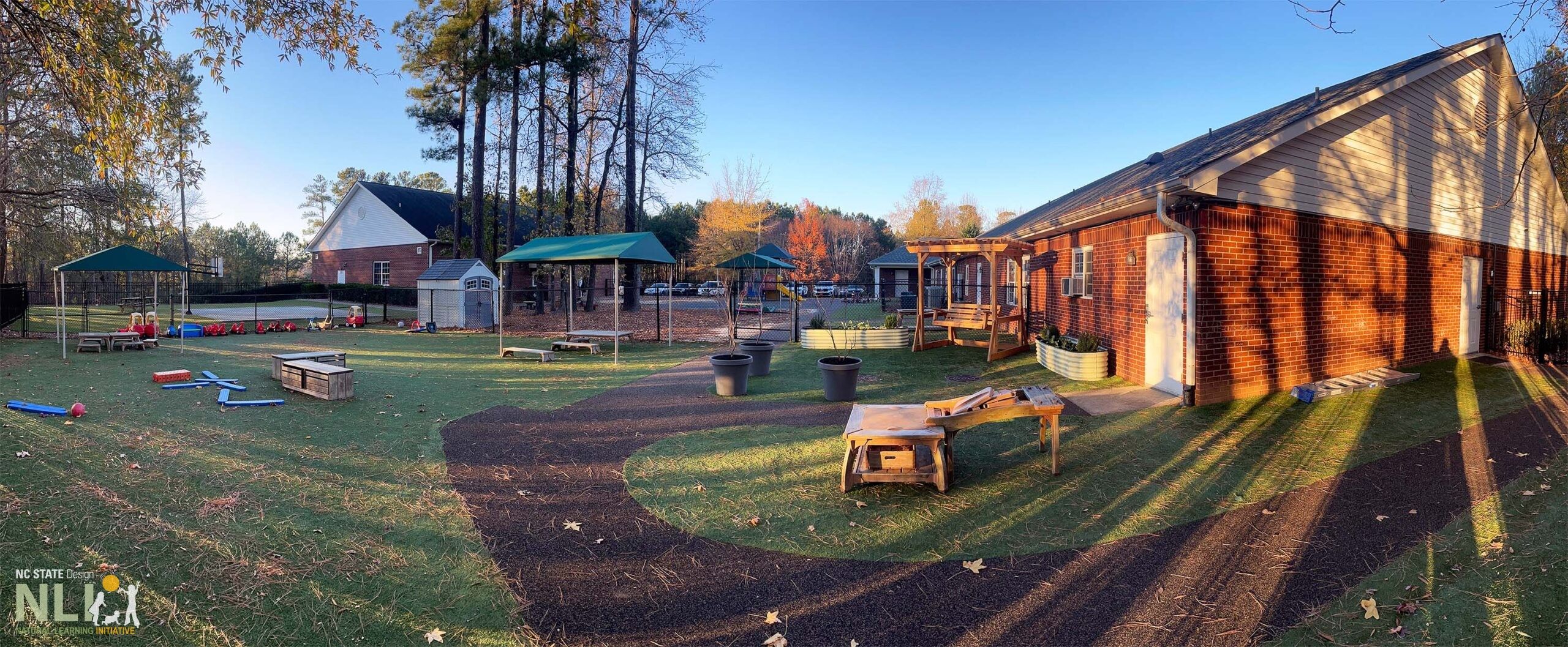
    panorama of bright beginnings after student installations
  • Grow Outdoors South Carolina Launch

    Grow Outdoors South Carolina Launch

    Grow Outdoors SC, launched at the MEGA Child Development Center, Gilbert, SC (12-11-23), is a unique partnership of two SC state agencies (Social Services – DSS, and Health & Environmental Control – DHEC), three universities (NC State’s Natural Learning Initiative (NLI), UNC-Greensboro, and Texas Tech), and ECHO (Early Childhood Health Outdoors), based at the National Wildlife Federation (NWF) – a national conservation organization.

    The launch celebrated prior achievements of the almost ten years of NLI engagement in SC, applying the POD (Preventing Obesity by Design) Strategy, beginning with state leadership professional development. In 2015, creation of demonstration sites began, showing how nature-based design attracts youngsters outdoors, increases their physical activity, motivates enjoyment of hands-on gardening and eating fresh produce, improves social-emotional development by stimulating joyful playing together, and supports STEAM learning outdoors.

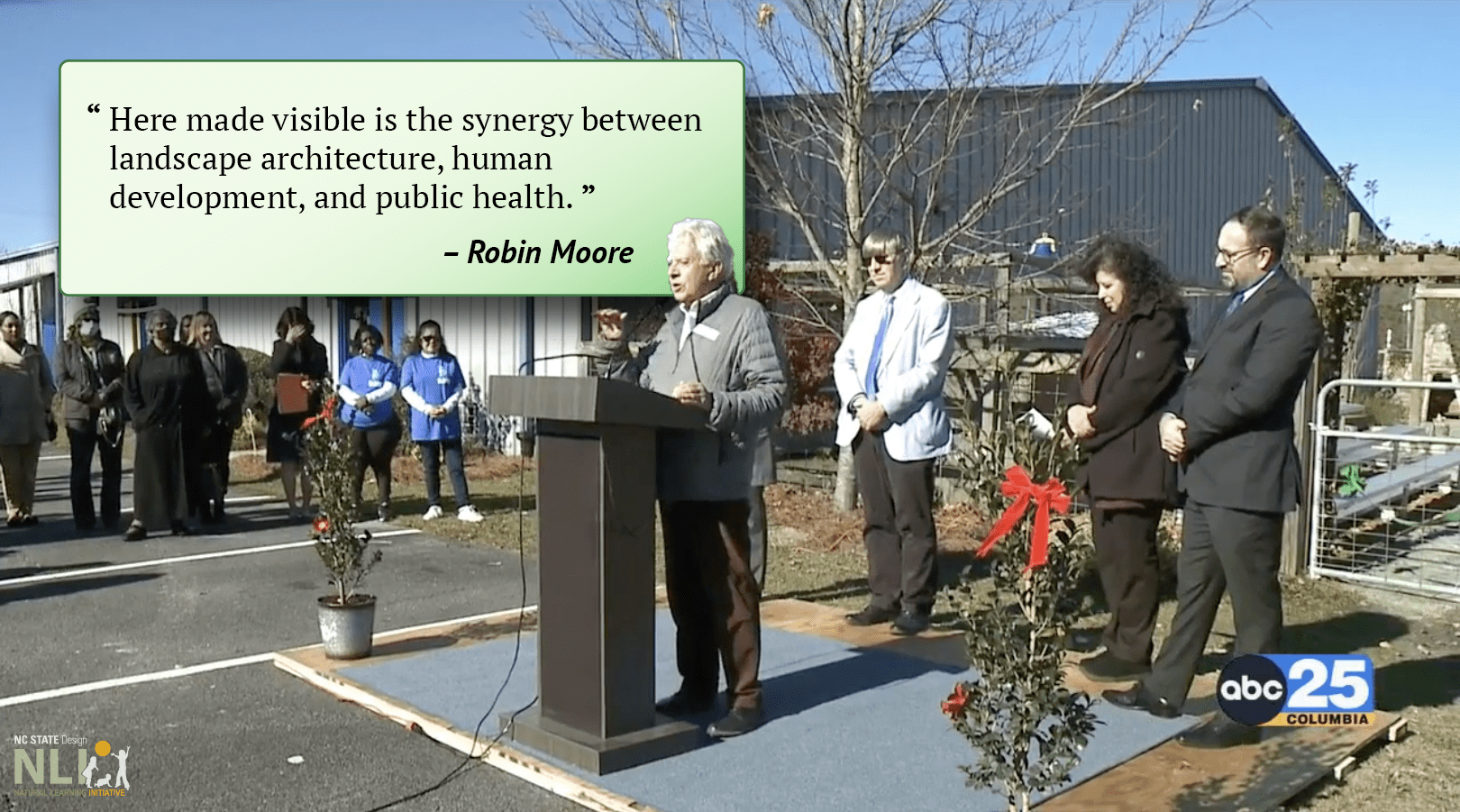
    Robin Moore news interview quote

    SC launch platform party from right to left:

    Dr. Edward Simmer, DHEC, Agency Director
    Michelle Bowers, DSS, Director, Division of Early Care & Education
    Michael Leach, DSS, Agency Director
    Robin Moore, NLI, Professor, NC State University, College of Design

    “Nature-inspired play areas aim to increase curiosity, physical activity among SC children”

    abc25 Newscast:

    Access Press Release Here

    abc 25 Columbia logo

    Download the Grow Outdoors SC One-Pager:

    Grow Outdoors SC One-Pager

    See DHEC Coin Awarded to NLI:

    NLI Receives DHEC Appreciation Coin

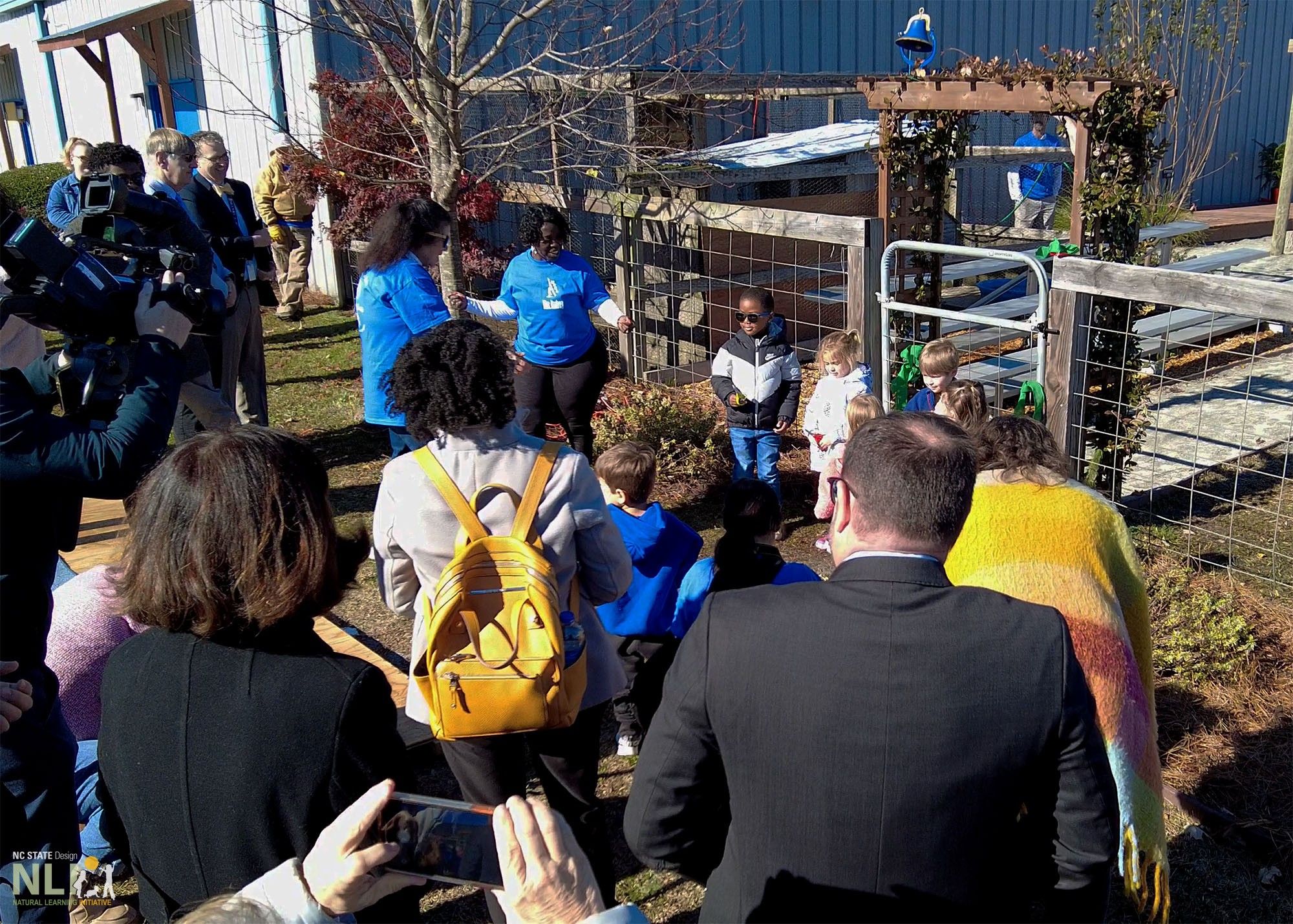
    children cutting ribbon

    Children cut the ribbon to launch expansion of Grow Outdoors SC at the entrance to the MEGA outdoor play and learning environment.

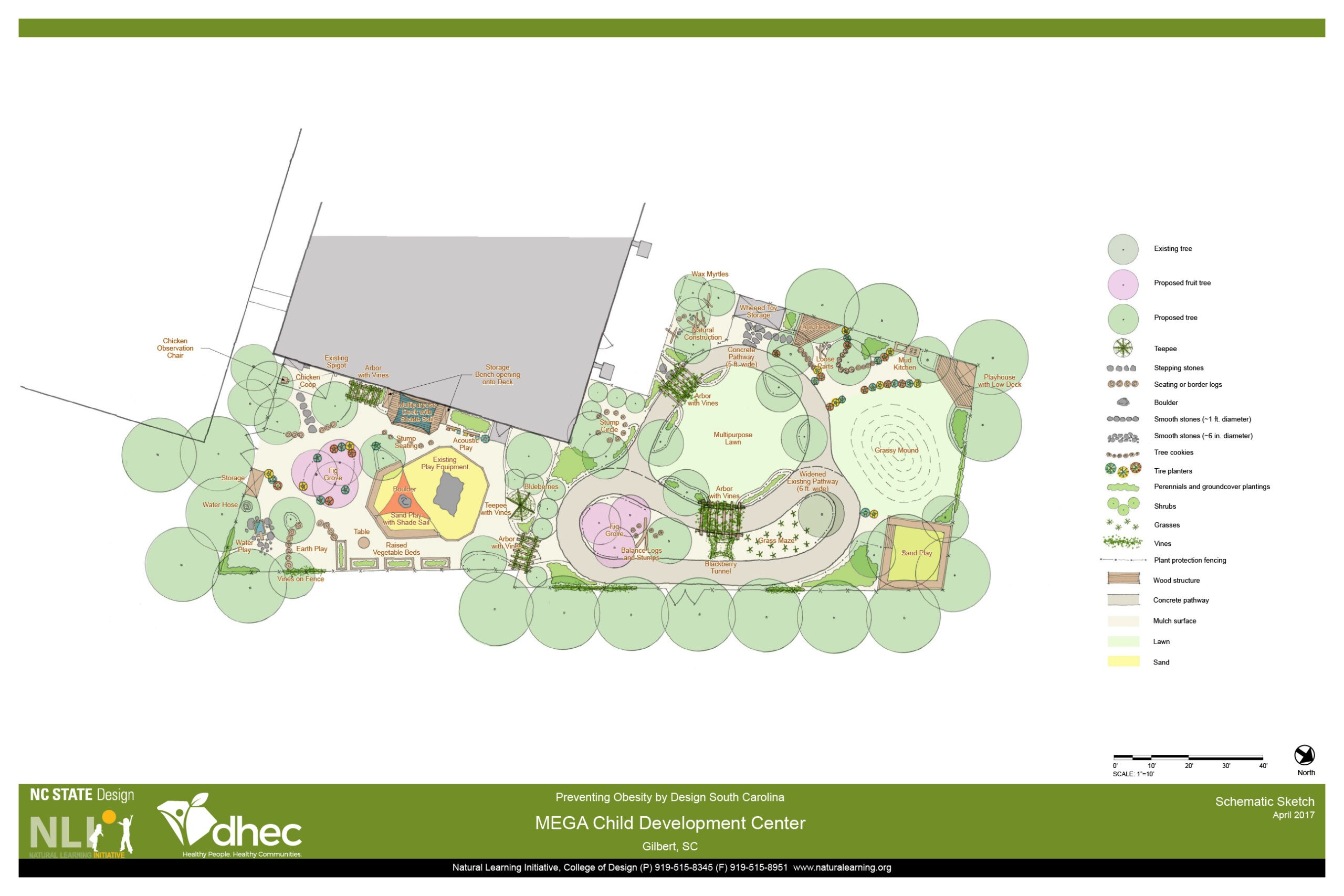
    MEGA Outdoor Play and Learning Environment Schematic Design (2017)

    MEGA child development center design plan

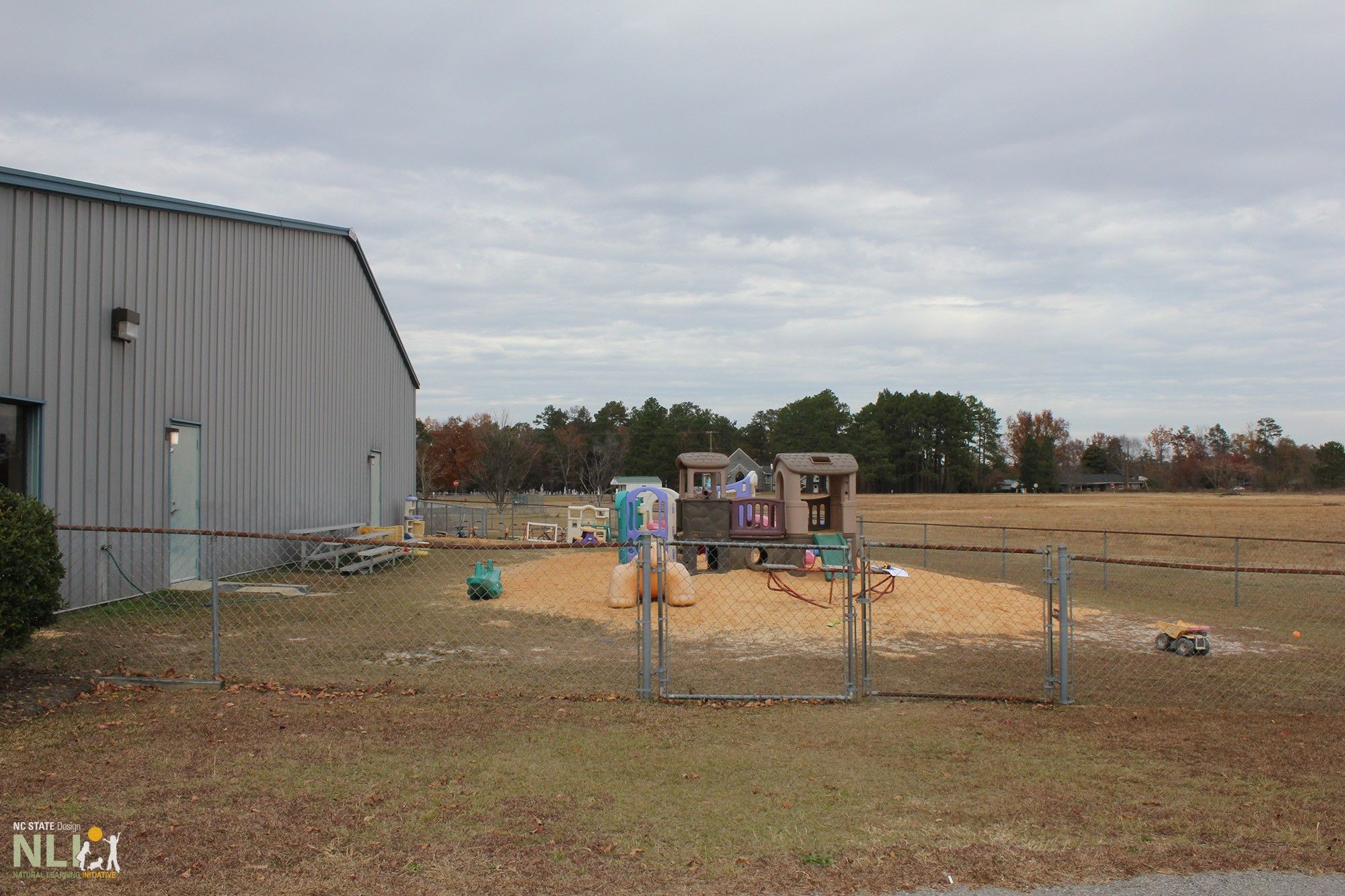
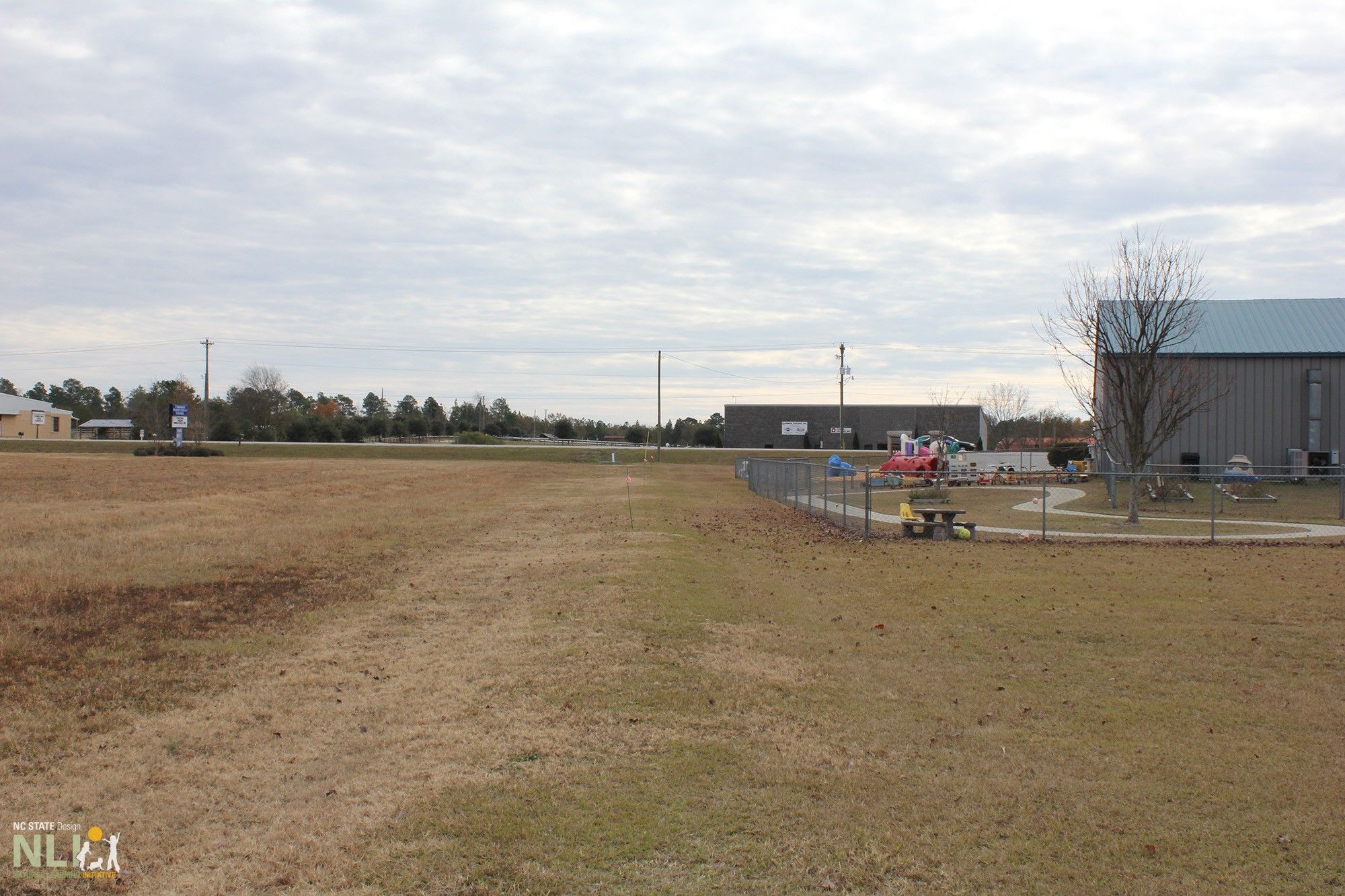
    Original MEGA Child Development Center Site

    original site before development

    Original site before development started.

    original site before deleopment
    Child giving nilda cosco berries

    Preschooler sharing thoughts about berries with NLI’s Nilda Cosco at the Grow Outdoors SC launch

    Promoting healthy lifestyle habits–exemplified at MEGA Child Development Center

    Environments that promote healthy lifestyle habits, like MEGA, evolve from the intersection of specialized landscape design, transdisciplinary professional development, incremental development linked to rigorous evaluation, and creation of regional demonstration/training sites.

    group of childcare providers

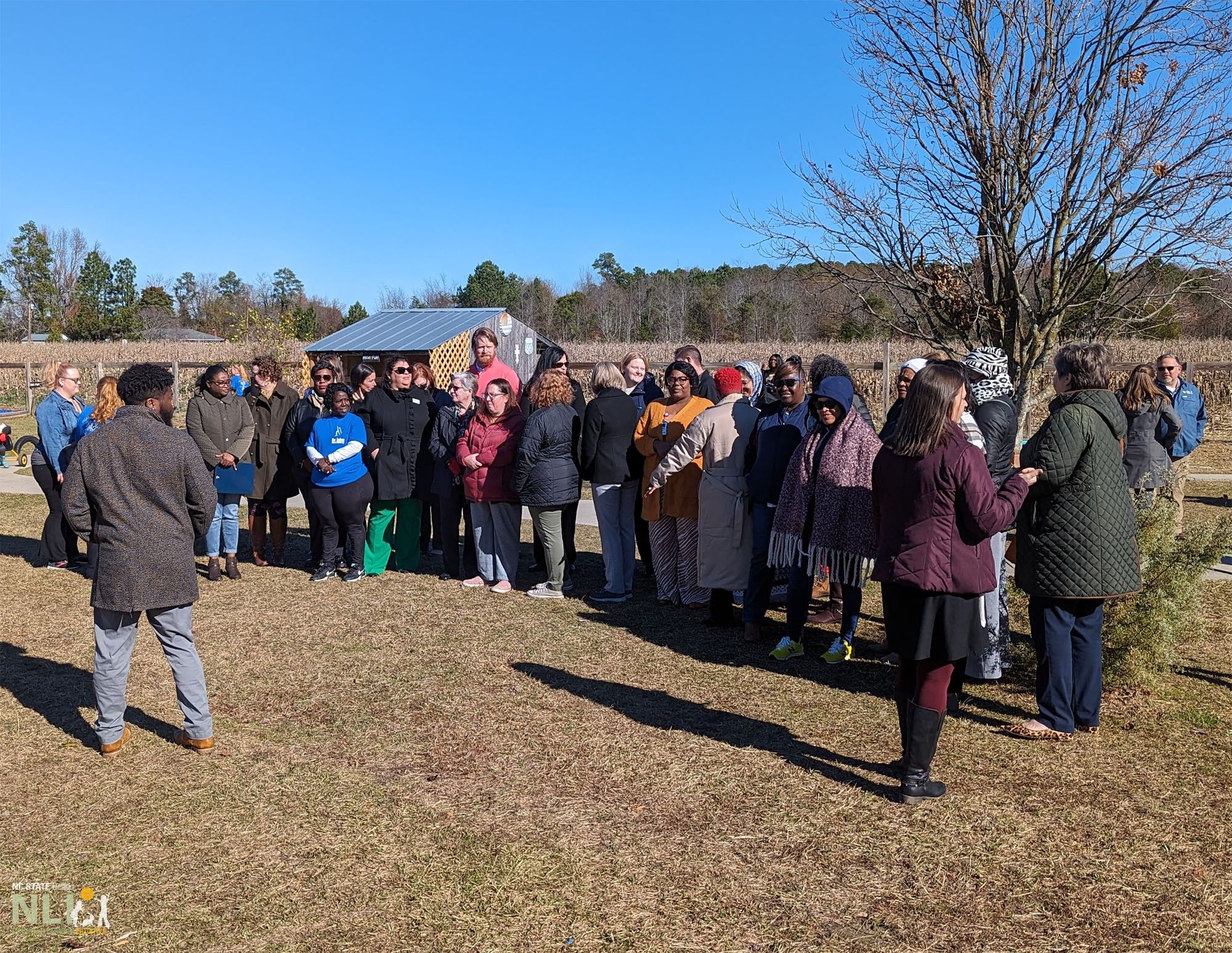
    Childcare providers from across the state celebrate Grow Outdoors SC.

    children on wheeled toys

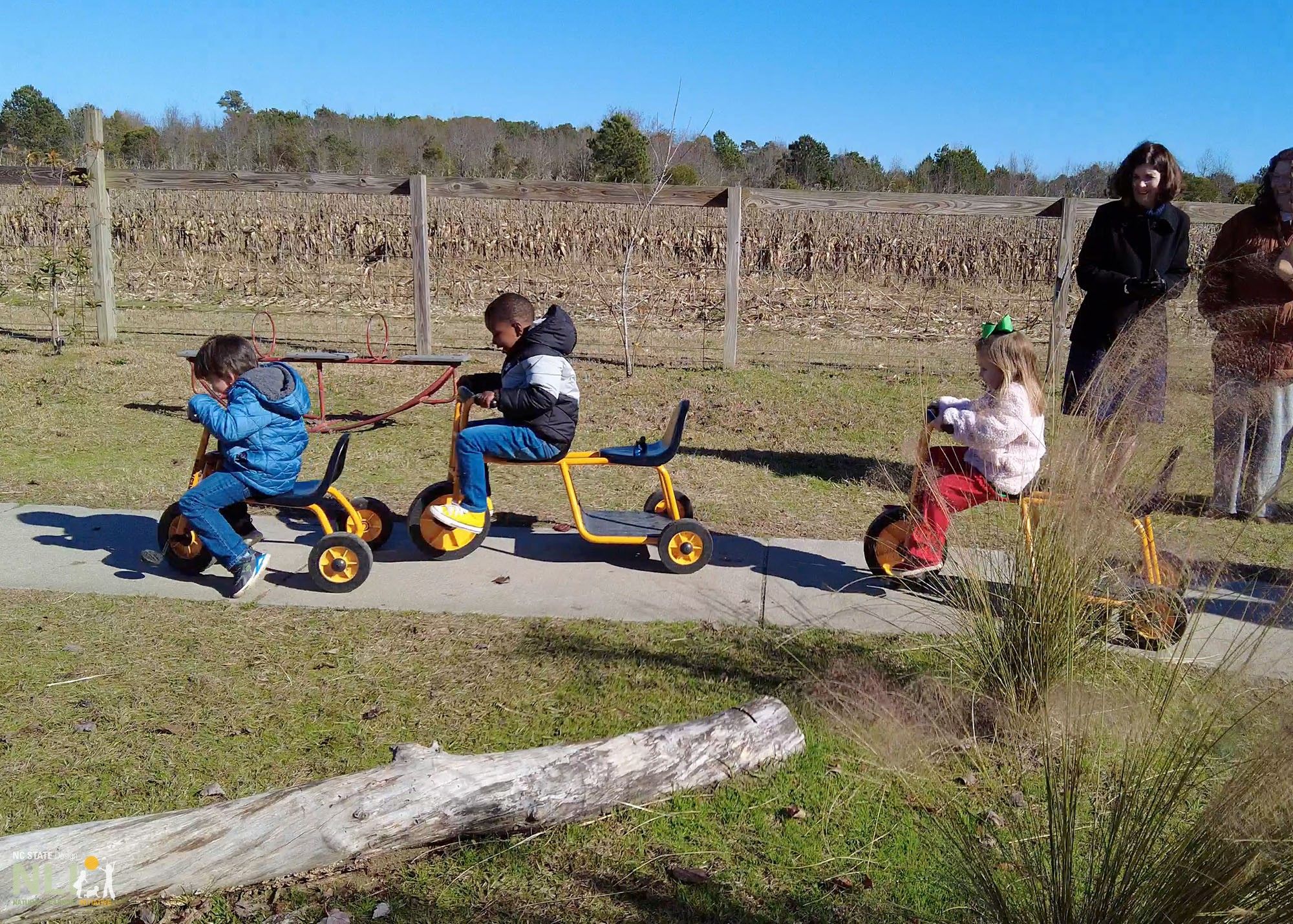
    Primary Pathway & wheeled toys – guarantees physical activity!

    children in a large playhouse

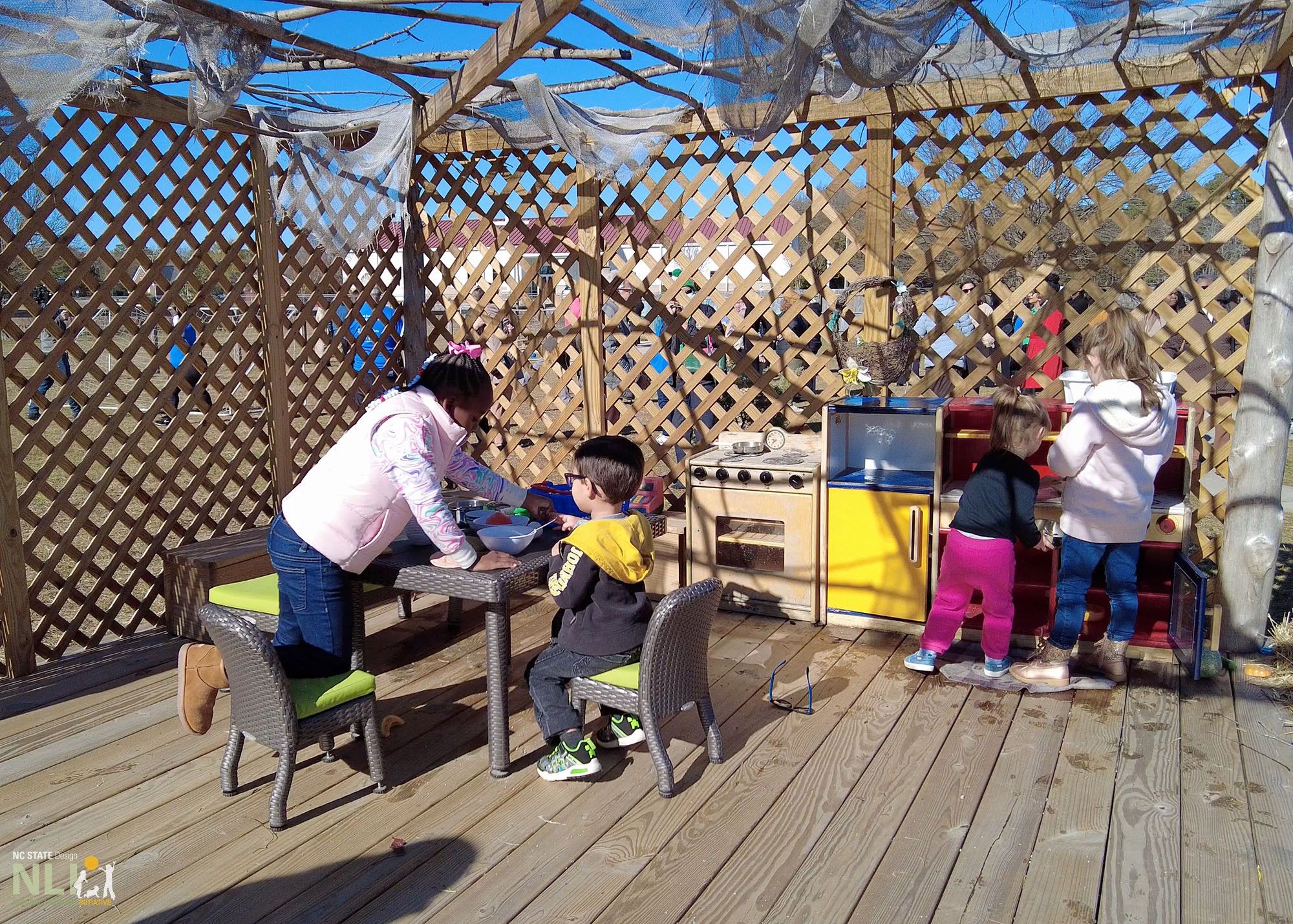
    “Playhouse” is large enough for diverse dramatic play group activity.

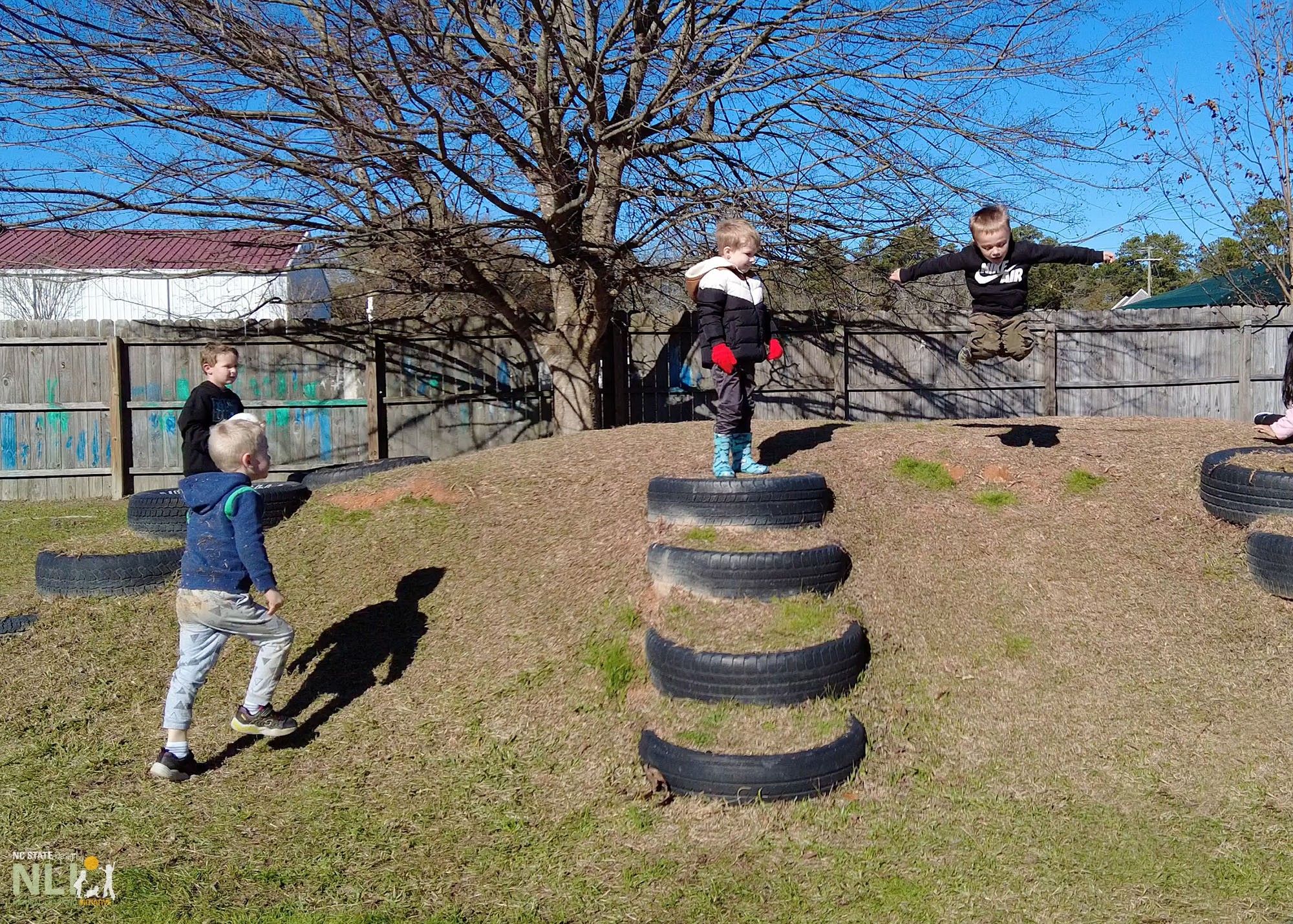
    children rolling down a hill with built-in tires

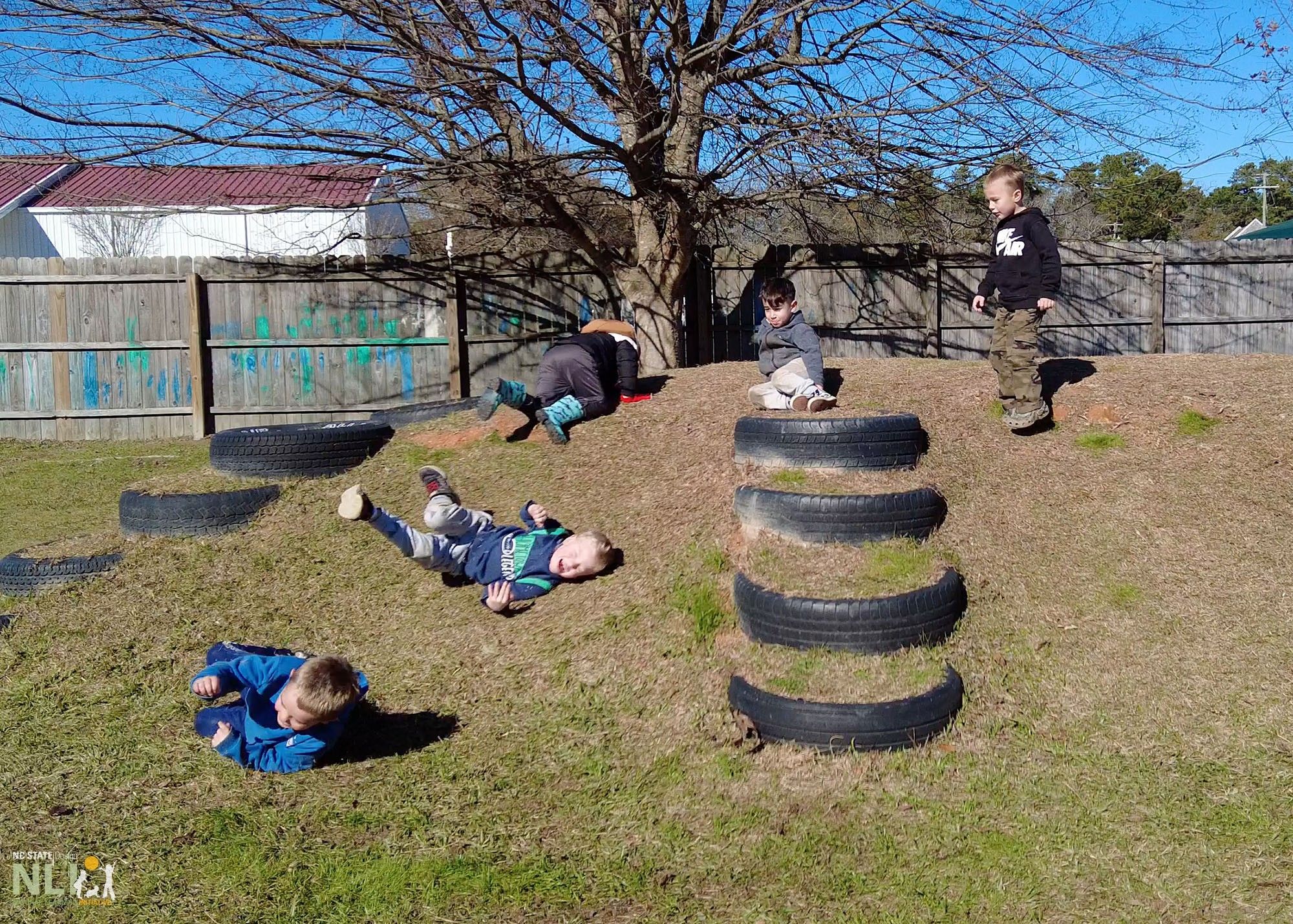
    Mound Play – for rolling and vestibular stimulation.

    children playing on hill with built-in tires
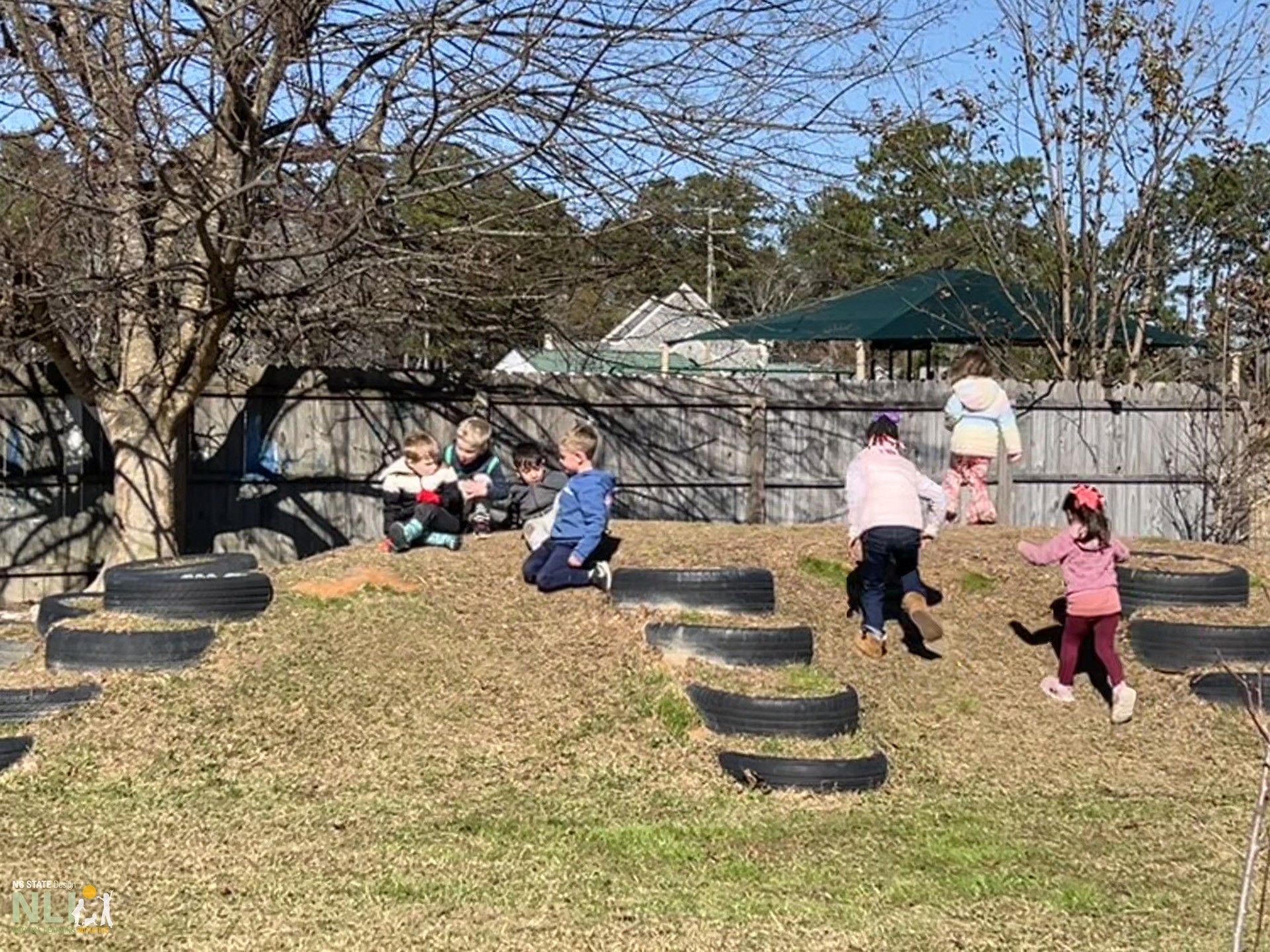
    Mound Play – for running up and down together.

    Mound Play – for running up and down together.

    child jumping while playing on hill with built-in tires

    Mound Play – for inventing new games, and stimulating social interaction.

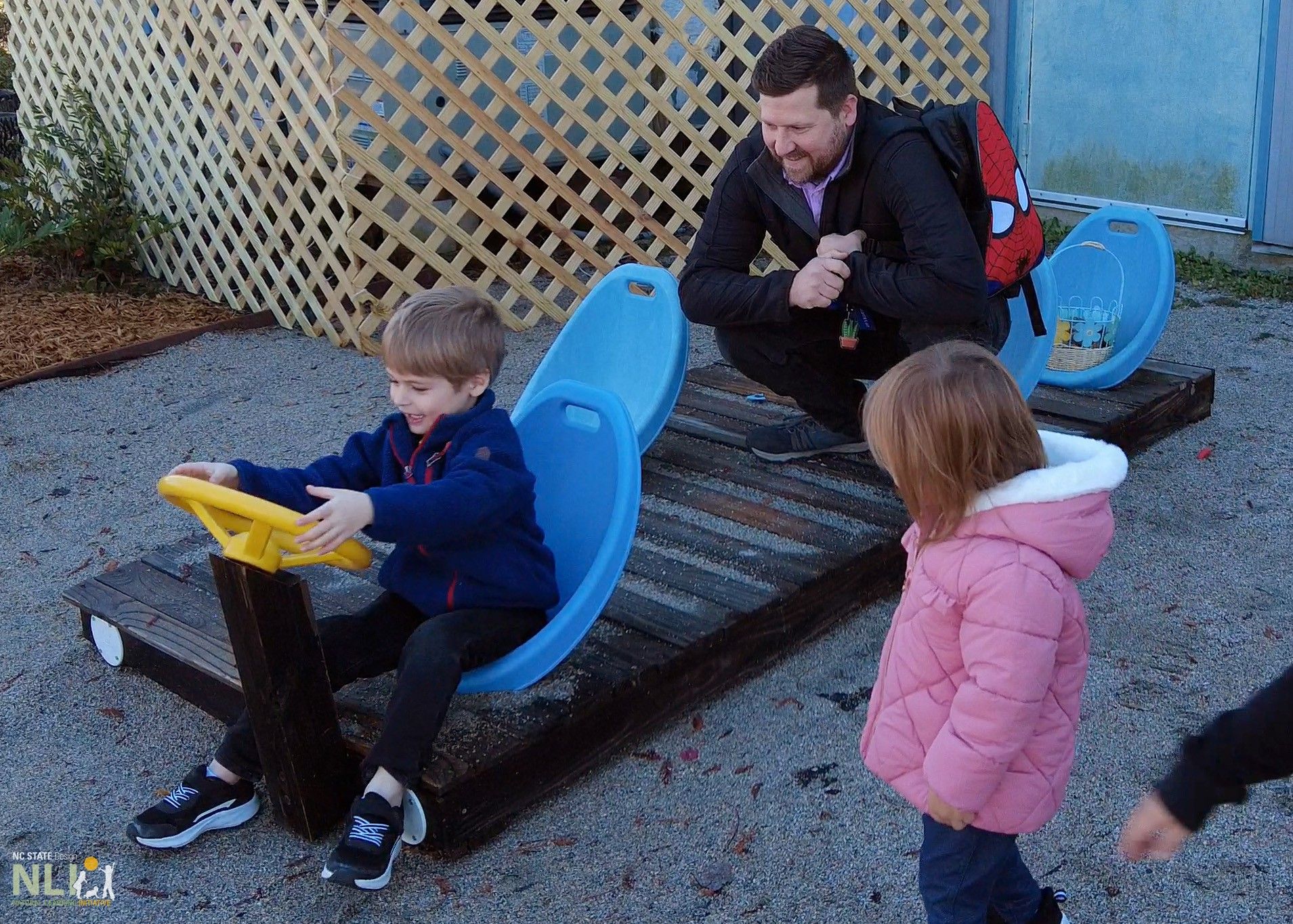
    child playing with his dad pretending to be a bus driver

    “Don’t worry Dad, I’ll drop you off on time” (son is bus driver)!

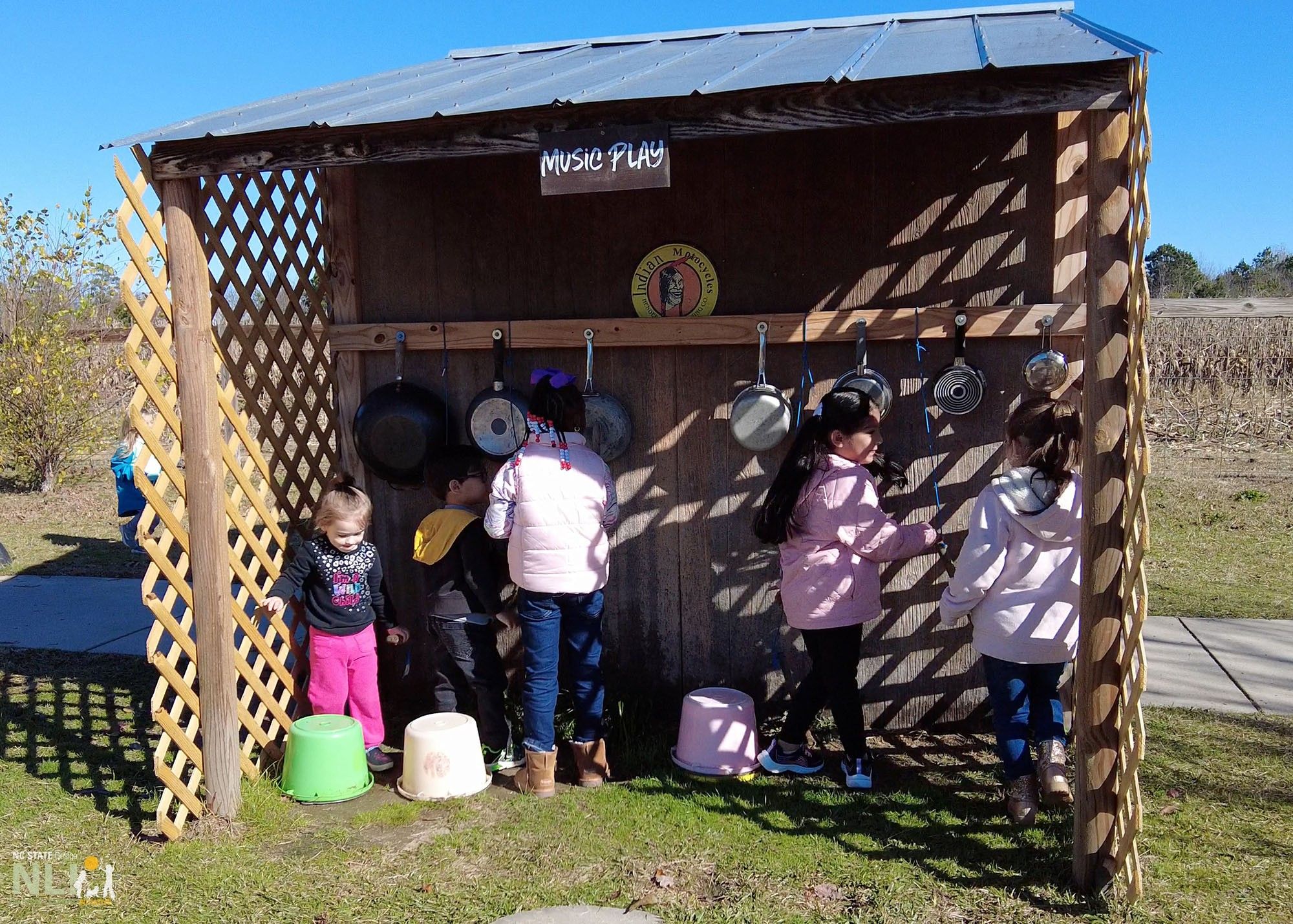
    children engaging in acoustic play

    Acoustic Play – adaptable to any vertical surface, here a “pots & pans orchestra.”

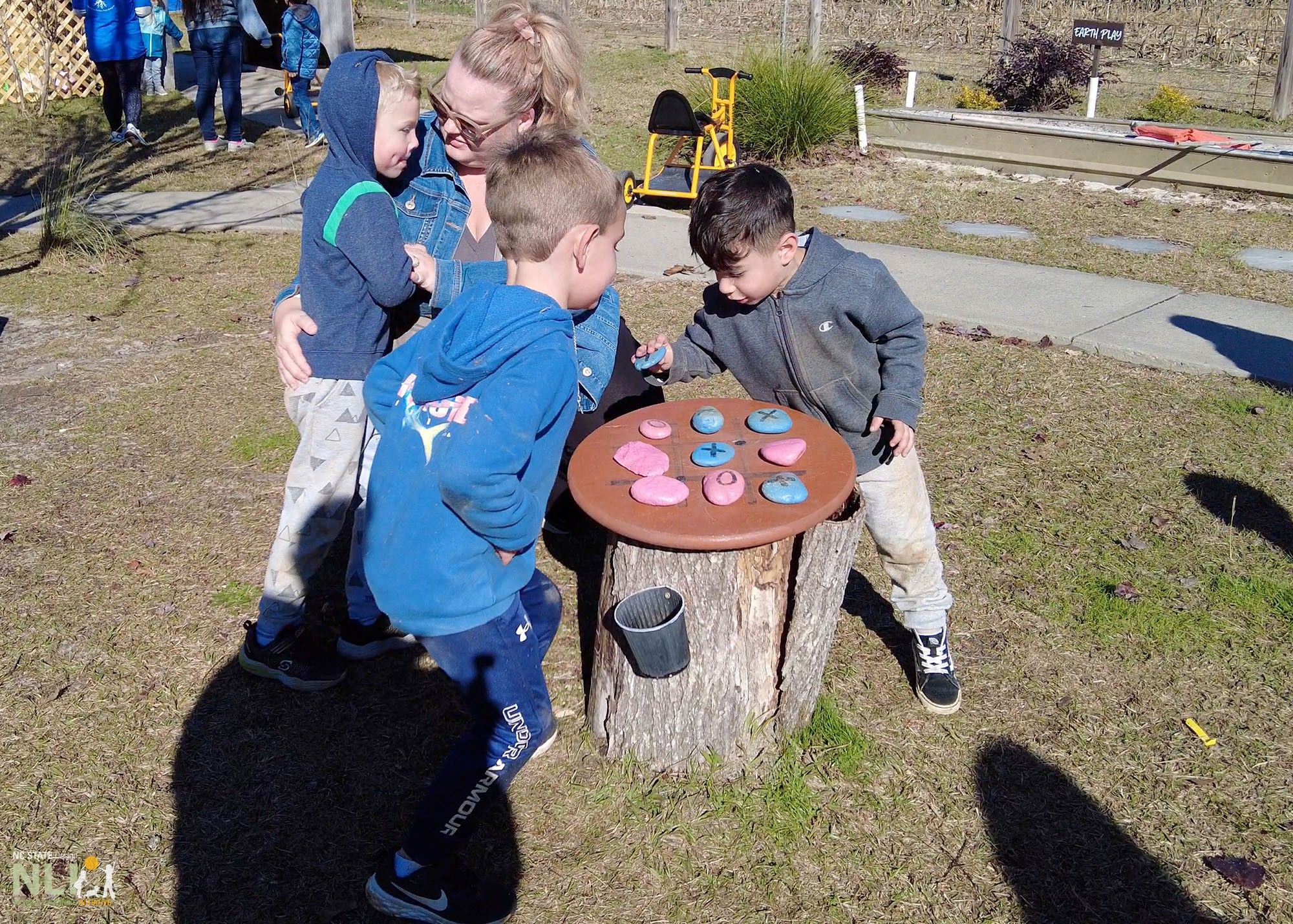
    children playing a game

    Tic Tac Toe – painted pebbles on a log, adapted by these players to make another game (guess what?).

  • North Carolina Division of Child Development Early Education

    North Carolina Division of Child Development Early Education

    In 2011, Creating a Supportive Network was successfully implemented in North Carolina as a collaborative project of the North Carolina Division of Child Development Early Education (NC-DCDEE) and the Natural Learning Initiative (NLI). More than a decade later the need to relaunch and expand the supportive network model is required to engage new DCDEE staff, to increase awareness of the physical and socio-emotional health benefits of nature-based child development, and to incorporate innovative advances in best practices. The project contains the following components:

    • Relaunching the network to support extension of nature-based best practices for outdoor play and learning environments in North Carolina.
    • Creating a visioning framework for nature-based programs and spaces in North Carolina child care facilities.
    • Developing professional training courses, resources, and technical assistance for increasing outdoor time, play, and learning in:
      • NC child care facilities.
      • NC child care homes.

    The goal is to increase the knowledge and confidence of child care consultants, assessors, and providers to support the creation, programming, and safe use of physically diverse, naturalized outdoor play and learning environments for young children in North Carolina child care facilities.

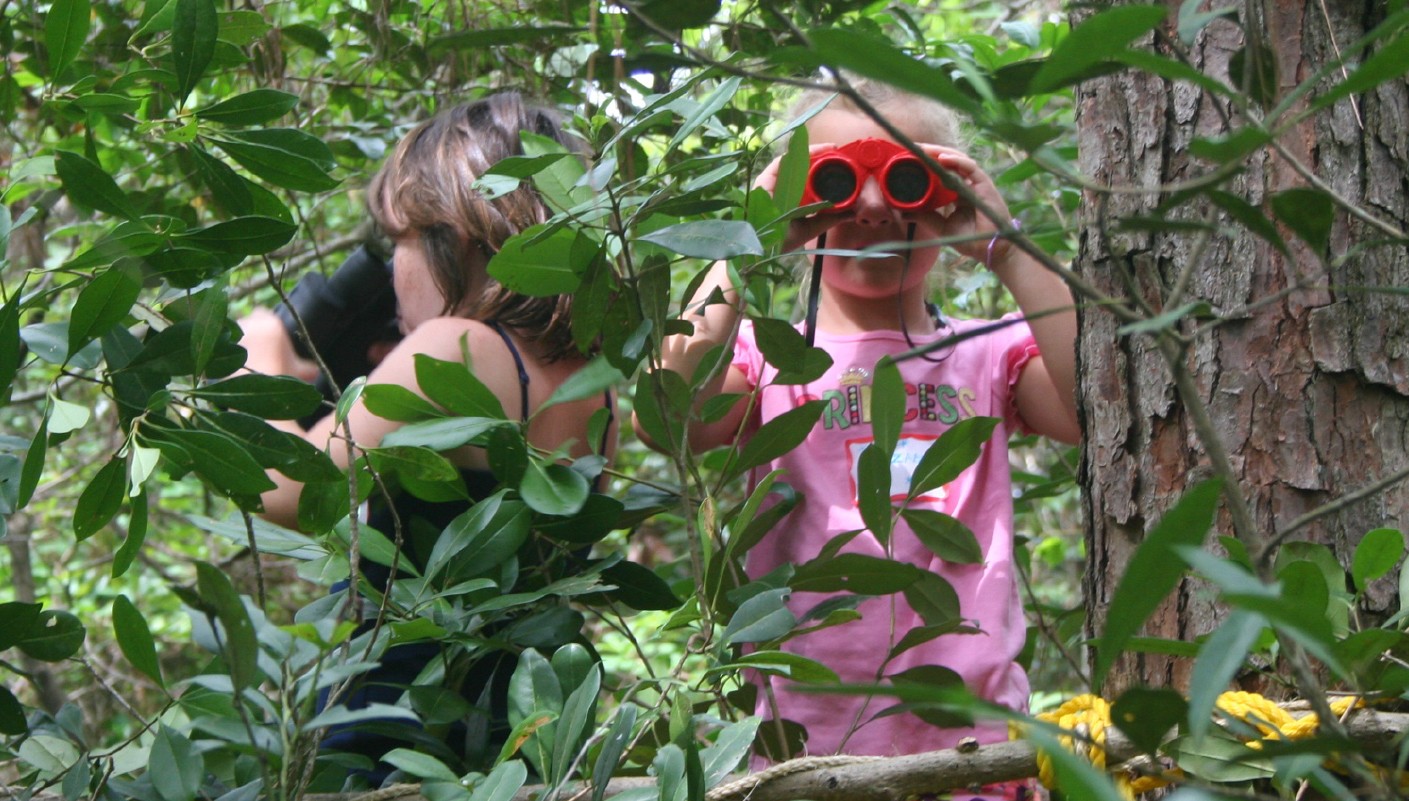
    children looking through binoculars in a wooded area

    Establishing a network with the green industry

    With the objective of disseminating landscape design practice and management, NLI recruited landscape design faculty at NC State University, Horticulture Sciences Department to infuse knowledge on early childhood environments in design studio teaching and practicums.

    To spread knowledge and reach private practices an effort was made to engage professional associations as a viable design-build-management business opportunity (i.e., NC Nursery and Landscape Association NCNLA).

    Learn more

  • Children’s Rights to a Healthy Future

    Children’s Rights to a Healthy Future

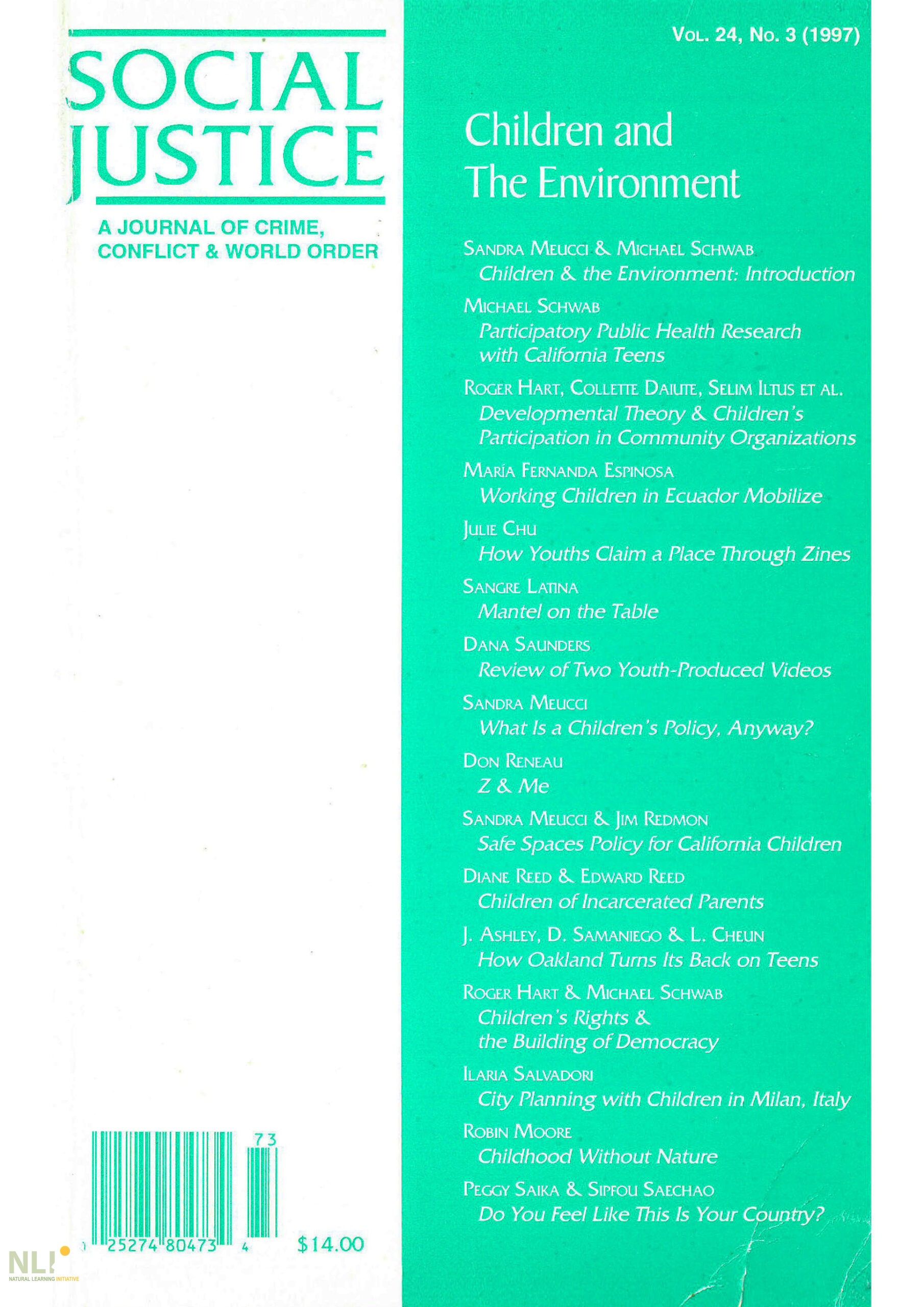
    Children’s right to a healthy future made historic progress in August 2023 when a group of Montana youth won a case re-affirming this right (Held vs. State of Montana), as covered by a 1972 amendment to the Montana state constitutional guaranteeing a healthy environment. The lawsuit challenging a recent restriction was ruled in the youth’s favor. This win and the earlier Juliana v. United States lawsuit for climate advocacy (see below), prompted thinking about intersections between nature-based play and learning, children’s environmental rights, and the NLI theory of change driving our mission (Creating environments for healthy human development and a healthy biosphere for generations to come.)

    Becoming a planetary lifeguard starts with early immersion in nature – in the first year of life, when all experiences, nature included, are new and unfiltered. Children are born curious and attentive to everything in their sensory field. Driven by a genetic endowment necessary for human survival, children playfully explore and discover the nature of nature – good and bad. If prominent in daily life, endless repetition evolves into nature-centric values.

    Time outdoors, playing, engaged with nature, creating adventures with siblings and friends, stimulates cooperation and the development of social skills. It boosts the immune system among many other health benefits. Above all, roaming outdoors in nature strengthens the executive function, and builds agency and resilience that help young adults fearlessly navigate the world along individual and collective life-course pathways. Not only becoming frontline leaders but the countless millions of committed, visible young people needed to achieve the tipping point, where political leaders take the massive action necessary to heal Planet Earth.

    As children travel the developmental pathway, attentive, caring adults (educators, parents, extended family, youth leaders, religious mentors) can help them extend and deepen a love of nature beginning with the tacit knowledge gained from sensory experience. Nature-based learning at school with nature-trained educators, reinforced by expanding spatial range from homes in nature-based neighborhoods, deepens understanding of the environment. The cumulative result is the social-emotional desire of youth to take collective action to protect nature and their right to a healthy future.

    A goal of NLI is to develop tools and resources that help communities create sequences of nature play and learning, as nature-based solutions (NBS) across the everyday spaces of childhood and youth – in childcare facilities, schools, parks, and neighborhoods, and nature centers, museums, public gardens, and nature preserves. The most basic step to help children learn about nature’s processes can be taken at age three, with hands-on fruit and vegetable gardening.

    An earlier lawsuit (Juliana vs. the United States), was filed in 2015 by Our Children’s Trust on behalf of 25 young people from 10 states. Based on the historic Public Trust Doctrine, the case made it through an Oregon appeals court but eventually failed. Nonetheless, the compelling voices of young people set an inspiring precedent that has helped set in motion an international movement of pro-bono legal teams working with young people using similar climate action strategies.

    We’re trying to spread the message that people everywhere, all over the world, hold these fundamental, inalienable rights to have their essential natural resources protected for themselves and for future generations …

    Attorney,Our Children’s Trust

    The Montana lawsuit challenged a provision of the Montana Environmental Policy Act (MEPA), which forbids Montana environmental regulators from considering global carbon emissions in environmental reviews.

    Montana is one of six US states with a constitutional “right to a clean and healthful environment” (Mont. Const., art. II § 3), enacted in 1972. In 2011, state law clarified that officials can only consider environmental impacts within the state, which then left the issue of global climate change off the table for Montana regulators. Five other states have similar constitutional rights: Hawaii, Illinois, Massachusetts, New York, and Pennsylvania.

    The plaintiffs brought a dense scientific case to the courts, which among other analyses, showed that Montana’s carbon dioxide output is equivalent to that of large countries like Argentina, the Netherlands, and Pakistan. This historic case for climate science in the court system exposed the multiple links between Montana’s carbon dioxide emissions and negative effects on the state’s natural environment. Therefore, setting the stage for the infringement of young’s people right to a healthy environment in the years to come.

    This case sets a new precedent for climate science as it applies to states’ rights to a healthy environment. Currently, similar cases are going through the courts in Colorado, Hawaii, Utah, and Virginia. Most importantly, the vision of Montana’s 1972 environmental rights is still very much alive, to continue protecting the environment for generations to come.

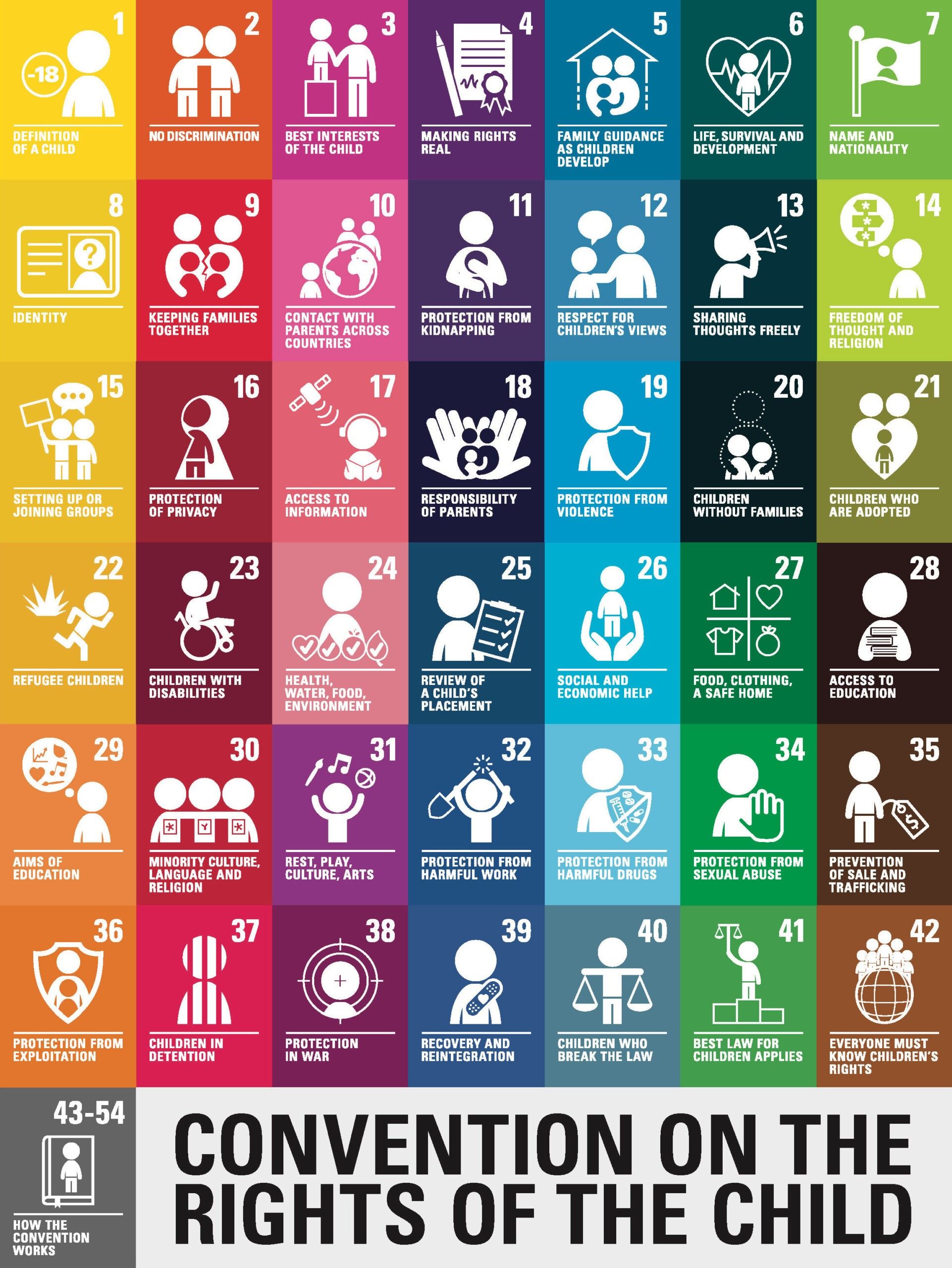
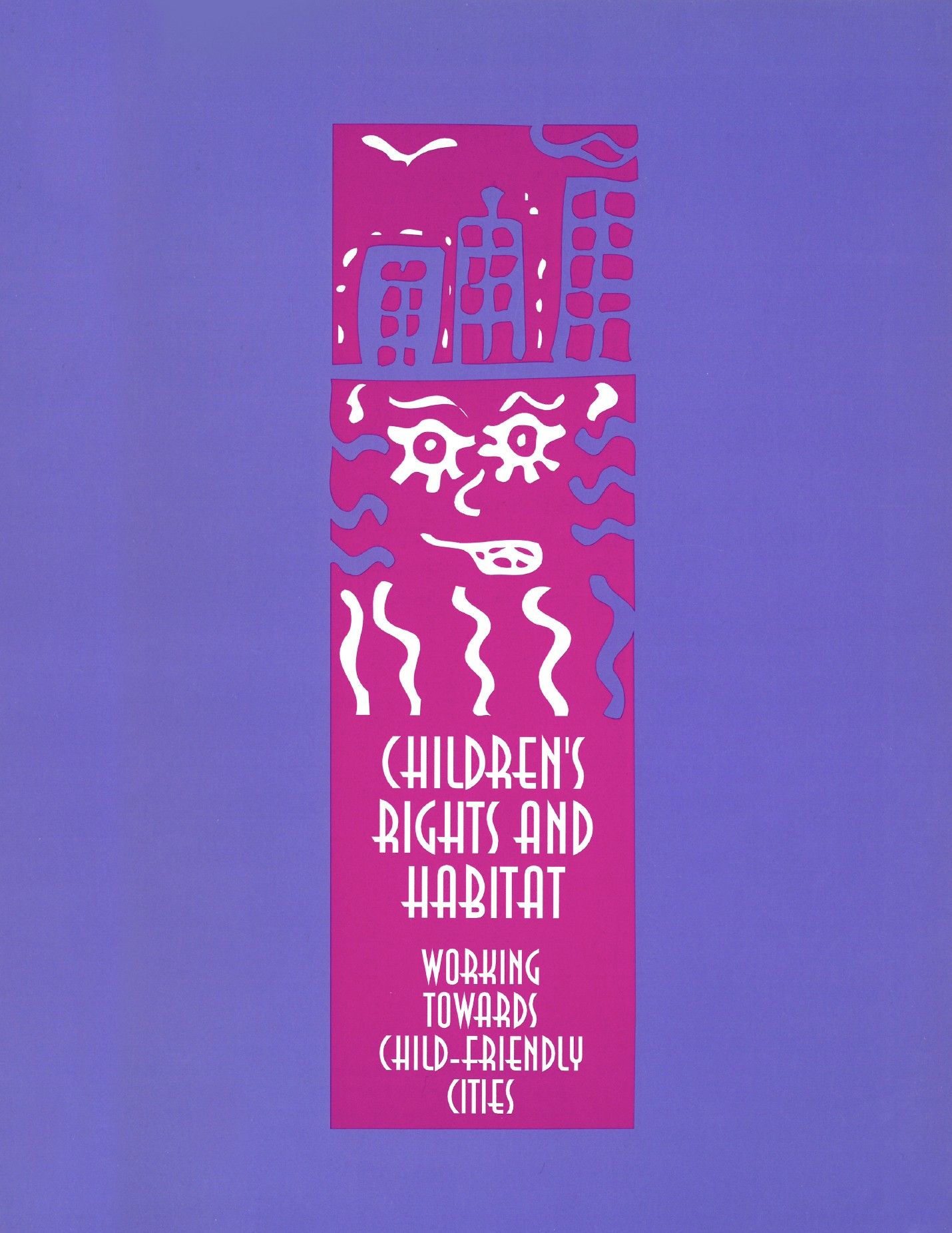
    It is encouraging to see the Convention on the Rights of the Child (CRC – adopted but not yet ratified by the USA), referenced by the NYT as a springboard for action. An example occurred in 1996 with the Children’s Rights and Habitat initiative. UNICEF convened an Expert Seminar in New York City (including Robin Moore), in tandem with a related workshop at the International Habitat II Conference in Istanbul. The combined gatherings resulted in the UNICEF & UNCHS/Habitat publication: Children’s Rights and Habitat-Working Towards Child-Friendly Cities.

    Juliana v. United States is a landmark climate lawsuit against the federal government of the USA, arguing it is depriving youth of their rights to a stable climate system. In September 2019, the young plaintiffs, aged 12 to 23, traveled to Washington, D.C. to get support for their suit from members of Congress and climate strike leader Greta Thunberg. This is their story. The Years Project (8:31) 2019

    Juliana v. United States extended story, including a discussion of legal arguments. 60 Minutes – Overtime (13:34) 2020

    Held vs State of Montana: 16 youths win historic climate trial(2:48) 2023

    Additional Videos:

    PBS News – Teens taking climate change to court (9:05) 2015

    PBS News – Interview with original Montana young activist(7:00) 2023

    Sources:

    Harvard Law
    New York Times

    Our Children’s Trust

    Resources:

    Convention on the Rights of the Child
    https://naturalearning.org/download/48130/?tmstv=1695926087
    https://digitallibrary.un.org/record/233327/files/UNICEF-UNCHS-Habitat-and-CERG-1996-Childrens-Rights-and-Habitat-Working-Towards-Child-Friendly-Cities.pdf?ln=en
    https://digitallibrary.un.org/record/233327/files/UNICEF-UNCHS-Habitat-and-CERG-1996-Childrens-Rights-and-Habitat-Working-Towards-Child-Friendly-Cities.pdf?ln=en
    https://ncchildrenandnature.org/nli-theory-of-change-climate-change/#:~:text=TheNeedforNatureAChildhoodRight
    https://ncchildrenandnature.org/nli-theory-of-change-climate-change/#:~:text=The%20Need%20for%20Nature%20%2D%20A%20Childhood%20Right

    Convention on the Rights of the Child

    Children’s Rights and Habitat: Working Towards Child-Friendly Cities

    The Need for Nature – A Childhood Right

    Montana Climate Youth Win – Our Children’s Trust

    Sun Journal News – Youths sued Montana over climate change and won. Here’s why it matters

  • Trolls Take Root at Dix Park

    Trolls Take Root at Dix Park

    A family of giant trolls has made Dix Park their new home—and they’re here to spark imagination and inspire care for the earth.

    Hidden among the trees and trails, these five towering sculptures are the work of Danish artist and environmental storyteller Thomas Dambo, whose creations around the world transform scrap wood into symbols of renewal and joy.

    Each troll tells part of a larger story about connection to nature, to community, and to the world we share. Built entirely from reclaimed materials, they remind us that beauty often begins with what we choose to reuse.

    The Trolls at Dix Park reflect the park’s growing vision as a cultural and creative destination—where art, nature, and play converge in unexpected ways. So lace up your shoes, grab your sense of wonder, and discover the trolls waiting to meet you among the oaks.

    Dix Park Conservancy – Trolls

    Dix Park – Trolls

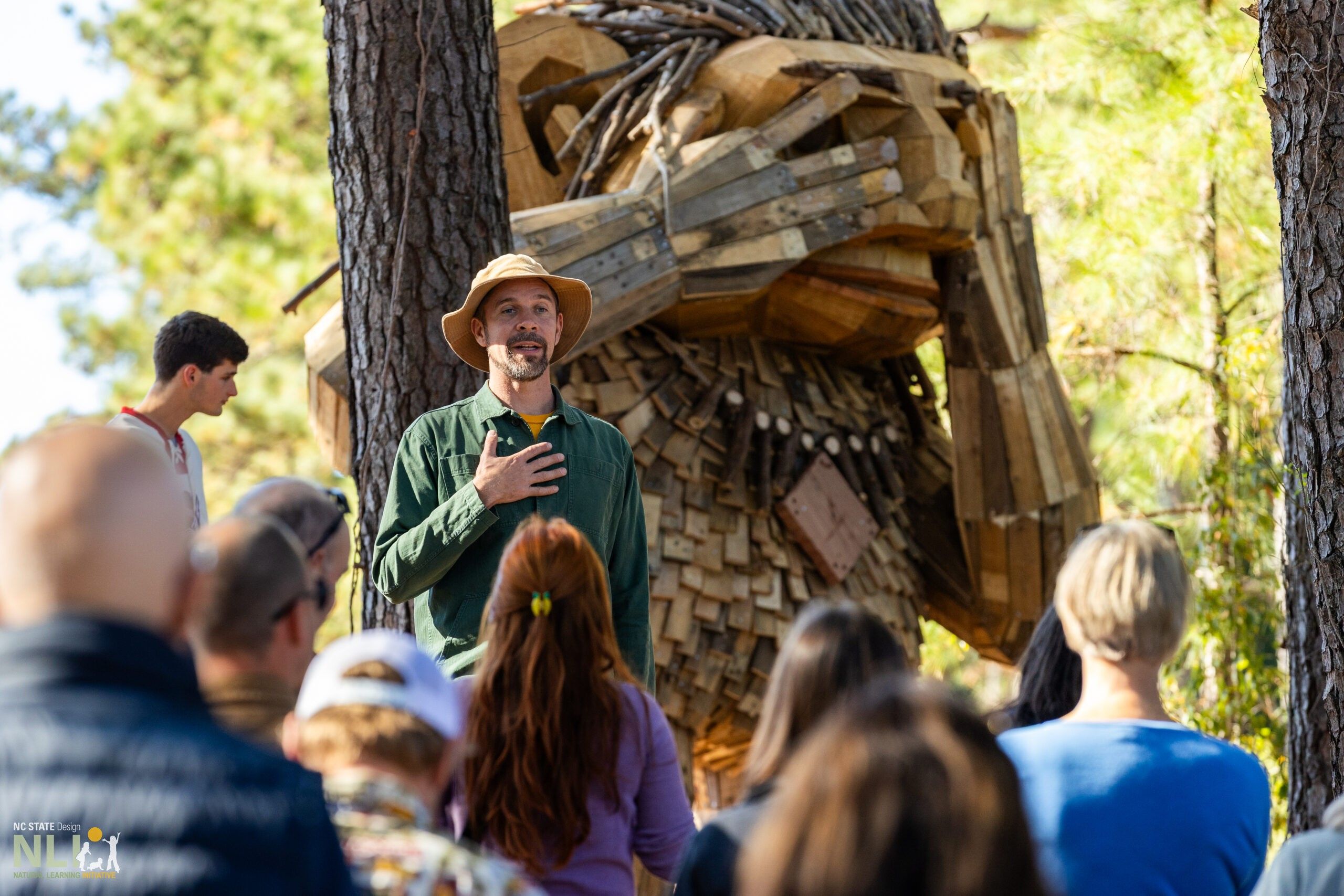
    Man in hat speaks to group near wooden sculpture in forest, promoting outdoor play and nature-based learning.

    “This isn’t just about public art. It’s about inviting people to step into the story, to leave behind the digital world for a few hours and make something real with twigs, twine, and teamwork.”

    Troll Artist

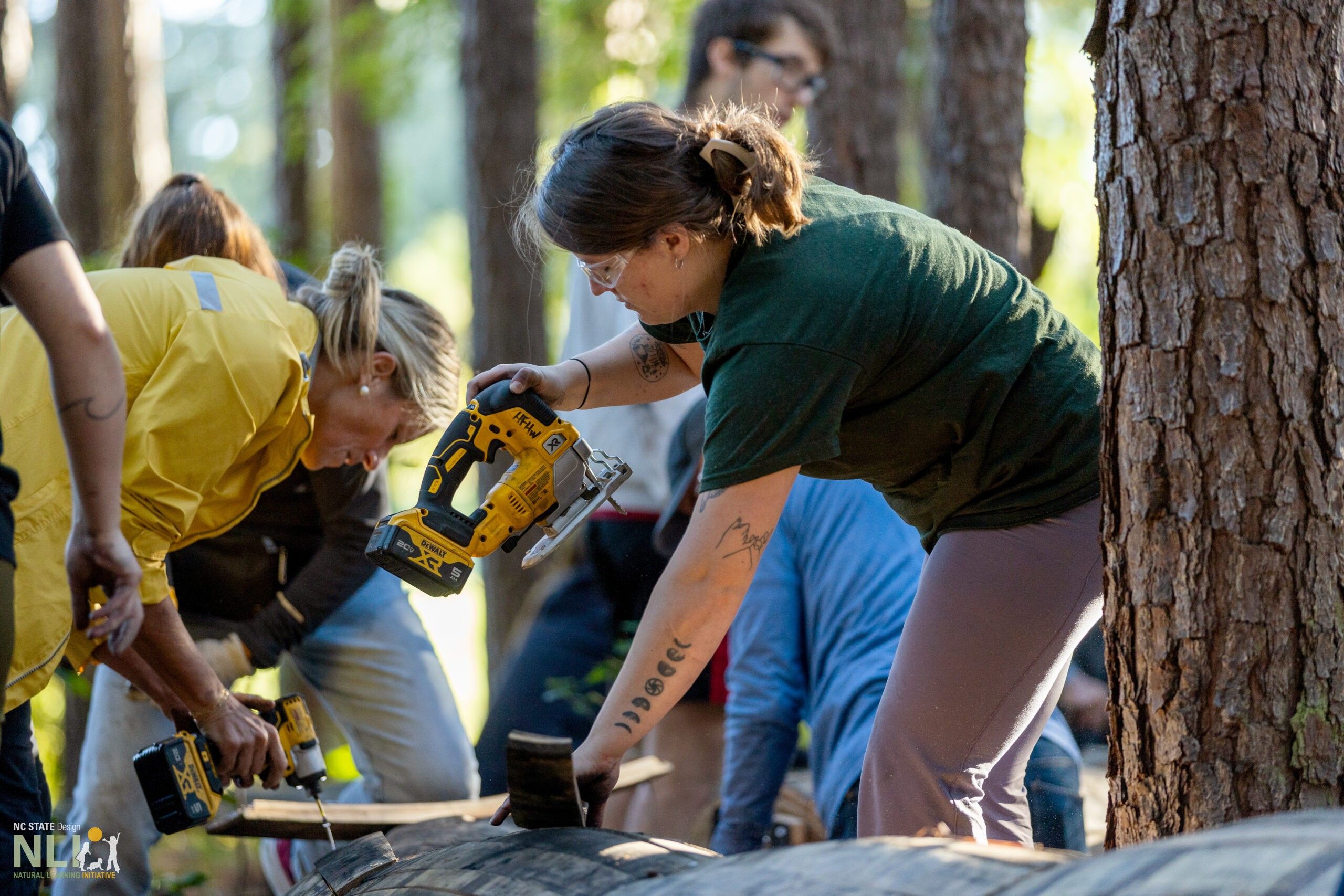
    Volunteers use power tools to construct outdoor play structures in a forest setting.

    Volunteers help construct the family

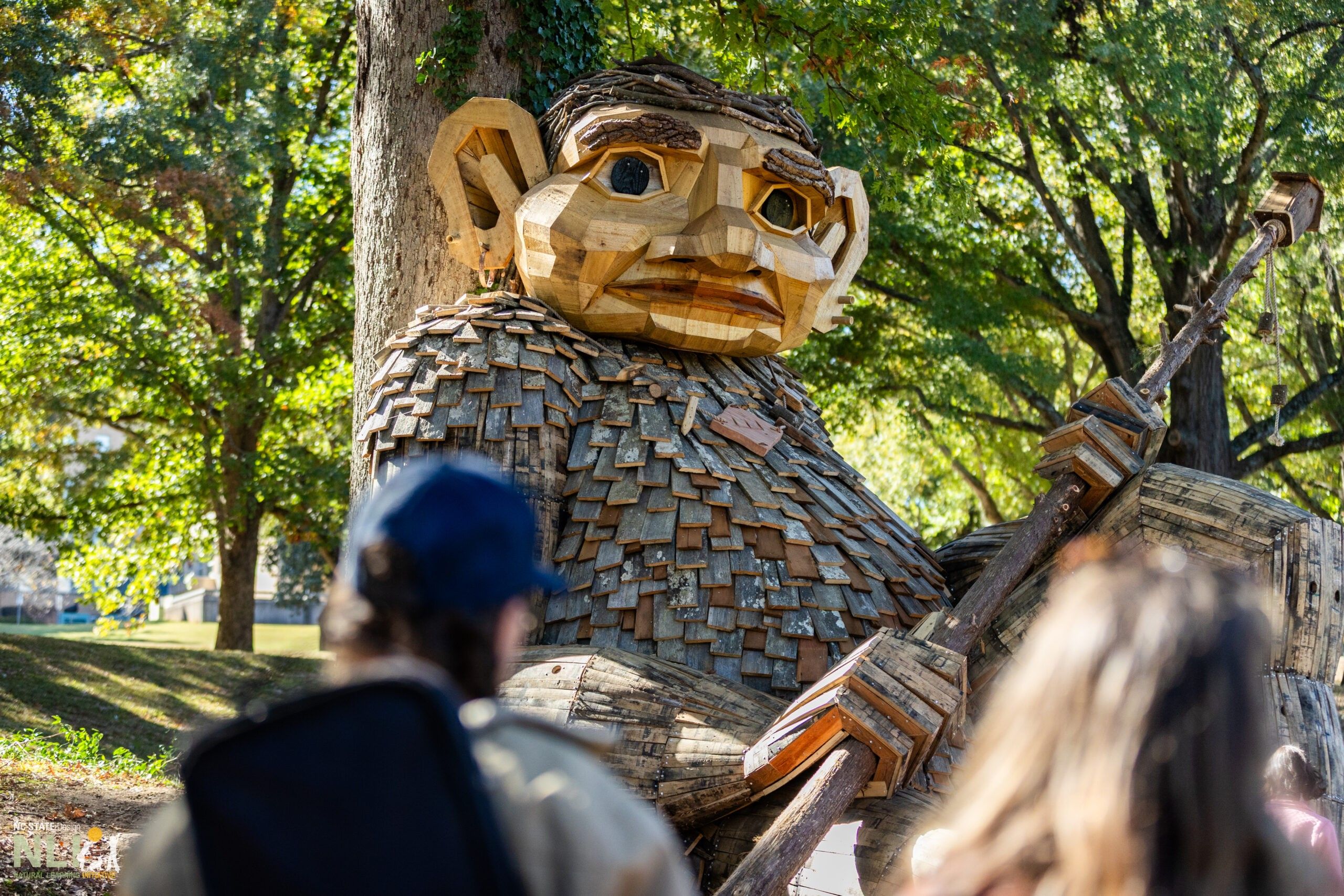
    Wooden monkey sculpture with shingled body in park, inviting outdoor play and nature-based learning.

    “Daddy Bird Eye”

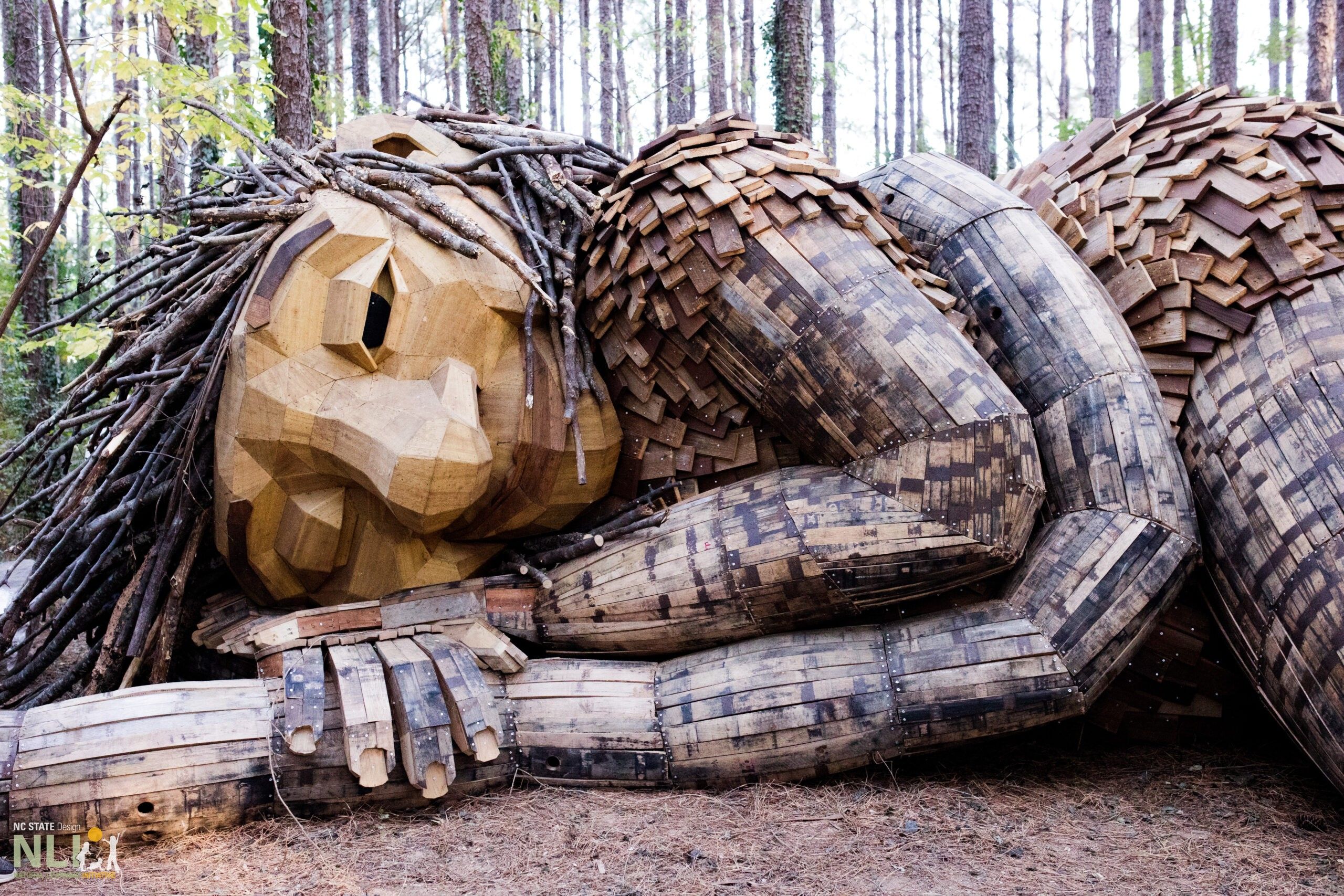
    Mother Strongtail: Giant wooden sculpture in a forest, inviting outdoor play and nature-based learning.

    “Mother Strongtail”

    Photo Credit: Dix Park Conservancy