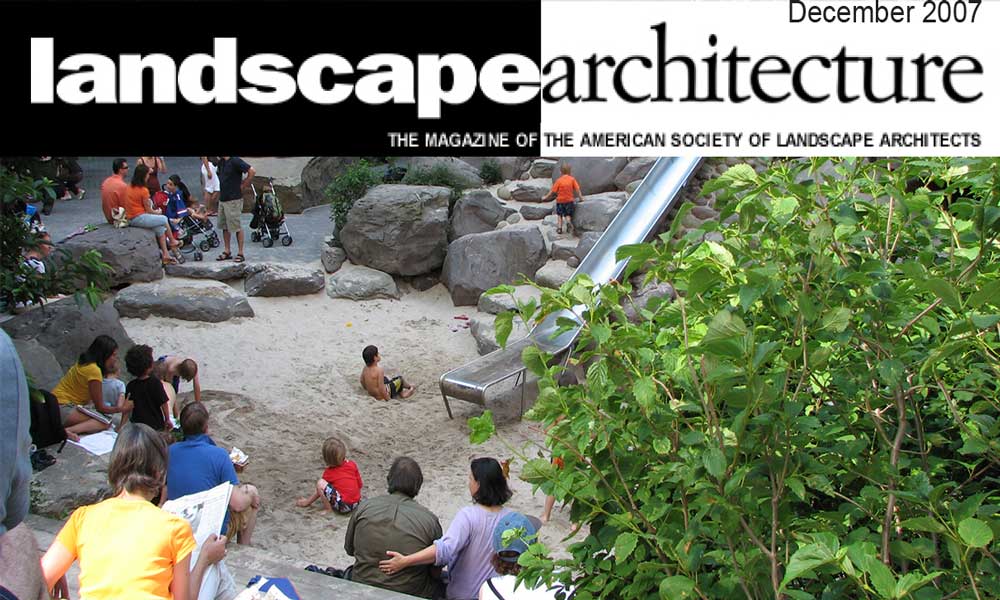
A discussion of the value of Post Occupancy Evaluations and a look at the reasons why so few are done. What can landscape architects learn from them and how could they be used to further the profession?
Childhood is a holistic process, different for each individual child. Many children do not learn effectively exclusively within a classroom. They need alternative, hands-on learning environments to match their varied learning styles. Test-driven education mandates often do not emphasize children’s emotional and social needs and opportunities for creativity. This limits the development of unique talents and the fulfillment of individual lives, and deprives society of practical, problem-solving intelligence.
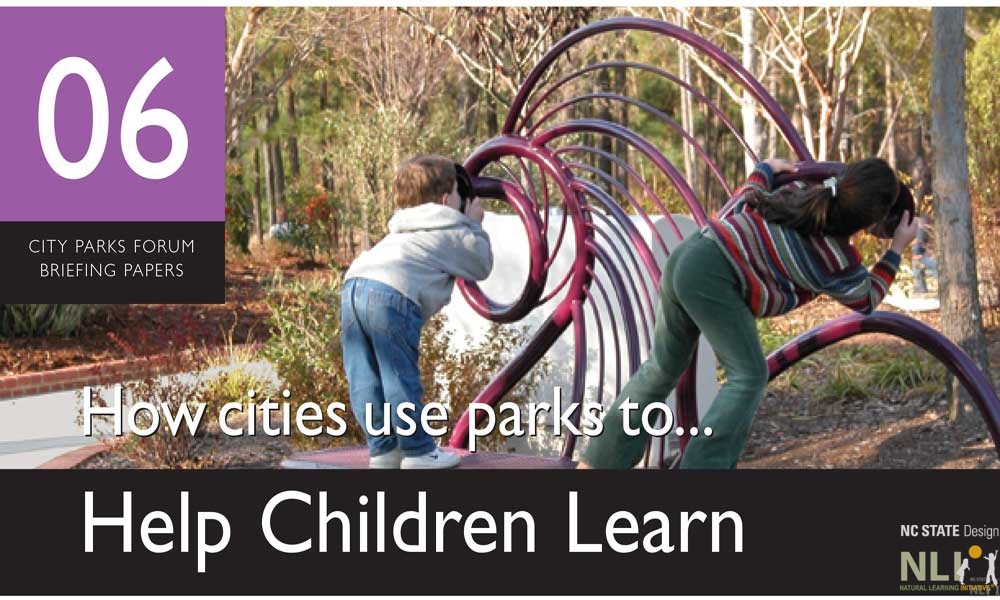
City parks, greenways, and naturalized school grounds can be a crucial antidote to these unhealthy trends.They can motivate young people to learn through the natural environment (which includes learning about the natural environment), bringing environmental education into the mainstream of state-mandated instructional programs. The informal learning, non-formal programs, and formal instruction associated with parks can reinforce each other, enhancing academic achievement.
InCity Parks Forum Briefing Papers,American Planning Association, 2003
The biological health of the planet and the health of the world’s children are interdependent. Together they form a single ecosystem under the potential influence and protection of the social construct of sustainable development. Childhood is the most critical stage in the human life cycle. A small but growing body of research indicates that daily experience of nature, spending time outdoors in the fresh air and sunlight, in touch with plants and animals, has a measurable impact on healthy child development. Children have a right to develop in an environment that stimulates their healthy development as mandated by the UN Convention on the Rights of the Child. To fulfill this mandate, nature must be seen as an essential component of the experiential world of childhood, designed into every childhood habitat, providing daily immersion in nature, putting children in close touch with the biosphere. In the urban world we live in, implementation of this right cannot be left to chance. It is a design imperative.
Presented at the international conference on People. Land and Sustainability. University of Nottingham, Faculty of Social Sciences. September 13-16, 2000
As a vehicle for healing children, gardens have special significance because of the way in which children relate to the world through play and their attraction to nature (Moore and Wong, 1997). Play is the child’s way of establishing authentic relationships with the social and physical world. Play is also a right as guaranteed in Article 31 of the Convention on the Rights of the Child (CRC, United Nations, 1989).
WHAT IS A CHILDREN’S HEALING GARDEN?
Insights about the significance of relationships between childhood, play, and nature have an extensive history. One needs only to think of names such as Montessori, Pestalozzi, Steiner, Froebel, and Dewey to realize that the legacy of more than a century of child development theory and practice can help us understand the role of children’s gardens as places of healing. Through playful interactions with people, natural objects, and materials, the child learns in a special boundless way that stimulates the development of mind, body, and spirit. Children’s interactions with the physical environment are intimate and immediate. This makes garden settings especially satisfying because they are diverse, constantly changing, multisensory, and alive. The “compressed nature” of gardens, regarded by researchers as a healing agent (Olds, 1985), counteracts boredom, stimulates children’s innate cursorily, and offers a huge range of experiential choices compared to synthetic environments (Moore and Wong, 1997).
Healing gardens have special significance as places where the inner life of the child can be integrated with the external world, where children can find both stimulation and solace. British child psychiatrist and pediatrician Donald Winnicott (Winnicott, 1971) called this experiential domain the child’s “potential space,” where, through play, children can work through internal conflicts, express fears, and communicate desires nonverbally. Winnicott’s notion of “potential space” (resulting from a lifetime working with children and families) lends powerful support to the idea that playful garden settings can serve as therapeutic or healing environments for children, their parents, and caregivers.
Great differences exist between adults and children in their perception and use of the outdoor environment. One of the greatest relates to residential streets. To adults, streets are functional resources: the quickest way from A to B or a good place to park the car. Sometimes, if lined with trees, they are valued as an aesthetic enhancement. Children see streets differently, as play opportunities discovered in lamp posts, curbstones, gutters, inspection chamber covers, overhead wires, parked cars, trees, piles of leaves, flights of steps, gates, bollards, hedges, retaining walls, driveways, building entrances, bus stops, mailboxes, street signs, and benches. Children measure the environmental quality of streets by the presence or absence of these mundane objects, not by the ease of traffic flow and parking. Nonetheless, traffic has a critical effect on street playability.
In Public Streets for Public Use, Van Nostrand Reinhold, 1987
Growing Up Green: Naturalization as a Health Promotion Strategy
Authors: Moore, Robin; & Cosco, Nilda.
The seven-step POD process engages the local community and center staff in a collaborative process with the Natural Learning Initiative to create a schematic design to be implemented in increments as local resources and funding permit. Professional development of state regulatory staff is essential to successful POD implementation. Best practice indicators, using a four-point scale, provide a new OLE quality measurement tool.
InChildren Youth and Environments,University of Colorado, 2014