This Is Me : Article 31 and a Child’s Right to Play
By:International Play Association (IPA World)
On February 1st 2013, the UN Committee on the Rights of the Child expanded the world’s understanding of the child’s right to play by adopting a General Comment on Article 31 of the Convention on the Rights of the Child.
Wolfpack Wellness Research Web Series: “Preventing Obesity by Design”
By:Wolfpack Wellness
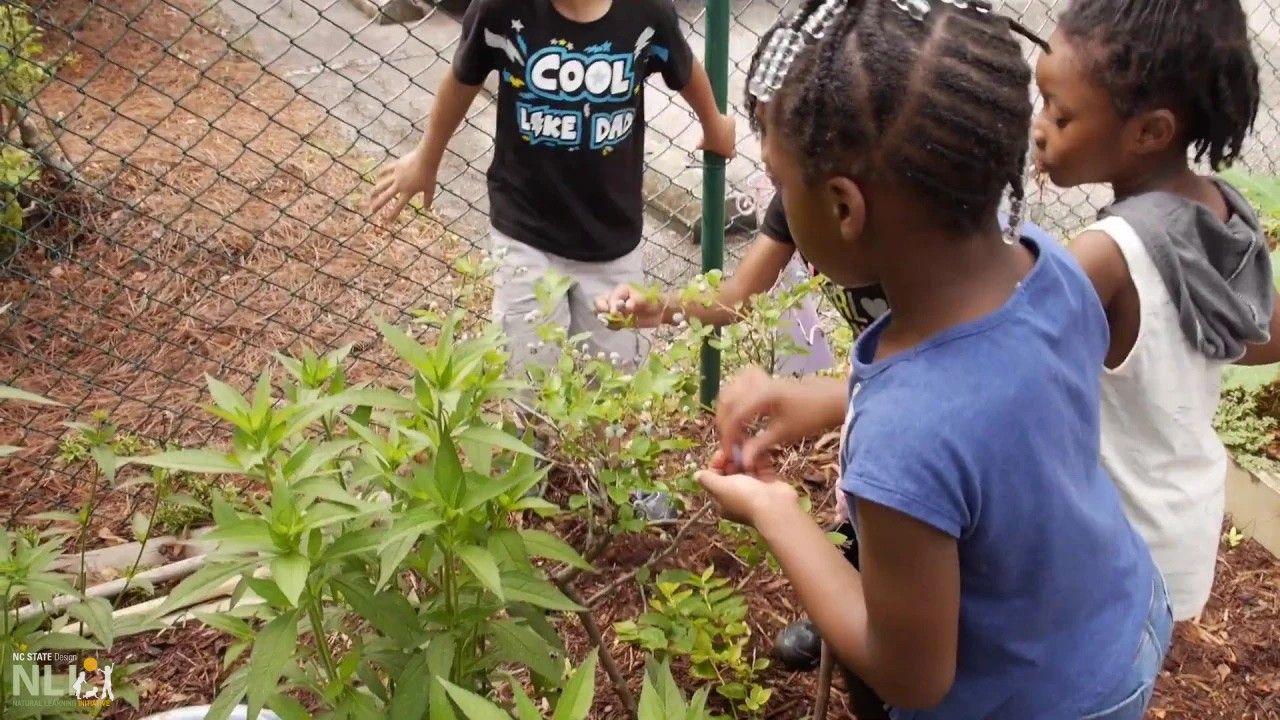
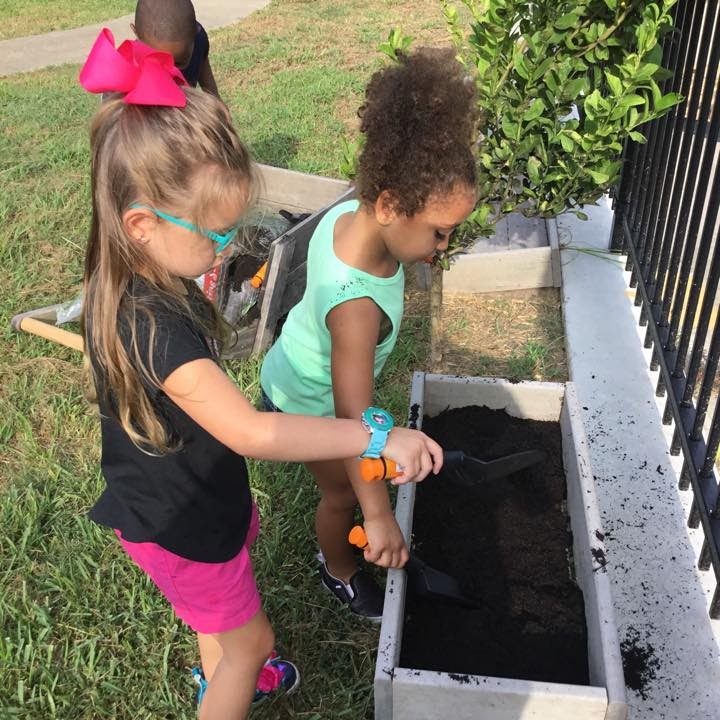
In November of 2023, NLI collaborated with the NC State University Department of Horticultural Science to deploy nature-based design interventions in two North Carolina child care centers as part of a state-wide grant with the NC Division of Child Development and Early Education. The following short is from a visit to Bright Beginnings Child Development Center in Cary, NC where Horticulture Science students helped build and implement planters and a pergola.
The Yale Center for Environmental Communication recently featured NLI’s Robin Moore in their Climate Connections radio program on the importance of shade in playgrounds. Robin shared insight on the important role that shade plays in creating more comfortable, usable spaces year-round and in preventing exposure to harmful UV rays. Shade solutions include shade trees, vine-covered structures like arbors, and shade sails.
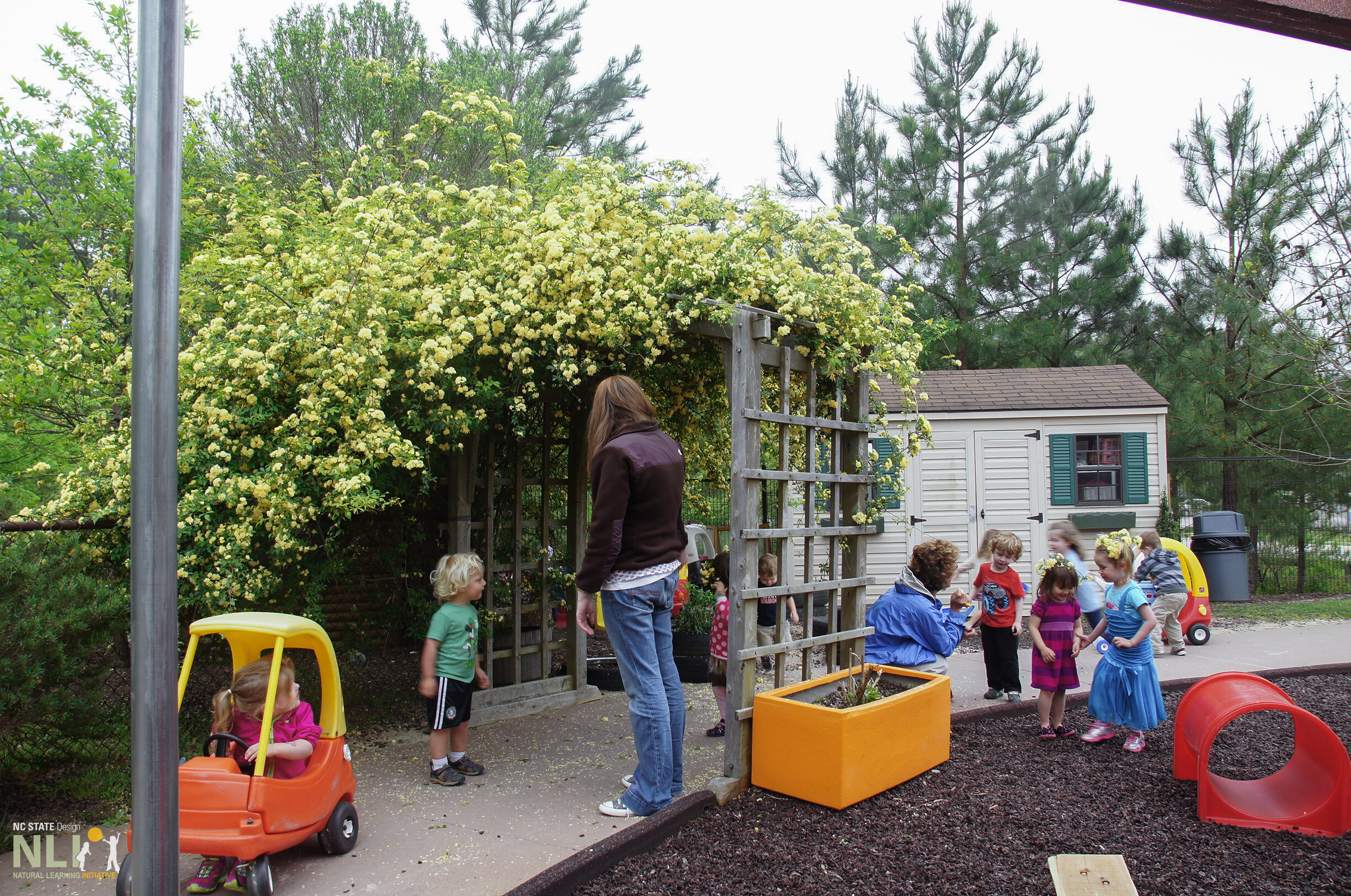
Covered by a magnificent cream umbrella of Banks rose, this arbor spans a preschool primary pathway, affords a patch of shade and snipped stems for flowery garlands.
This large shade sail provides comfort for a community gathering at Follow the Child Montessori in Raleigh.
This large shade sail provides comfort for a community gathering at the Follow the Child Montessori in Raleigh
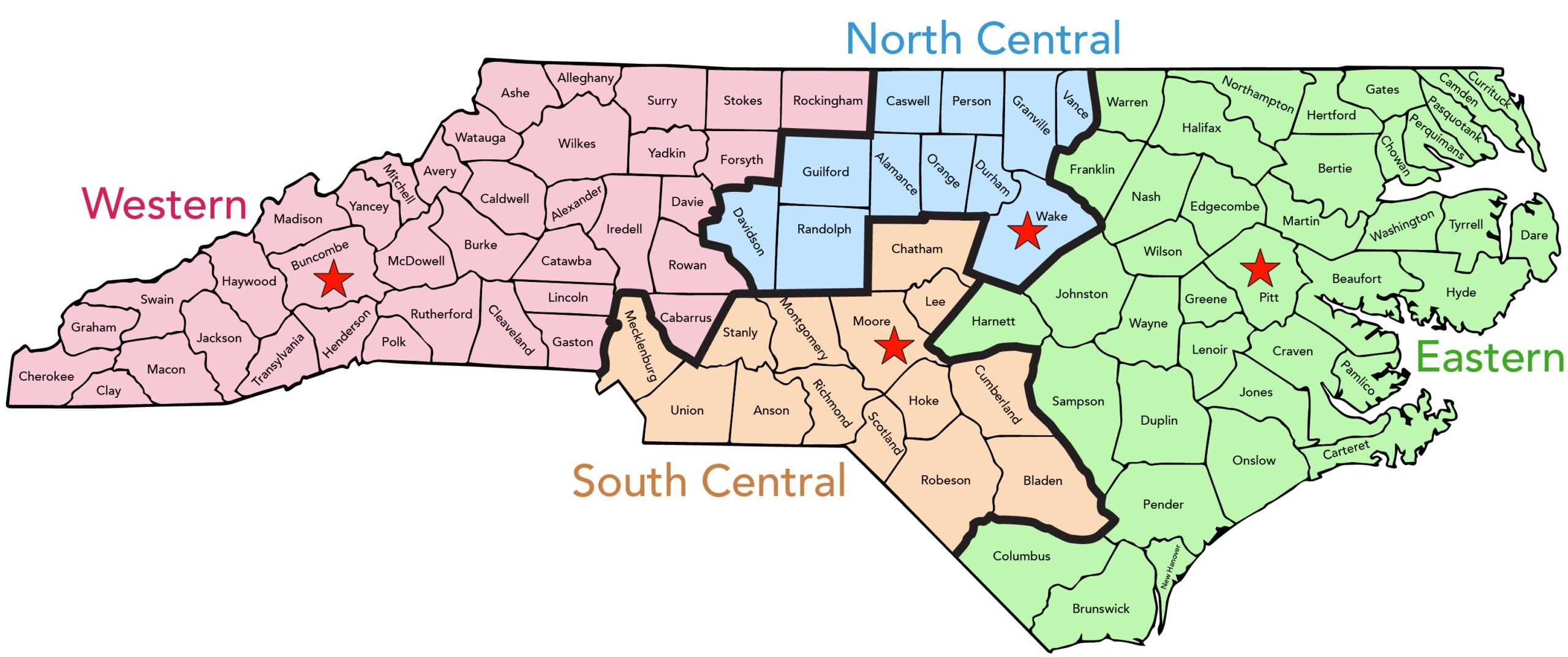
The meetings brought together licensing consultants, investigations consultants, environmental assessors, and DCDEE leadership. The aim was to increase awareness of the health and wellness benefits of nature-based outdoor play and learning environments in NC early childhood facilities and to share progress on the ground. Each meeting featured an inspiring natural learning environment with a guided tour to strengthen the case for nature engagement.
At each meeting, participants were welcomed by the NLI and DCDEE teams and the site host, before presentations and discussion.
Nilda Cosco, PhD, NLI Director of Programs and NLI Cofounder, reminded participants of the first statewide project to create a supportive network in 2011, now relaunched as “Supporting Naturalized Outdoor Play and Learning Environments in North Carolina Child Care Facilities.” Nilda introduced NLI as a research professional development design assistance and communications unit at the College of Design, NCSU, celebrating 25 years of progress in 2025. She discussed the concept of “One Health,” underscoring the benefits of outdoor time and the impact of interaction with nature on healthy child development – the primary aim of the new project.
Robin Moore, NLI Cofounder, emphasized biophilic design and environmental diversity for increasing target health impacts: time outdoors, physical activity, gardening, and healthy eating, and social-emotional learning, and introduced NLI best practices and evaluation tools. He discussed the need to engage the green industry, landscape design professionals, and other potential partners in system change to scale up progress and support high-quality naturalized environments for young children.
Julieta Sherk, Department of Horticultural Science, NCSU, demonstrated how her landscape design students engage with childcare centers to install cost-effective improvements to their outdoor play and learning environments. As a proof of concept, the Desing/Build Studio completed installations in two local centers.
Linda Hestenes, PhD (Department of Human Development and Family Studies, UNC-G) discussed different types of nature-based early childhood programs, presented highlights from a recent national survey, and shared findings from interviews conducted with established providers across the state.
A post-lunch natural learning environment tour offered inspiration and mental and physical refreshment before a debrief and review of NLI’s best practice measurement tools, including POEMS (Preschool Outdoor Environment Measurement Scale) and COLEQT (Childcare Outdoor Learning Quality Tool). Each meeting concluded with an open discussion among participants who shared valuable stories and insights from day-to-day experiences in the field.
By the end of the regional meetings, there was no doubt that early childhood professionals in the State of North Carolina understand the need for children to be in contact with nature and are enthusiastically making progress to support high-quality outdoor environments within the parameters of current regulations.
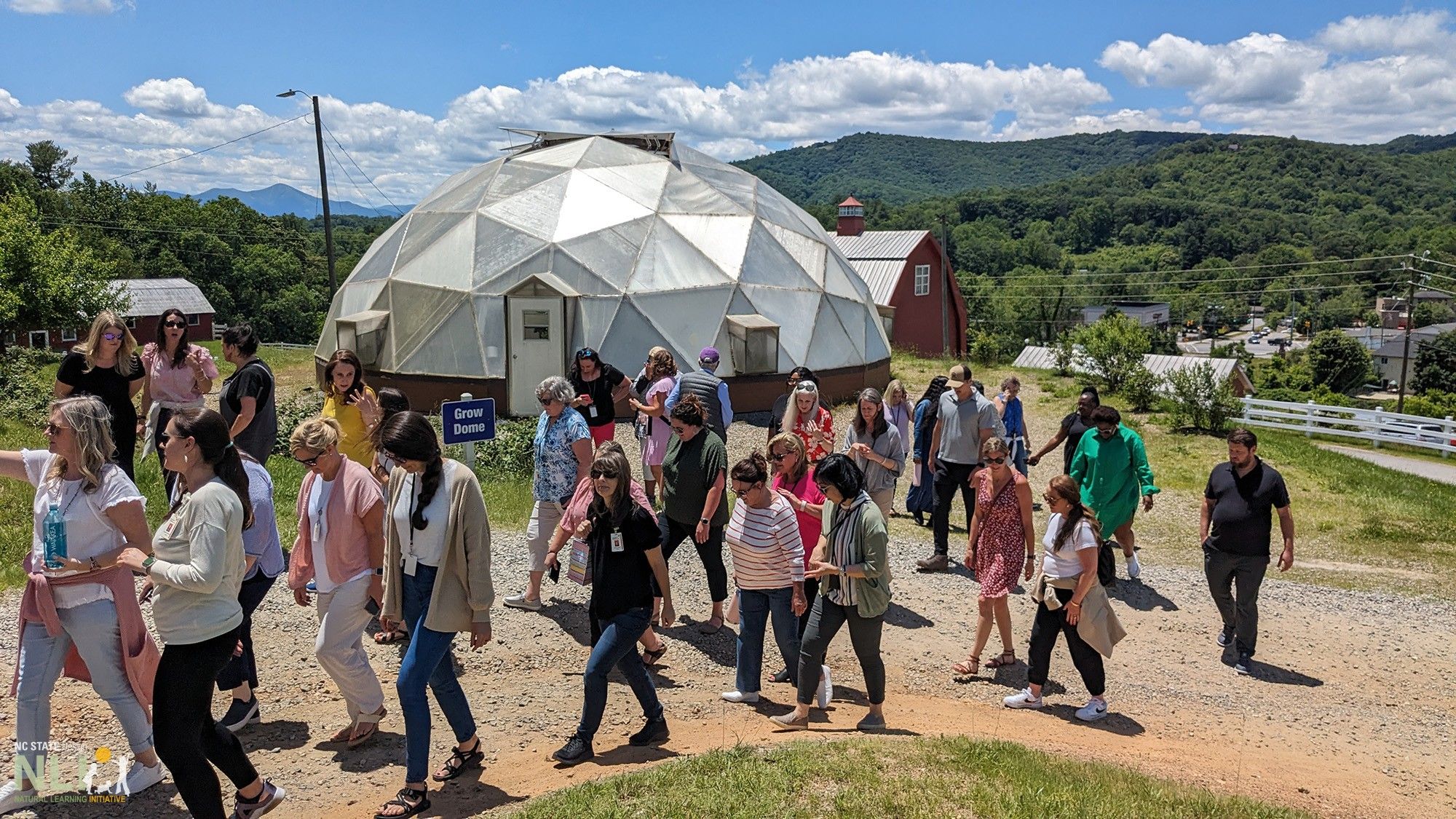
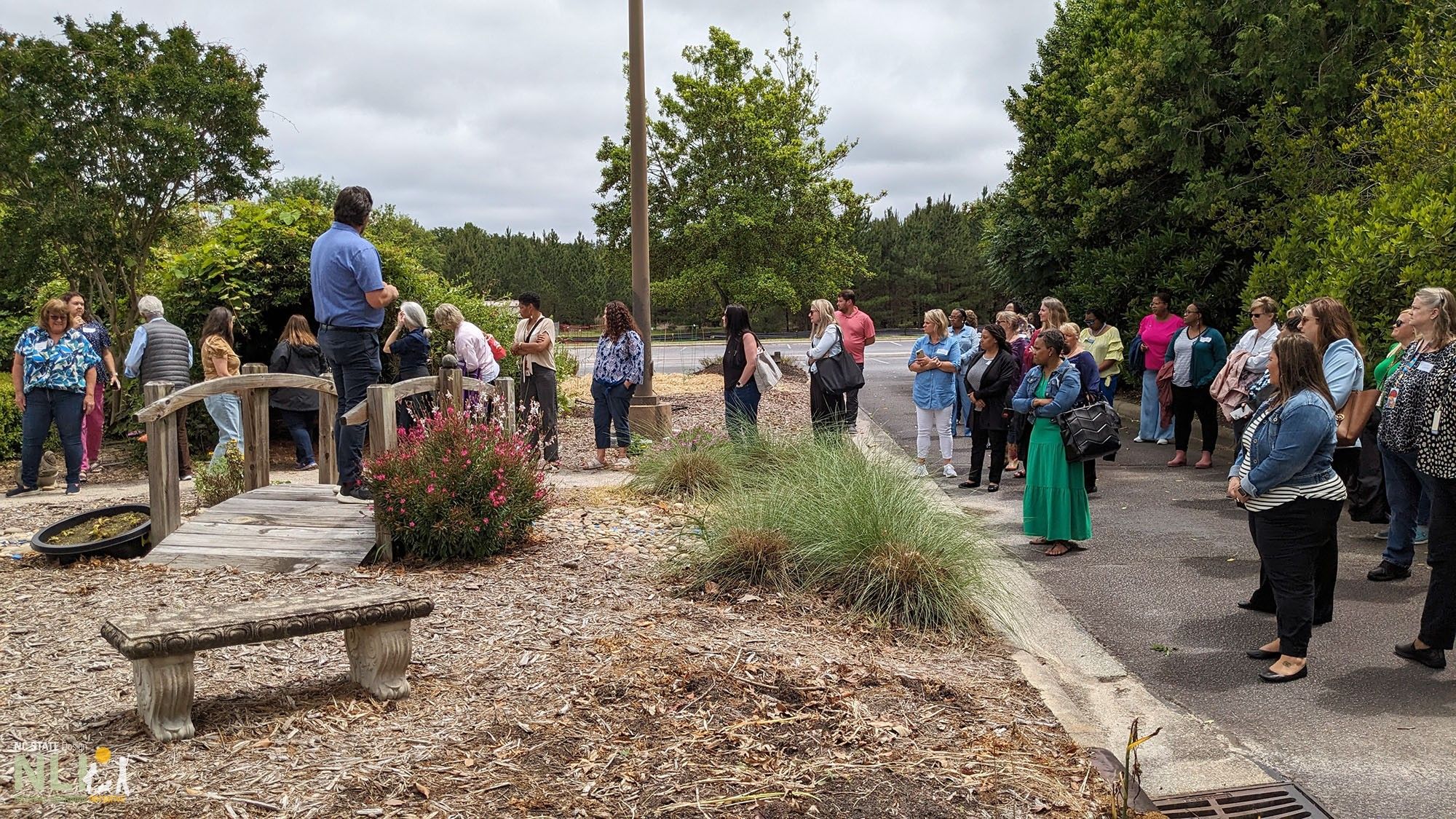
Each regional meeting featured a guided tour of an innovative outdoor learning environment located at the venue, exemplified here at Eliada House, where the Western Regional Meeting was held.
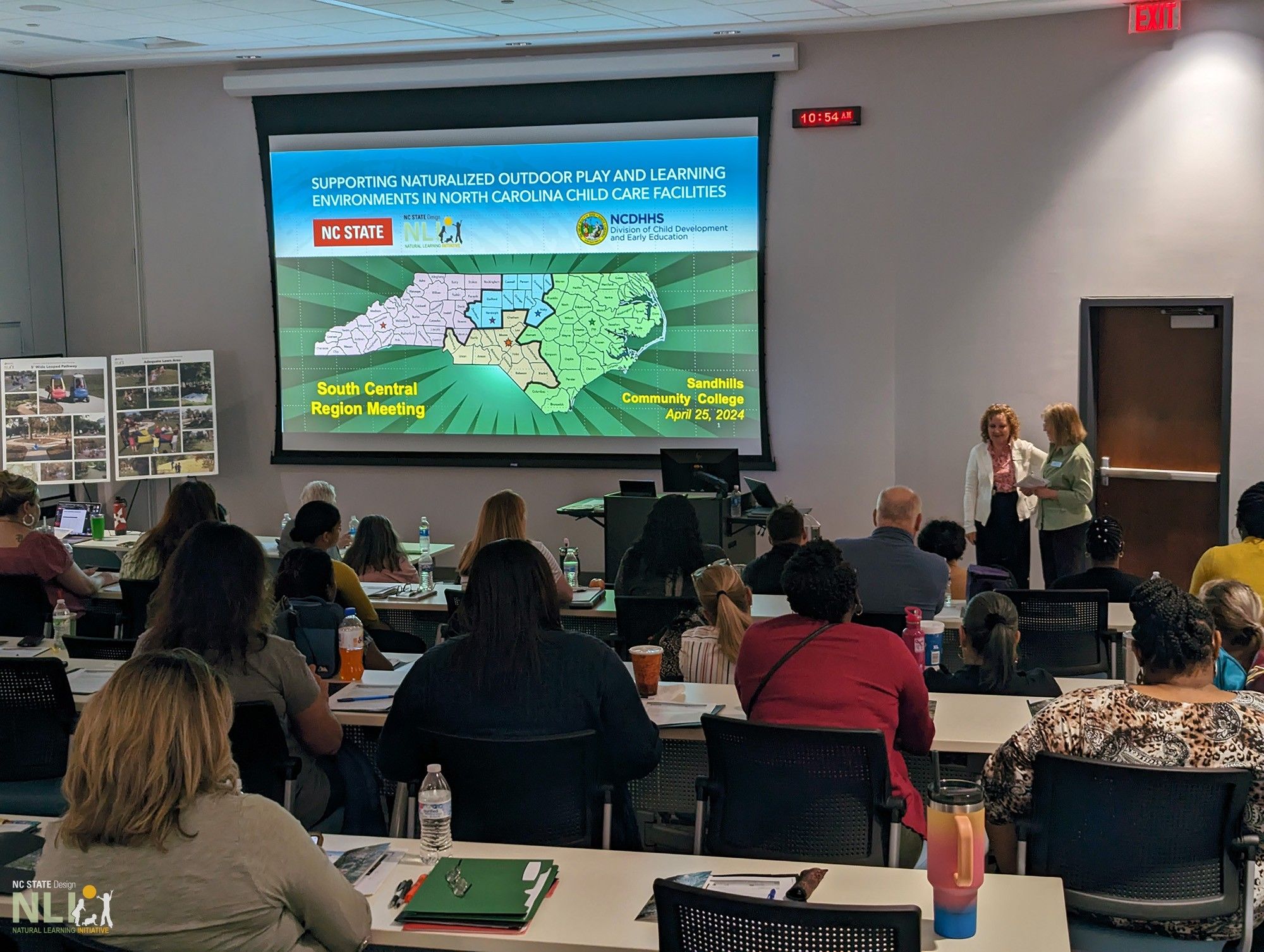
South Central – Sandhills Community College, Pinehurst, NC
Nilda Cosco, NLI, and Julieta Sherk, Professor of Horticultural Science, welcome participants to the DCDEE South Central Regional meeting.
Ronda Hawkins, Professor of Early Childhood Education, Sandhills Community College, showcases the outdoor classroom for teachers, including the storage for toys and interactive activities, and explains the easy access from the primary looping pathway.
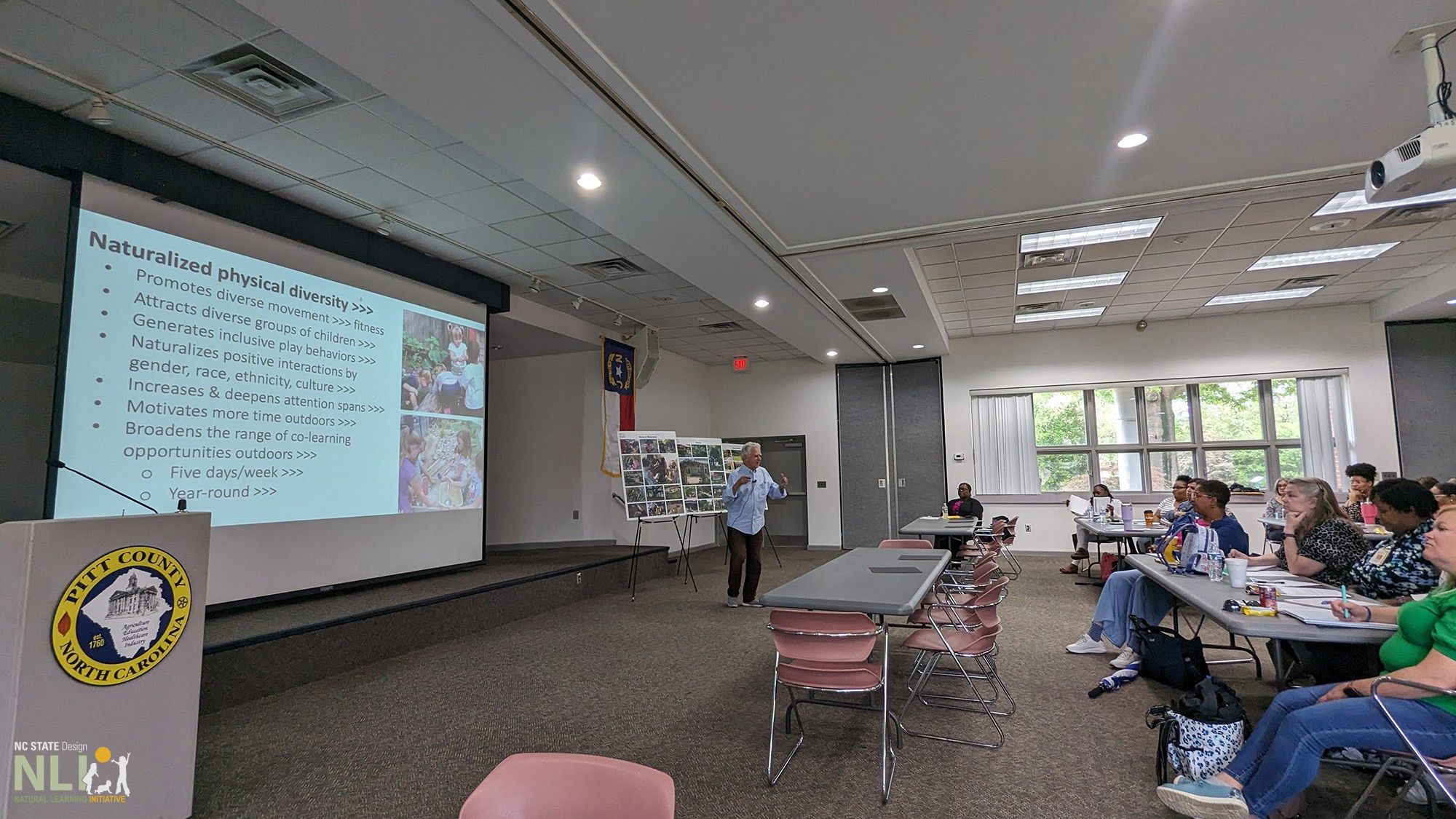
Eastern – Pitt County Arboretum, Greenville, NC
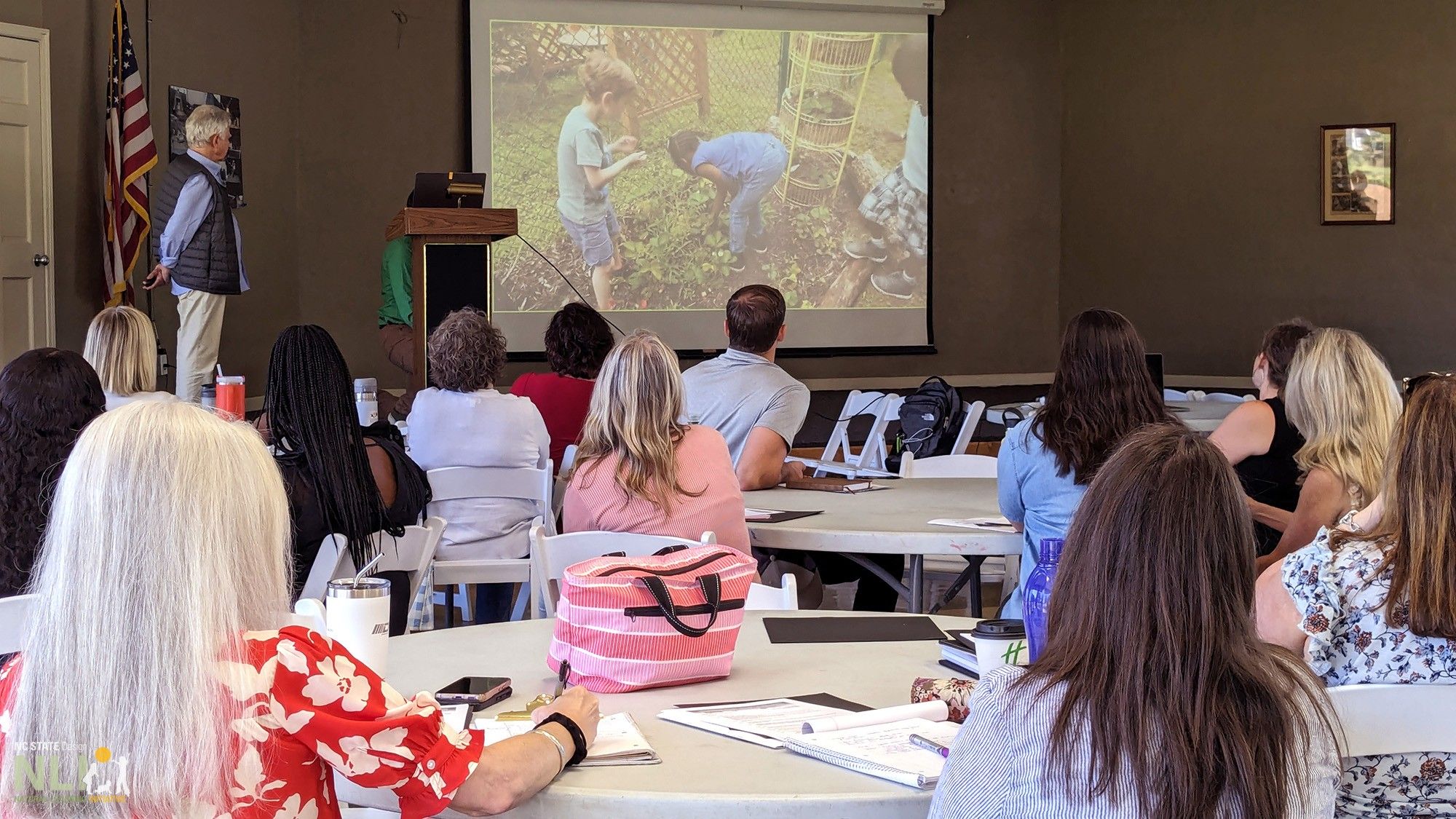
Robin Moore, NLI, delivers a presentation on creating natural childhoods using a biophilic design approach.
Matt Stevens, Pitt County Extension Director, gives an interpretive tour of the Children’s Garden at the Pitt Co Arboretum.
North Central – Department of Horticulture Science, NC State University, Raleigh, NC
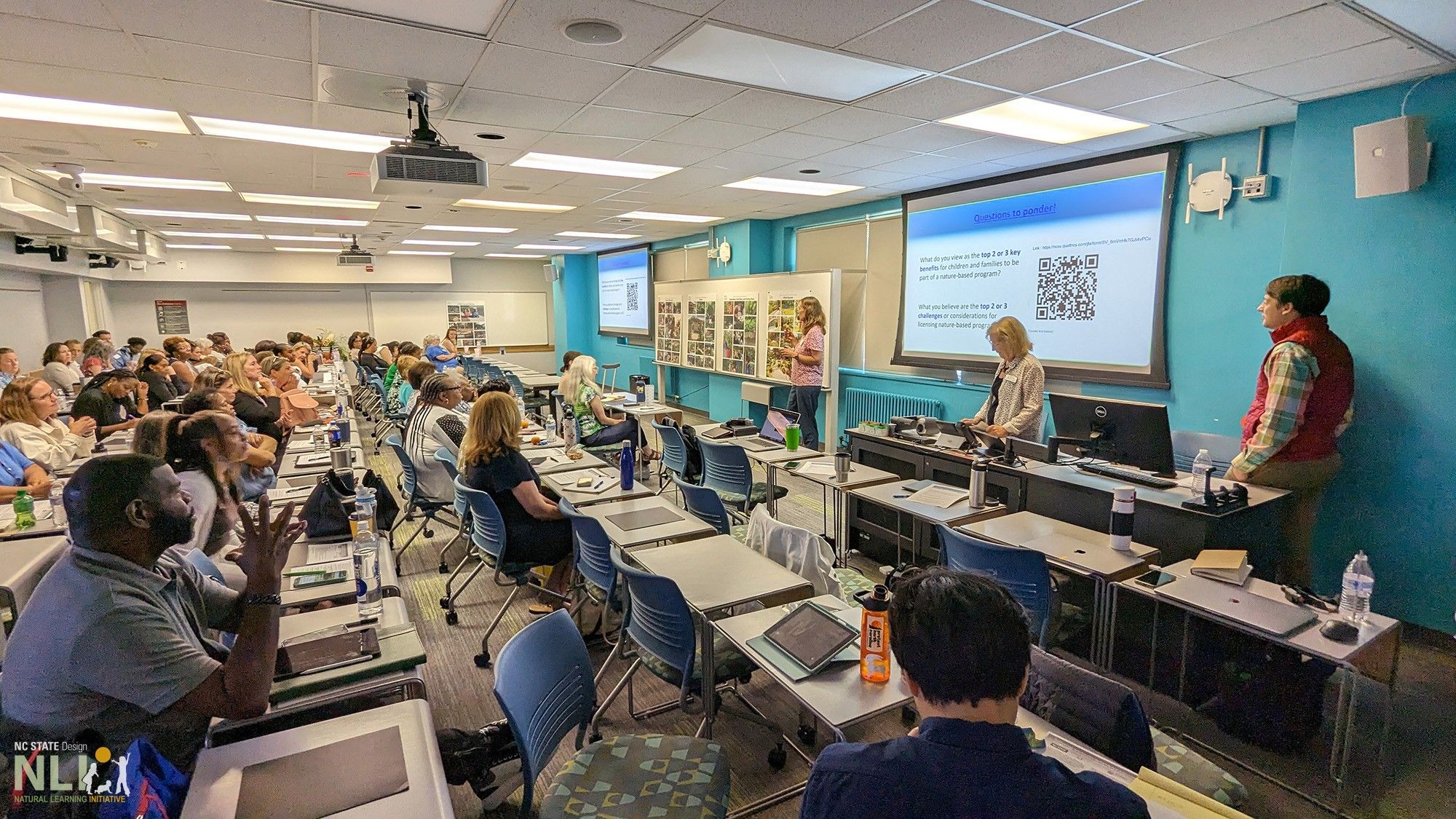
Linda Hestenes, Professor of Human Development and Family Studies, discusses the Nature Preschool Visioning Process, outlining its key benefits and challenges.
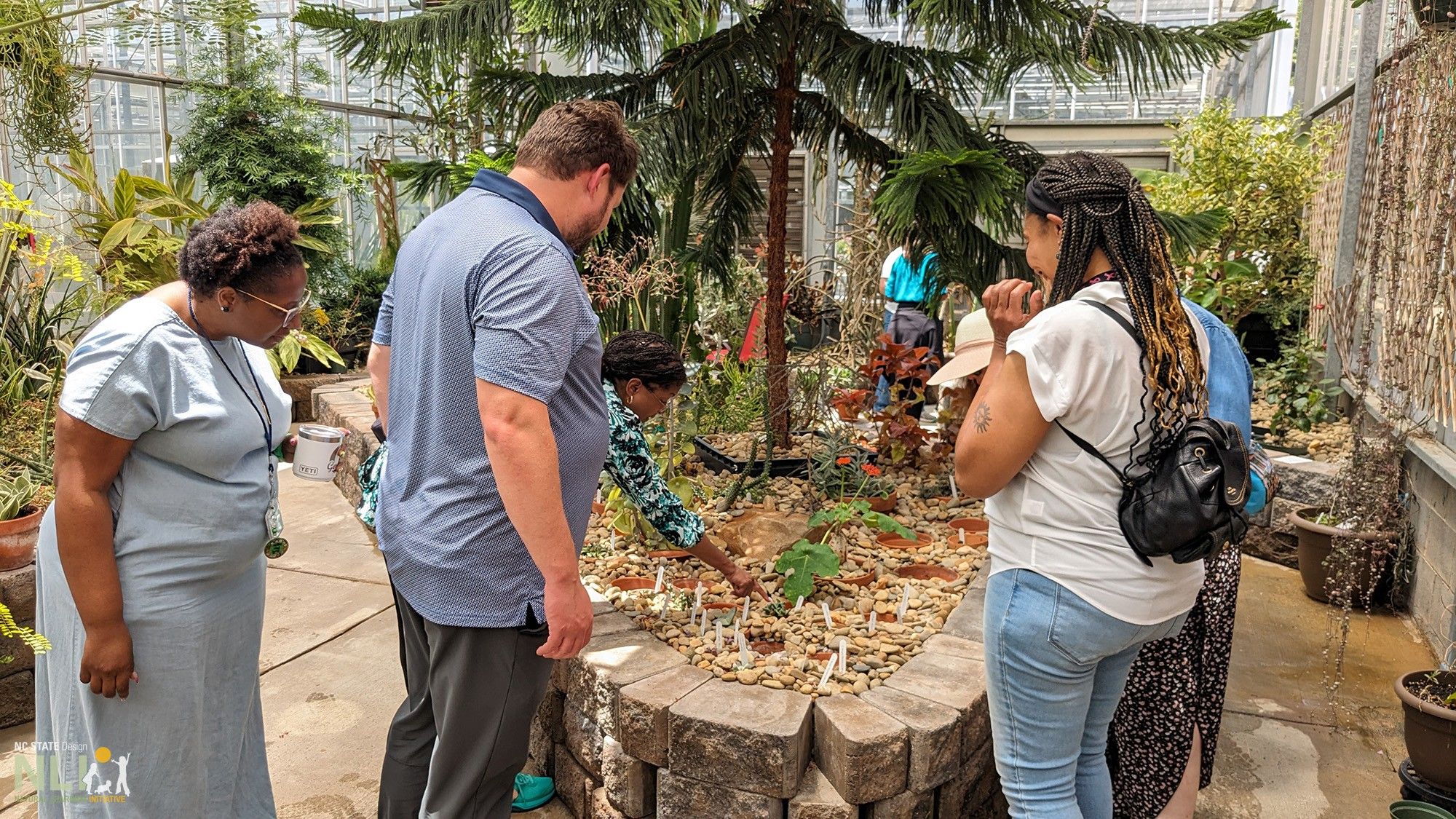
DCDEE staff explore the Arid and Tropical Conservatories, Department of Horticulture Science with the helpful guidance of Diane Mays, Conservatory Curator.
Western – Eliada Homes, Asheville, NC
NLI presents an engaging OLE video titled “We Change the Culture Here,” showcasing the impact of an OLE at one of the Wake County demonstration sites located in Raleigh, NC.
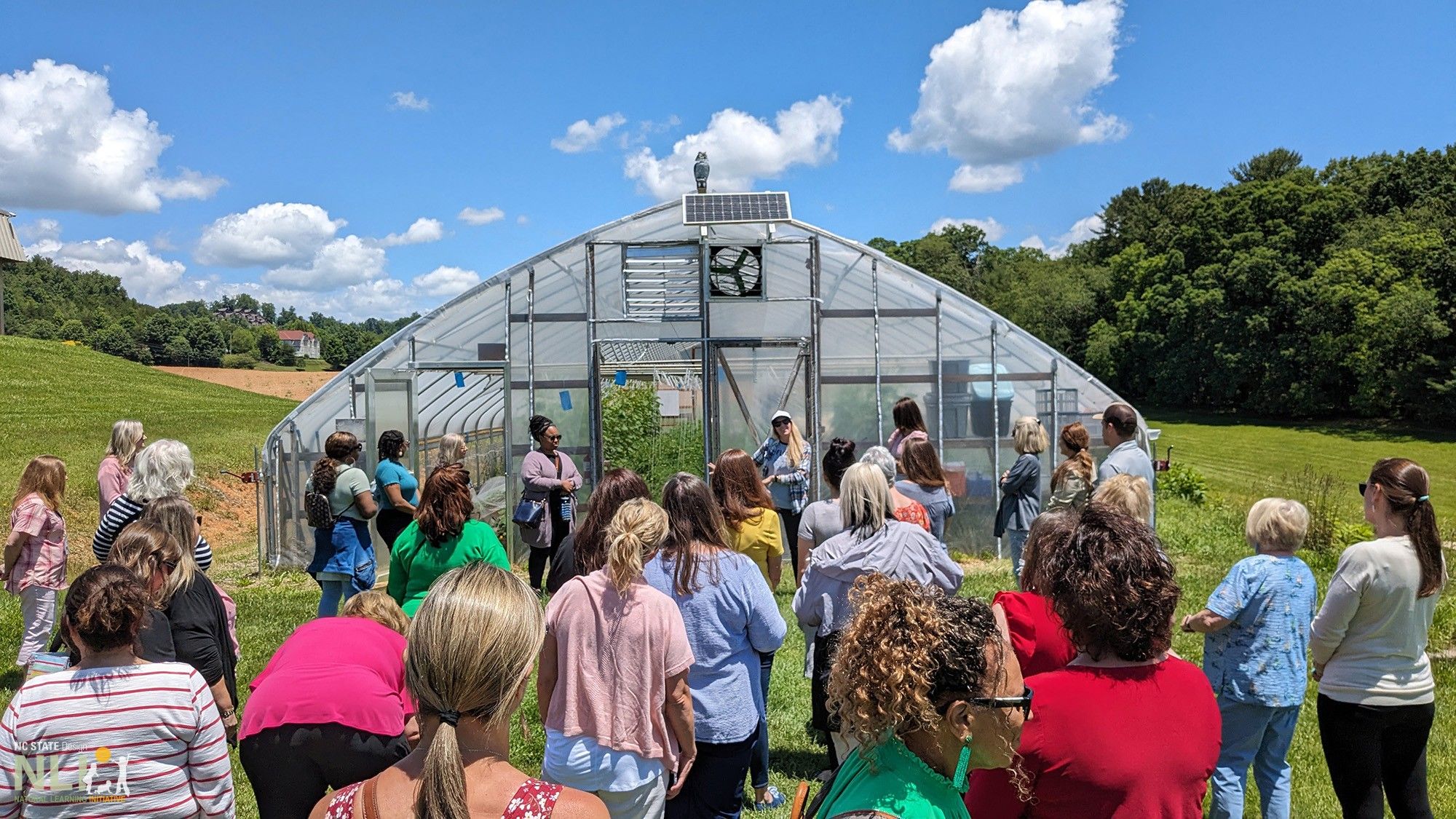
Erica Blumenfeld, Eliada Farm Director and NC State graduate, guides participants through the campus production farms and greenhouses.
Cari Browning from Department of State Health Services (DSHS) talks About OLE! Texas
On April 6th Cari Browning sat down with Sarah Coles, Texas Children in Nature Network Executive Director, to talk about the OLE! Texas initiative and how it is creating nature-rich outdoor spaces for Early Childhood Centers across the state.
Introduce yourself and tell us about what you do:
My name is Cari Browning, I am a Recreation Therapist with a master’s degree in International Health Promotion. I work as the Physical Activity Coordinator for the Department of State Health Services, Obesity Prevention Program in the Health Promotion and Chronic Disease Section. Our mission is to serve all Texans by improving and supporting systems, policies, and environments that promote health and improve quality of life.
My experience practicing as a Recreation Therapist provided me with the opportunity to work with people of all abilities; this experience illuminated how physical environments (policies and practices within) can either include or exclude people. I learned that our environment (albeit chosen or not) is the antecedent to consider.
My personal interest in nature is rooted in my work with municipal parks & recreation programs. Connecting with natural environments is what I aspire personally & professionally for (thank you childhood Dogwood tree and world travel). My passions are to connect and inspire people & stimulate human connections with nature and the world. These passions carry into my professional work to create environments that support movability.
Tell us a bit about OLE! Texas.
Outdoor Learning Environments (OLE!) Texas is a statewide initiative that promotes healthful, nature-based outdoor spaces at early childcare and education (ECE) programs. A healthful outdoor environment helps preschool children be more physically active while they play, discover, and connect with nature. It supports the Children in Nature movement and is a collective impact initiative for early childhood education programs.
We know through research, implementation & observation that outdoor spaces influence child behavior & health; interest in food, critters & nature. There are so many benefits! The most amazing part of OLE Texas is that while the work is aimed to improve environments for our youngest Texans, it also is influences adults (parents & teachers) as well as community understanding of the importance of creating & connecting natural environments.
It started with hard work, connections, and interested people connecting to make it happen.
In 2012 DSHS was awarded funding by the Centers for Disease Control to support work to address the rising statistics of Texas children 0-5 being overweight or obese. This funding provided the first opportunity for the Obesity Prevention Program at DSHS to focus attention on improving policies, systems, and environments related to nutrition and physical activities for children in ECE’s. Promoting physical activity in ECEs is a critical step in reducing obesity. It also encourages healthy behaviors that support children during early development and later in life.
With more than 1.1 million little Texans spending most of their time at the state’s nearly 17,000 ECEs and having over 30% of Texas children between the ages of 2 and 4 already overweight or obese, directing obesity prevention efforts to improve nutrition and physical activity environments for our youngest Texans became a health promotion priority.
The goal is for ALL childcare operations in Texas to have quality outdoor spaces! That is a lofty goal… So to start, we are working to identify, connect & create early education, landscape design, horticulture & health resources and systems (on both state and local levels) to support ECE programs to have quality outdoor spaces according to best practices and Texas policy.
How does this program work in the nature and equity space in Texas?
The initiative promotes the naturalization of outdoor spaces in early childcare and education facilities for all of Texas. It is inclusive of state and local departments & organizations that provide (or want to provide) service to early childcare professionals. The aim is to create a better space for our youngest Texans.
OLE! Texas supports equity in that all children and communities across Texas can aspire to improve resources & access in nature opportunities for learning in Texas ECE’s. We have local chapters that are working with local needs and resources. By design what we are doing is inclusive of all abilities at the ECE level and encouraging local access (and expansion) to nature opportunities at the local level.
How is collaboration important for the overall success of the initiative?
Collaboration is the initiative! Without collaborative efforts OLE! Texas would not exist. This effort takes coordination between early education, higher education, design and landscape professionals, influencers, and systems. This is no small feat. However, the interest and momentum for the health of our youngest Texans and communities are impressive!
How did you get involved in the Texas Children in Nature Network?
I became involved when I was working with the City of Austin Parks and Recreation Department. I wanted to be involved because I believe that our environments are interconnected with human health.
What makes you passionate about helping children and families spend time in nature?
It feels like it is part of my being!
When I would teach leisure education and help people find interests; most of what I would see is that people tend to enjoy being outdoors and learning something about themselves in that space. Add that the moment you see an infant, toddler, child, and/or adult in nature, there is something there. It is instinct; we are connected to nature. It is part of our coding. I think COVID has brought this to the forefront of our minds.
I soulfully believe that humans have a right to be in nature and healthful environments. I am passionate and fortunate to facilitate an initiative that supports the early education system to make that a reality.
Where would you like to see Texas Children in Nature Network in five years?
I am glad to see it has become its own entity! I would like to see Texas Children in Nature Network able to provide funding as a foundation for this important work.
Thank you Cari for your time today.
To learn more about the OLE! Texas initiative, check out these links:
Bambino’s Playschool, a current POD site, is committed to making a shift in the way children and their families view healthy eating. The owner/director, Adria Boyd, takes great pride in only serving children fresh produce. The school’s chef, affectionately known as Mama Jenkins, makes eating healthy meals fun and inviting for children. Her passion for healthy eating is inspiring. Bambino’s is licensed for 164 children birth-K.
Activity settings add value to outdoor learning environments (OLEs) by supporting specific play and learning activities. An outdoor stage, for example, enables a range of imaginative and dramatic play. The addition of trees, shrubs, flowers, and grasses to OLEs further increases play and learning value by connecting children with the wonders of the natural world. This InfoSheet introduces different types of activity settings and key design considerations for successful implementation.
1. INDOOR-OUTDOOR TRANSITIONS
When classrooms open to the outdoors, children and teachers feel intimately connected to the outdoor play and learning environment. Transitional spaces link classrooms with larger, shared play and learning areas and allow indoor-outdoor programming to be managed more easily. Key considerations include:
Type.
Transitional spaces can take the form of decks, pergolas, and patios. Depending on available space, planting beds, raised planters, or portable containers can be installed.
Enclosure.
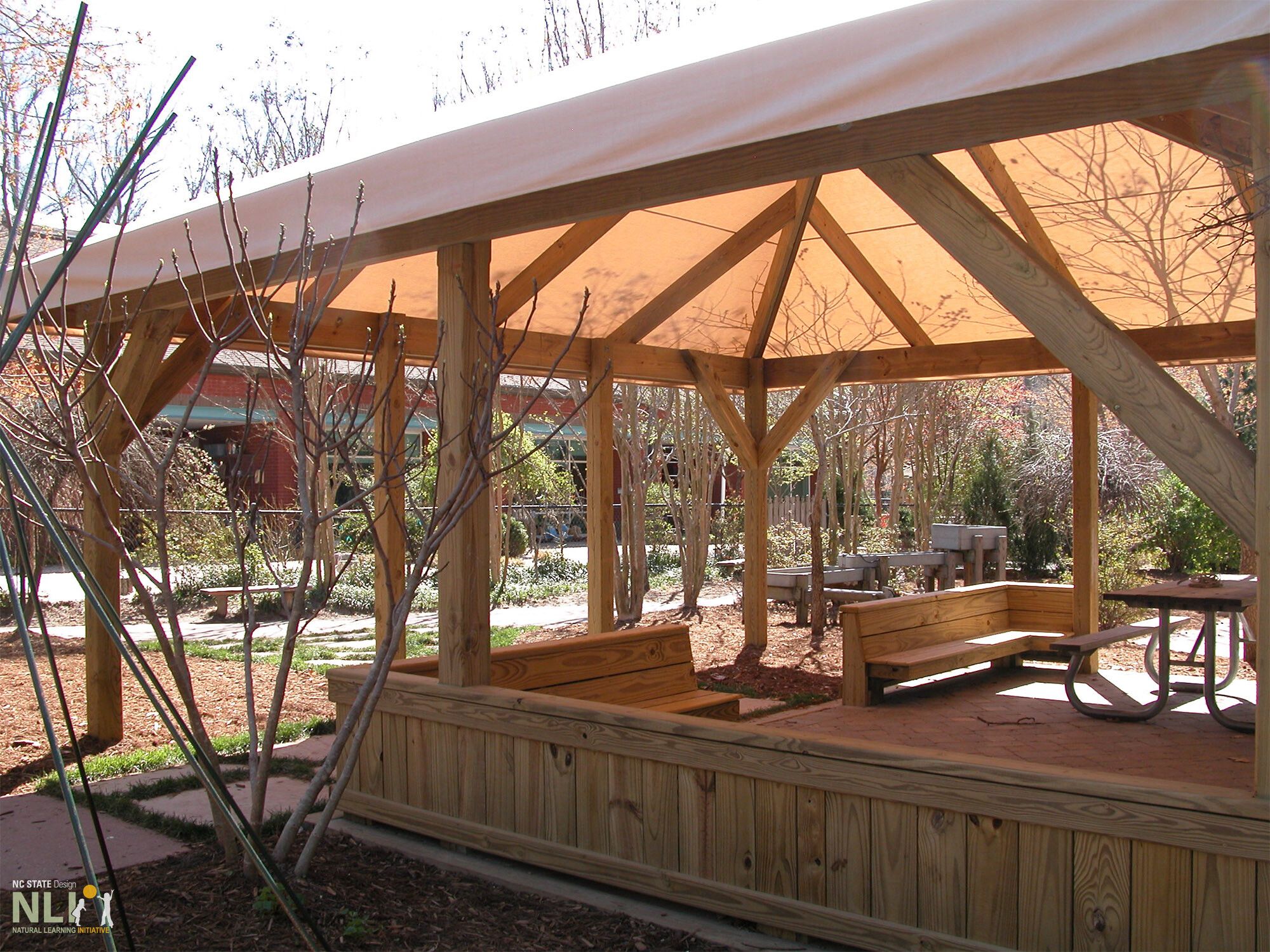
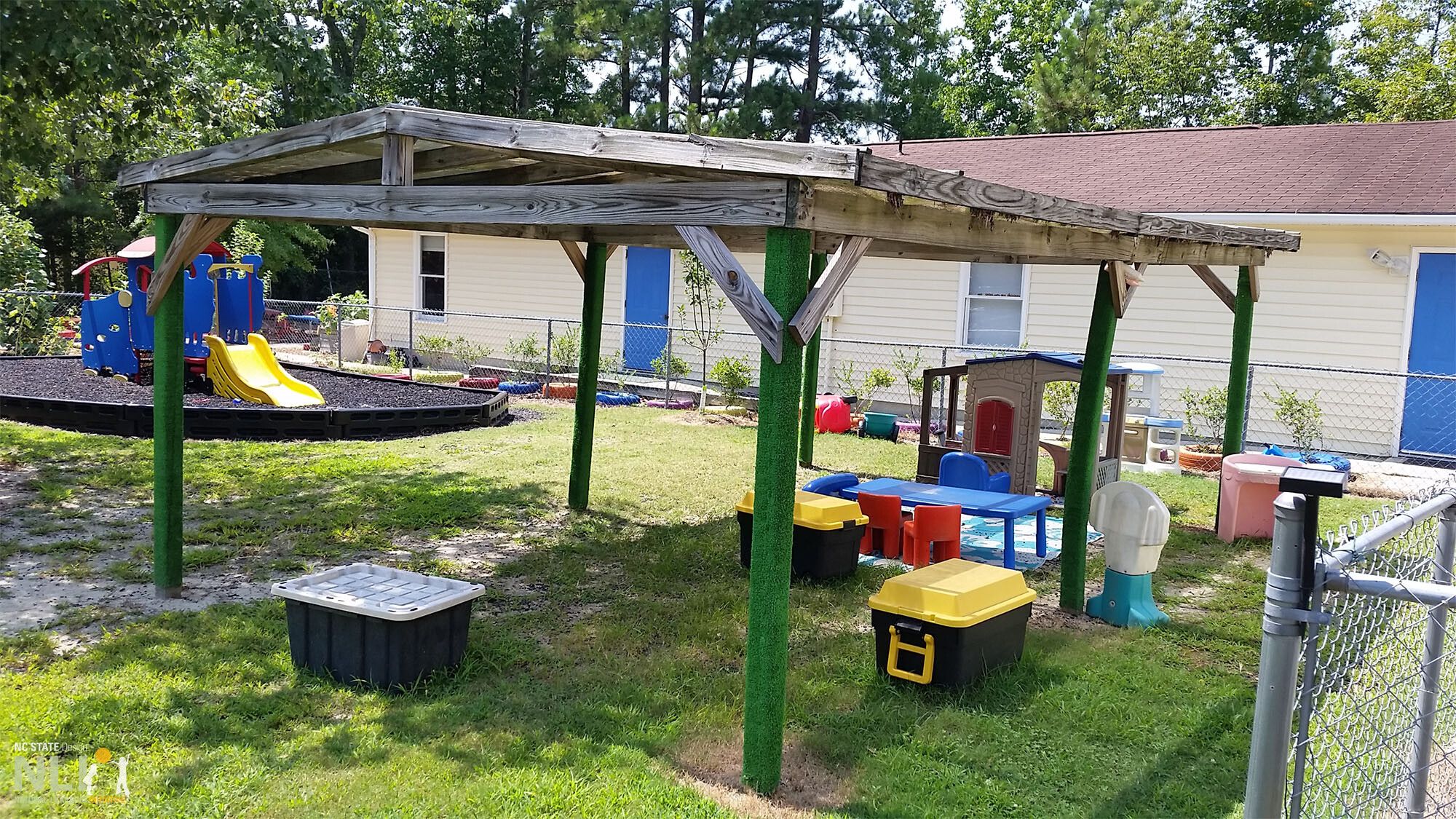
Visible boundaries are crucial for communicating that transitional spaces are “private” classroom extensions. Coverings should be unobtrusive and relatively open to allow sunlight to penetrate (Figure 1).
Shade.
Vine-covered pergolas can provide a comfortable, semi-sheltered space of flowering vines and edible fruits. Deciduous shade trees can also improve comfort in summer and winter.
2. PATHWAYS
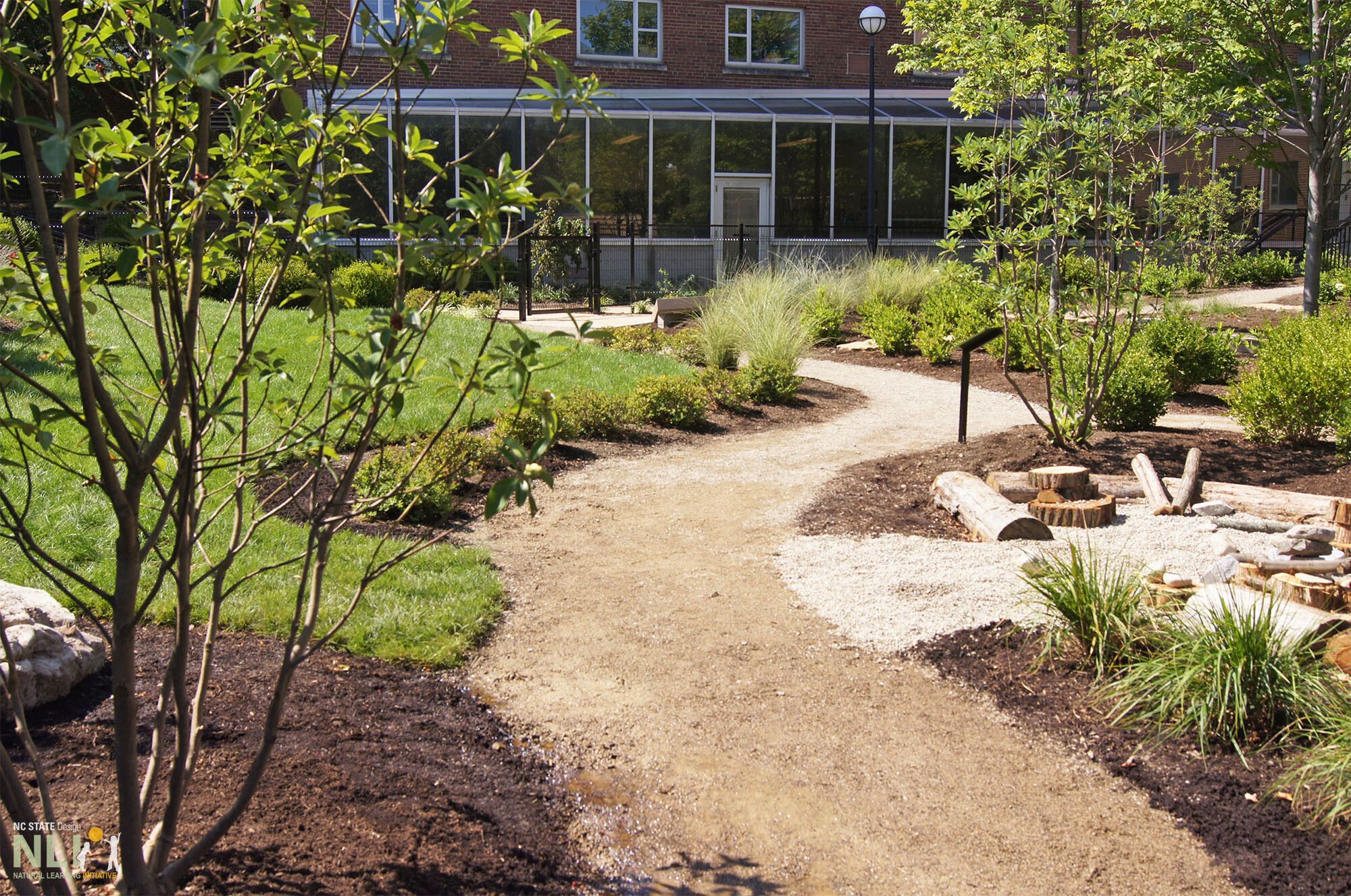
A structured hierarchy of pathways provides spatial structure and access to activity settings within OLEs (Figure. 2). Primary pathways directly connect indoor and outdoor spaces and provide easy movement for teachers and children. Secondary pathways create shortcuts and exploratory routes between primary pathway segments. Tertiary pathways lead to intimate landscape settings, branching off other pathways with unique textures (Figure 3). All pathway types promote physical activity by facilitating walking, running, chase games, and wheeled toy use (Figure 4). Key considerations include:
Surfacing.
Hard surfaces such as concrete, asphalt, or decomposed/crushed stone work best for primary pathways. Wood chips work well for secondary and tertiary pathways.
Edging.
Install low rails, metal hoops, or small stones to protect planting adjacent to primary pathways.
Alignment.
Continuous curves add a sense of exploration and motivate children’s movement.
Width.
Make primary pathways at least 5 feet wide to accommodate wheeled toys passing each other. Avoid sharp corners, bottlenecks, and dead ends.
3. GATHERING SETTINGS
Gathering spaces encourage children to meet and work together in small groups, stimulating social interaction and cooperative relationships. Such spaces can support art-making, storytelling, and science exploration. Key considerations include:
Location.
Gathering settings should be located adjacent to high activity zones and program bases so that tools and materials are close at hand.
Types.
Options range from simple log or stone circles to substantial pergola-type structures. Consider creating differently sized gathering spaces for both intimate and large groups. Vine or fabric-covered tee-pees are an attractive, inexpensive option.
4. DECKS
Available in many shapes and sizes, decks provide dry, above-ground surfaces for all-season play. As gathering places for children, decks support diverse social and imaginative play. Larger decks can accommodate educator-facilitated group activities. Designed as stages, decks support expressive group activities and dramatic play, including storytelling and talent shows. Key considerations include:
Size.
A minimum width of 4 or 5 feet provides useful activity space—up to 15 feet affords greater diversity.
Location.
Against site boundary fences or in fence corners is recommended. Avoid differences of more than 6 inches in level between a deck and the ground.
Shape.
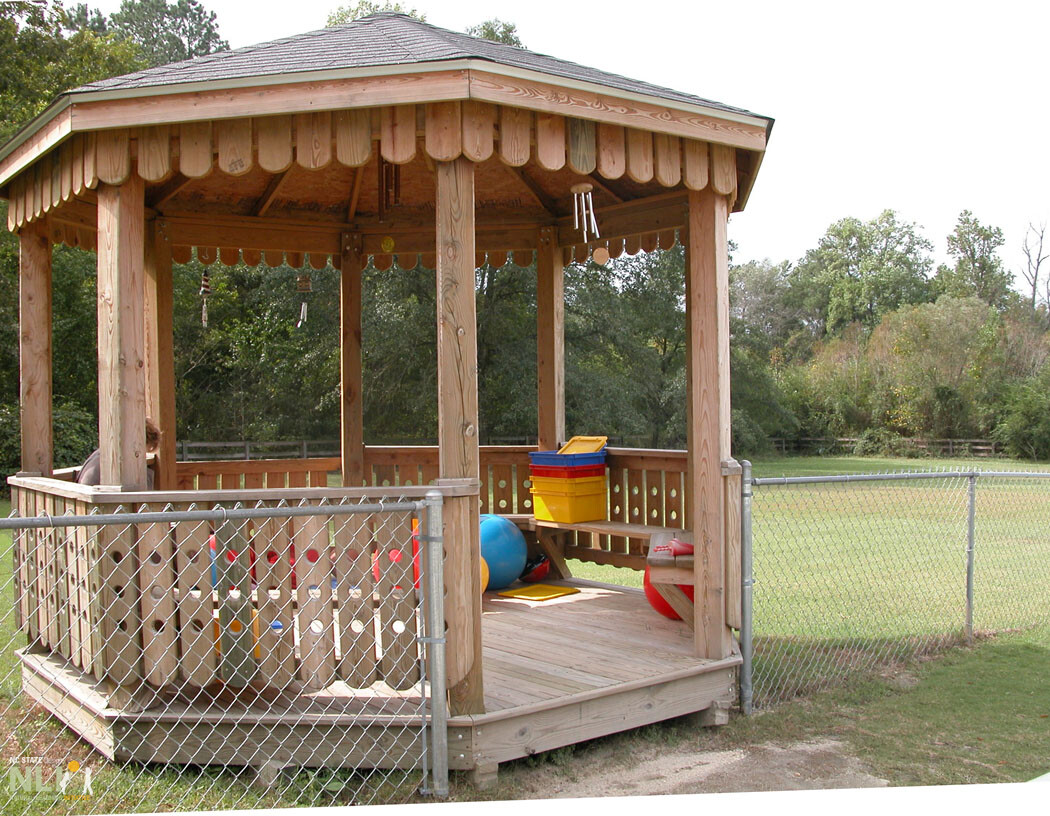
Squares, rectangles, hexagons, and octagons are easy to construct with timber (Figure 6). Specialized polygons can be easily constructed to fit particular location dimensions.
Enclosure.
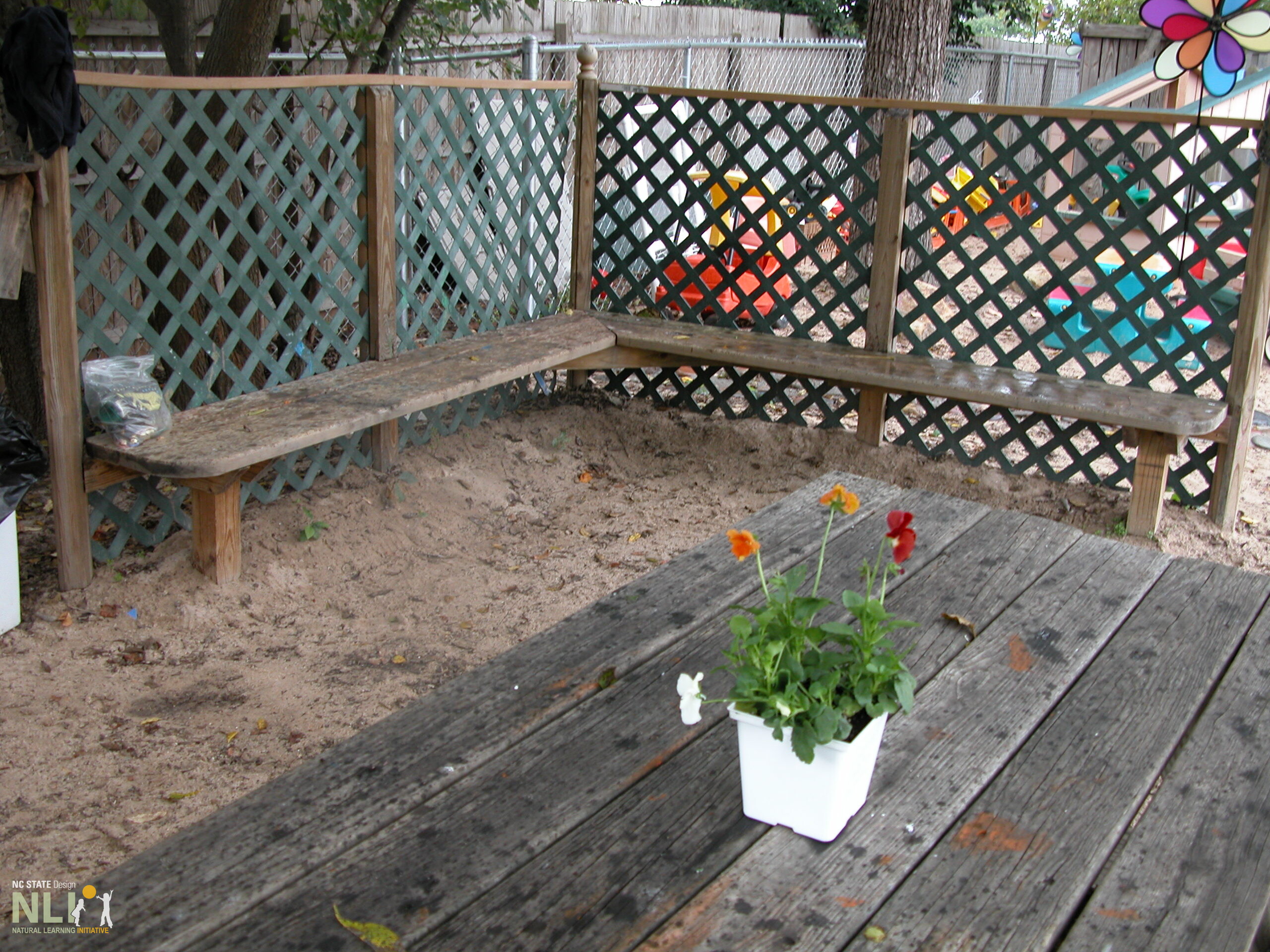
When located against a fence, trellises or lattices around the perimeter of a deck can add a sense of enclosure while maintaining visibility for educators.
Shade.
A vine-covered arbor overhead can transform the deck into a shady, fragrant space.
1. A covered open indoor-outdoor transitional space.
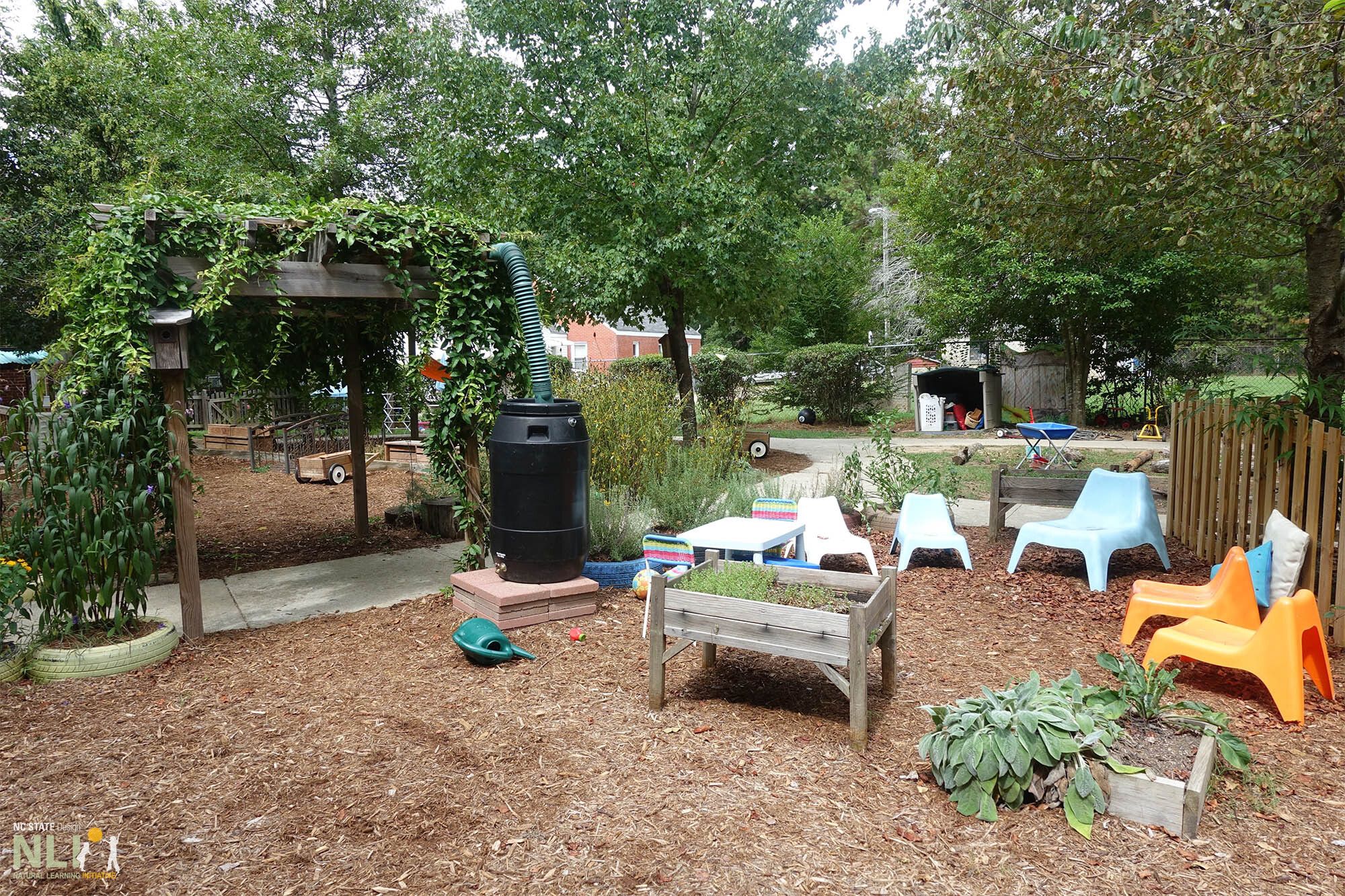
2. A primary pathway with adjacent plantings and settings.
3. Tree cookie path.
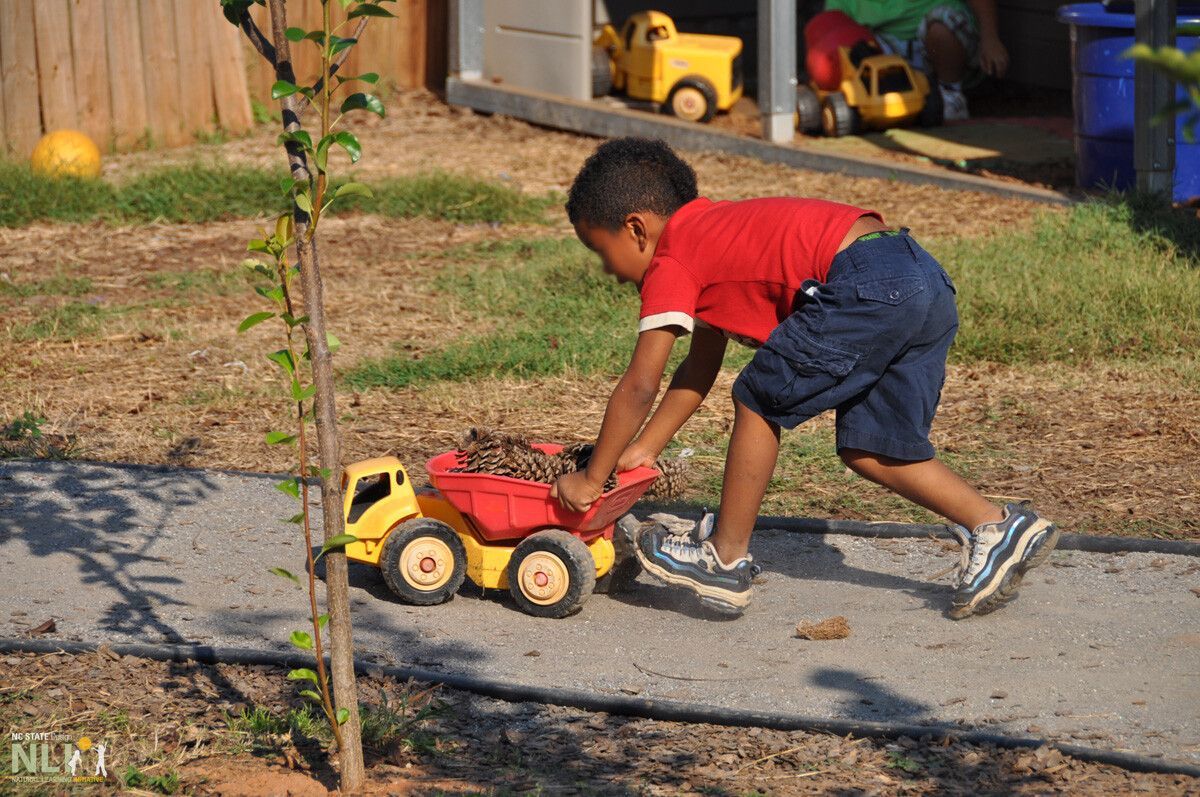
4. Pathways promote physical activity.
5. A gathering space adjacent to active play settings.
6. A versatile play deck.
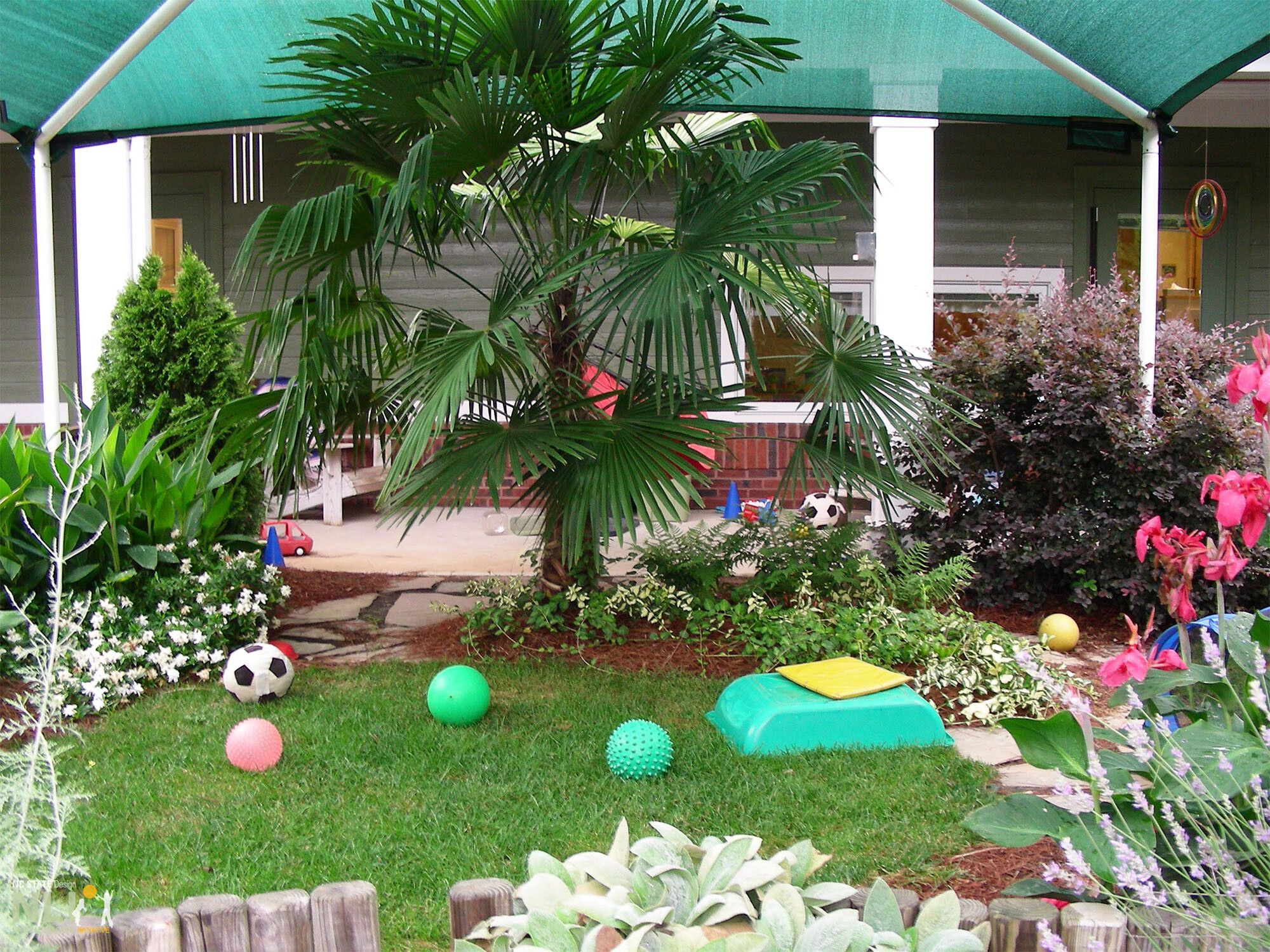
7. An enclosed play lawn, ideal for mobile play equipment.
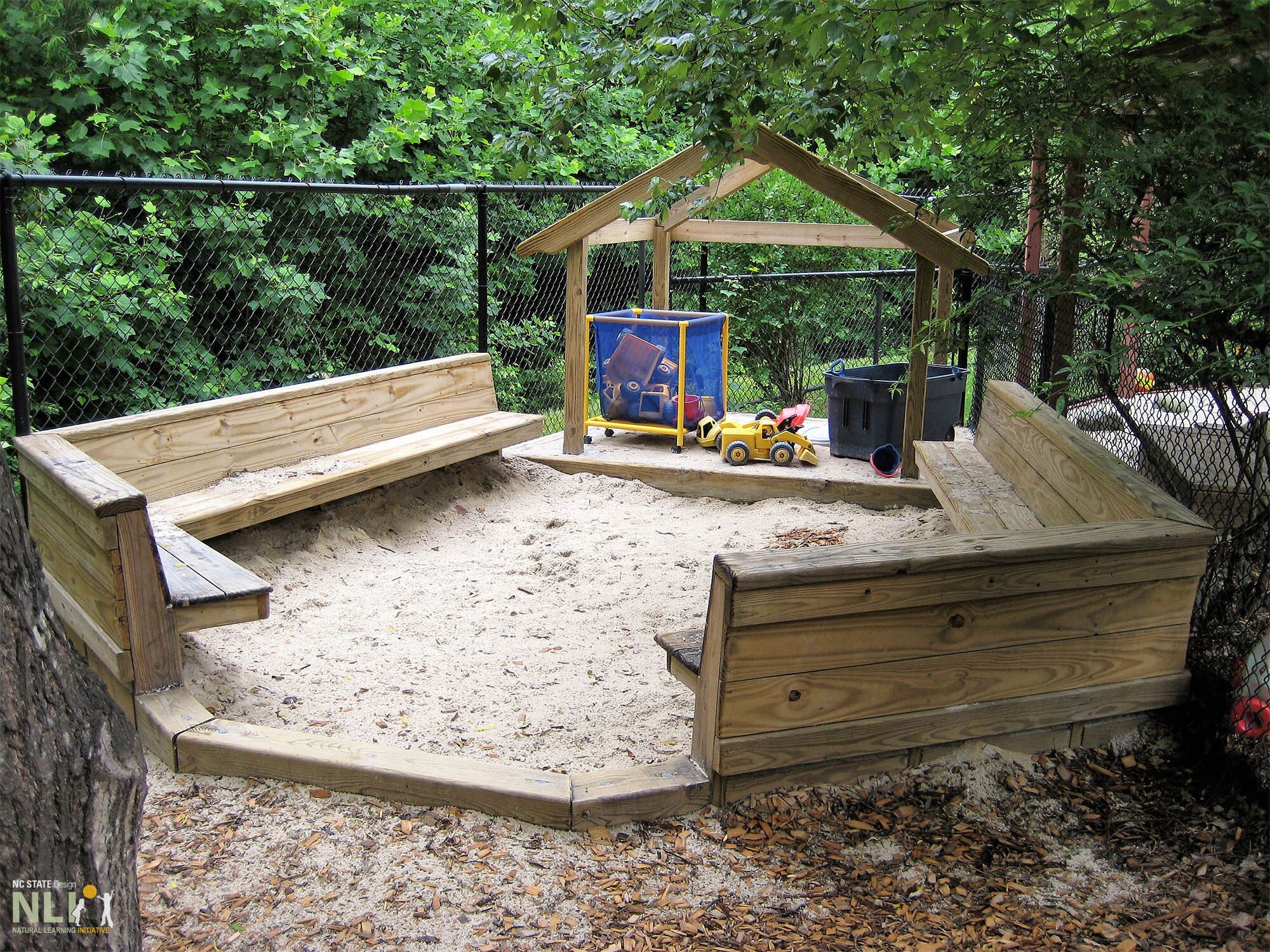
8. An enclosed sand play area with interior benches.
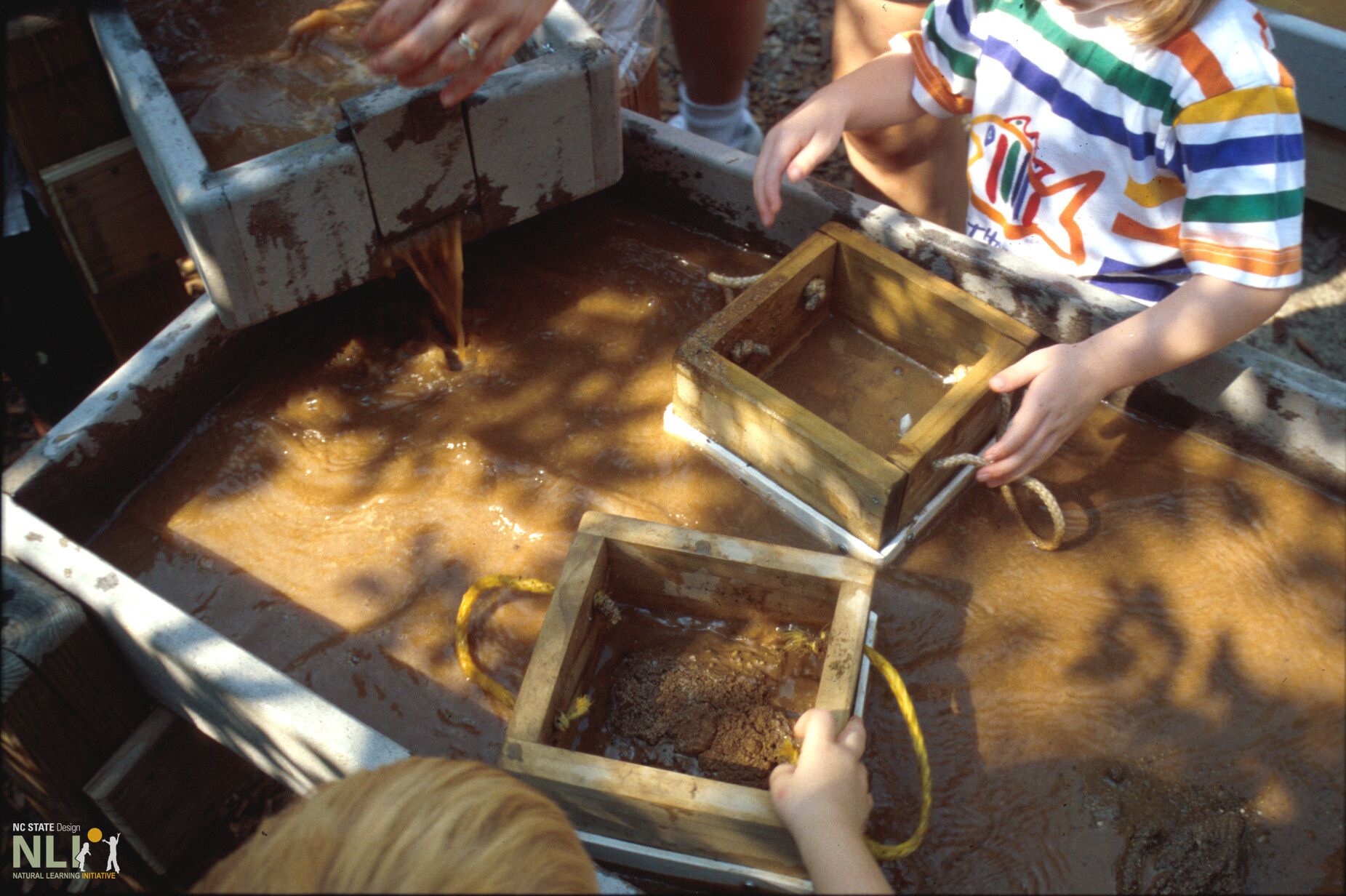
9. Mud making and water play.
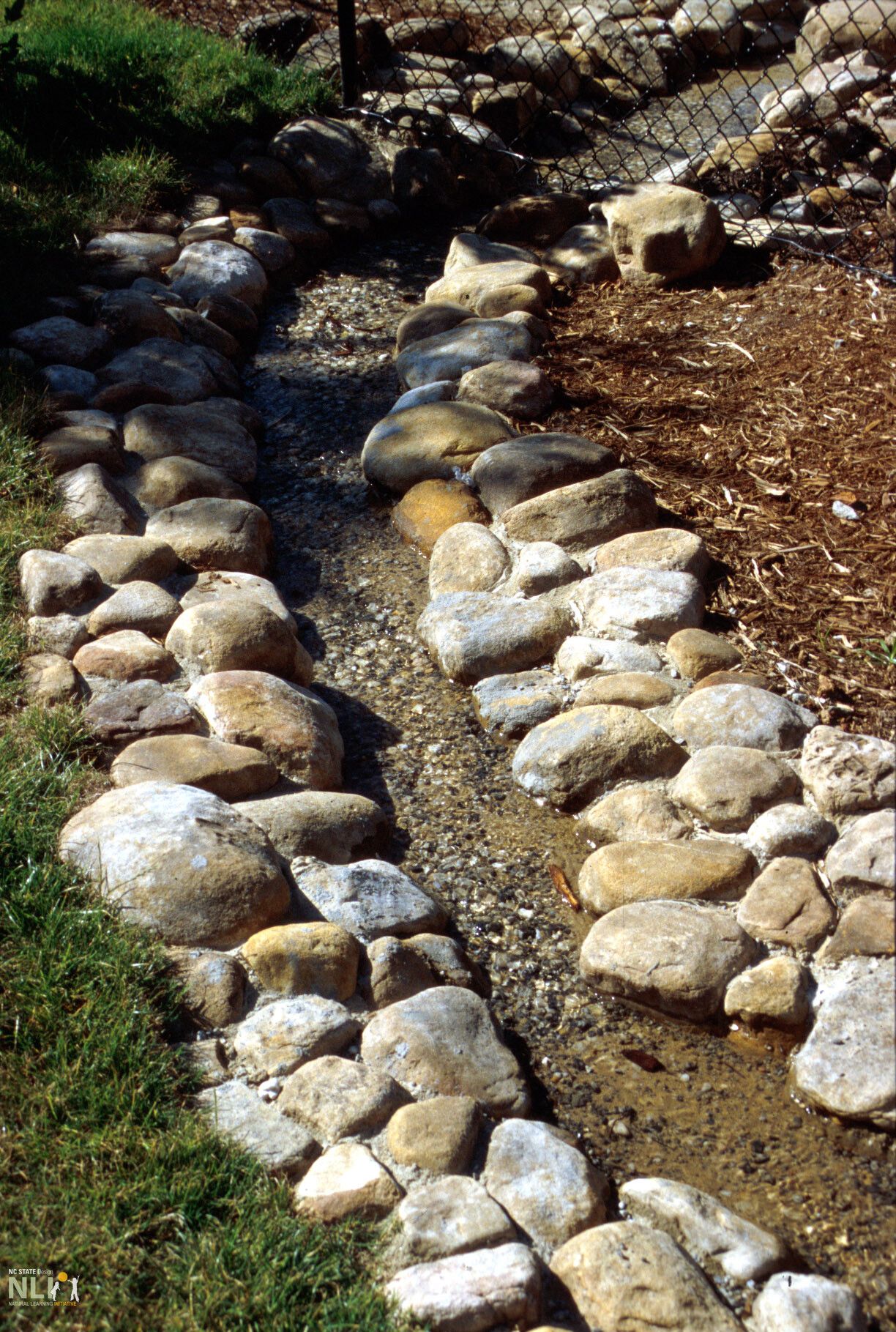
10. Dry stream bed.
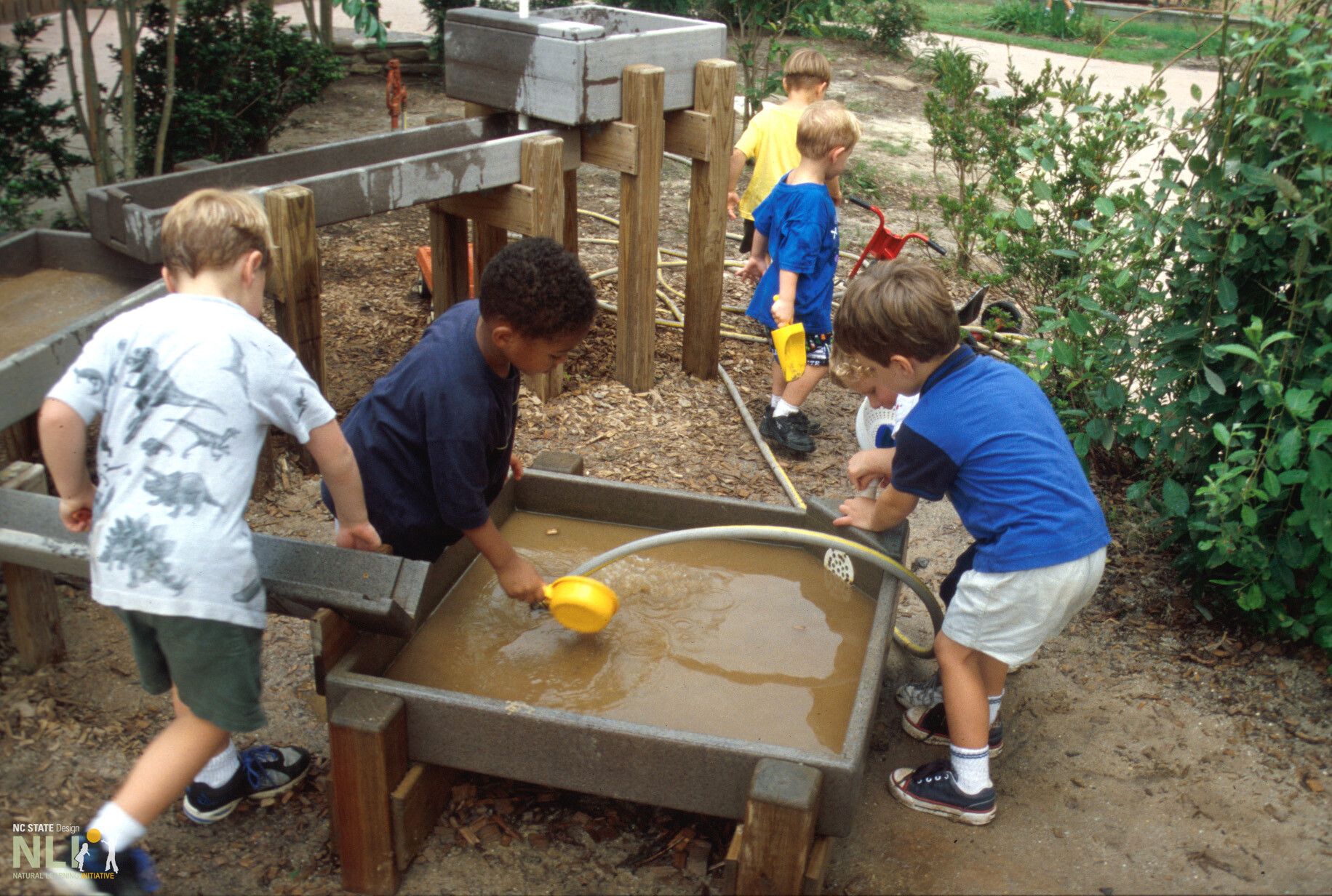
11. Water tables at different heights allow for diverse play.
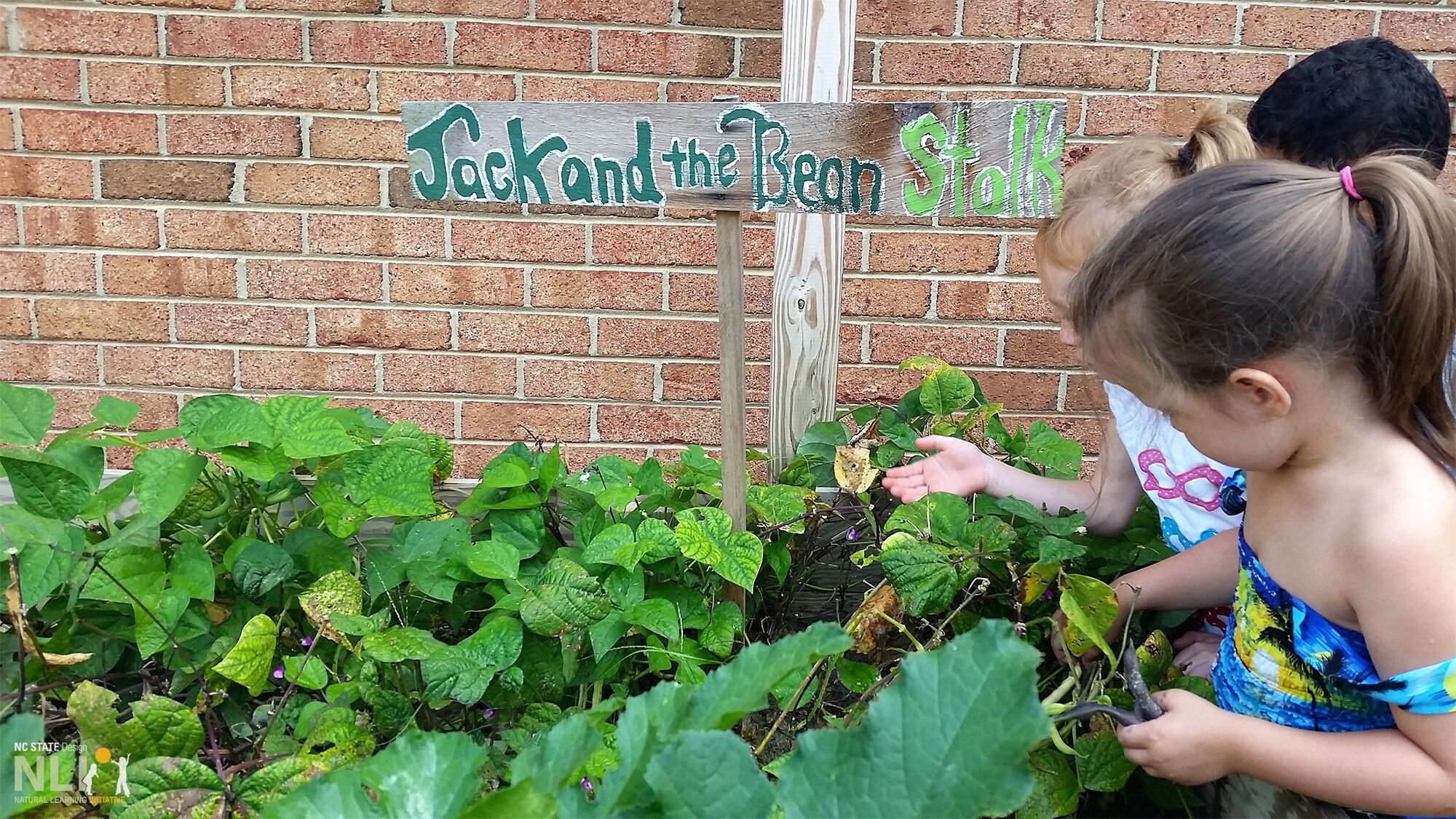
12. Edible landscapes connect children with nature.
13. A covered shelter serves as a learning space.
14. Vines growing on a wire armature create a shady tunnel.
5. MULTI-PURPOSE LAWNS
Multi-purpose lawns support high-energy group games, water play, and the exuberant joy of running — activities that promote cooperation and gross motor development. Lawns provide an ideal space for play with balls and other types of mobile equipment that require a soft surface (Figure 7). Lawns can accommodate social gatherings such as story time and offer a place for simply relaxing. Key considerations include:
Size.
Scale the lawn relative to the entire OLE. For preschoolers, 150-300 square feet is appropriate.
Location.
Try to locate a lawn as a central focus of the play and learning area, connected to primary pathways.
Shape.
Lay out in a naturalistic /curvy form, with edges defined by low railings or shrubs to create calm corners in the midst of active play.
Material.
Invest in high quality lawn turf, making sure the subsurface soil has been appropriately amended for good drainage.
Shade.
Install deciduous shade tree on the south side to create shady spot(s) for social activity.
6. SAND
Sand provides opportunities to move, mold, dig, sift, sculpt, and pour. It is a classic natural material, providing a multitude of opportunities for creative play and social interaction. Key considerations include:
Depth of sand.
For toddlers, 12-18 inches; for preschoolers,18-24 inches.
Location.
Locate against a boundary fence or in a fence corner to avoid sand “migration” and away from paths to prevent slip hazards. Avoid central locations because sand will migrate in all directions.
Containment.
Use timber construction, logs, or large, smooth rocks with plant buffers to contain sand (Figure 8).
Shade.
Crucial in hot climates. Shade can be achieved with deciduous shade trees or permanent, suspended, shade cloths.
Entry.
Provide a single entry to avoid circulation disturbance. Consider a threshold of slatted wooden deck to shake off sand if close to pathway or indoor space.
Covering.
Use ½-inch to 1-inch mesh net as to protect sand from animals. Do not use a tarp — it keeps light from reaching the sand, which then becomes rancid.
7. WATER PLAY SETTINGS
Water creates endless, multi-sensory play opportunities. Water features allow children to interact with diverse objects; floating leaves, manipulating water flow with movable stones, pouring with containers, splashing, painting with water, and more (Figure 9). The primary methods of providing water play include elevated water tables or in-ground, hard-surfaced streams. Key considerations include:
Supply.
Use a potable water supply that drains into either a sewer system or rain garden or flows into a dry stream bed.
Drainage.
Features should drain at the end of each day to avoid standing water.
Sanitation.
Consult local regulations that may apply to childcare center water installations.
Surfacing.
Surfaces around water play settings should be nonskid and well drained.
Height.
Elevated water tables can be located in sand play settings as an effective way of combining sand and water play (Figure 11).
8. EDIBLE LANDSCAPES
Edible landscapes include annual vegetable gardens and permanent edible landscape elements such as perennial vegetables, fruiting trees, shrubs, and vines. Gardens can be a small, single bed or a large managed garden of 200-300 square feet. Edible landscapes get children excited about eating fresh fruit and vegetables and connect them intimately with nature. Key considerations include:
Types.
Garden forms include: raised beds; large, walk-in beds; tubs and other containers; window boxes; beds along fence lines supporting annual vines; and whatever you can invent!
Size.
Because of the limited reach of small children, beds of all types need to be narrow (24 to 36 inches for double-sided beds) and 12 to 24 inches high.
Location.
Sunny, south-facing, low activity area. Adjacent to storage or “potting shed.”
Protection.
To keep children from trampling plants, edge beds with framed timber between 6 and 18 inches high, or create informal borders with stones and logs.
Layout.
Define clear spatial structure with a single entrance and primary and secondary pathways laid out for convenient access to narrow beds. For a smaller garden, ensure beds are far enough apart to allow movement between them.
9. OUTDOOR CLASSROOMS
All outdoor play and learning programs need a base of operations and storage for play equipment and materials, including wheeled toys, loose parts, and garden tools. Create an outdoor classroom by adding a greenhouse, multipurpose deck, or covered porch to serve as an activity space. Key considerations include:
Location.
Access from primary pathway, as close as possible to settings where play and educational programs are held.
Access.
If contents are accessible to children, they can learn to take initiative, carry out an activity, tidy up and return items when completed.
10. SHADY PLACES
Adequate protection from the sun is essential for the health and comfort of young children outdoors. Key considerations include:
Vegetation.
Use medium-size trees or large shrubs interspersed within existing settings or clustered around a deck to create a shady grove. Install 2½-inch caliper trees to produce sufficient shade in a few years.
Structures.
Arbors, pergolas, tunnels, and trellises scattered throughout the play and learning area create patches of shade and three-dimensional space scaled to young children. Experiment with standard construction elements such as light metal grids and netting to create armatures for vine growth (Figure 14).
Gathering settings support formal and informal play and learning activity. Sizes may vary to accommodate a group as small as two (e.g., child and teacher) or a whole class. They can be designed to suit specific play and learning needs, including dramatic play, formal learning, and informal socializing. Gathering settings can be as simple as a single large, flat, “sit-able” boulder or elaborate timber constructions. Timber decks can also serve a gathering function (see InfoSheet: Decks/Stages). Manufactured outdoor furniture can be used to create social spaces and formal learning settings. Best practice includes a diversity of gathering settings created with different natural and manufactured materials, which may be sourced through community groups or local businesses.
MATERIALS
Logs are a valuable, low-cost solution that can be acquired from felled trees, including street trees and trees harvested from parkland in urban areas. For further information on treatment and installation of log-based gathering settings, see Infosheet 05: Gathering Settings Created with Logs.
Boulders and stones may be donated or sourced from a landscaping company. Boulders should be too heavy to move once in place. Make sure any sharp edges are ground down. Stones should be smooth. Stones and boulders may need to be purchased but they basically last forever. Their unchanging character can provide long-term identity to a space.
Bamboo can be used to make teepees and similar structures as discussed below.
Straw bales can be used to make instant, temporary, and playful gathering settings. Bales can be replaced as permanent location decisions are made and funds become available.
Bamboo and straw bales can be combined with other natural materials such as burlap, cloth fabric, and tarps to create temporary or semi-permanent shady hideaways of various sizes and shapes.
Manufactured outdoor structures and furniture, including gazebos, benches, chairs, and tables, are useful for creating more formal gathering settings that may include learning functions. Although the initial cost may be higher, they last longer than untreated natural materials. Gazebos can also support classroom activity.
TYPES OF GATHERING SETTINGS
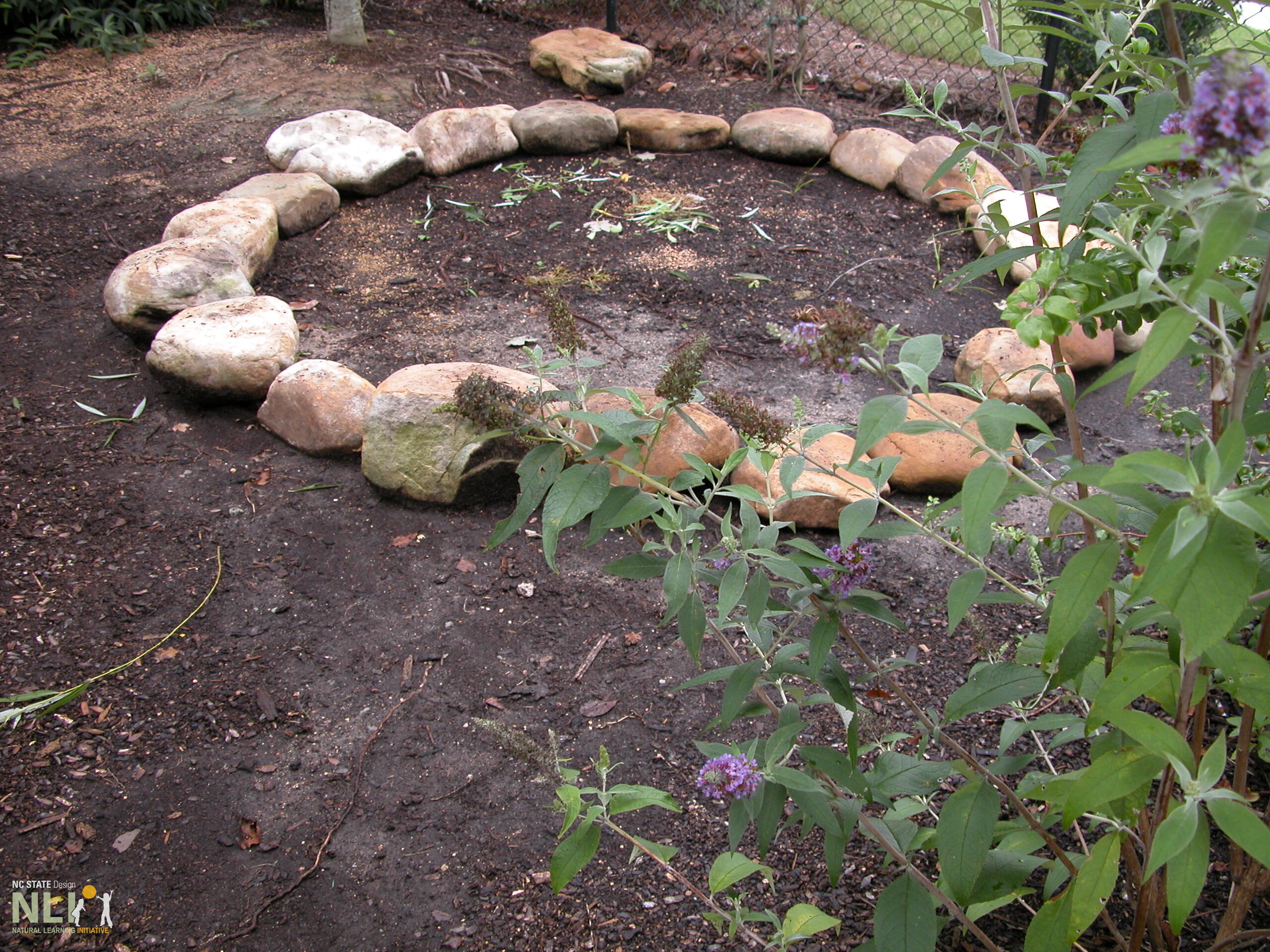
Council rings are a classic form of gathering setting invented by Danish-American landscape architect, Jens Jensen, to symbolize American democratic values. They are particularly appropriate for programmed activities, such as storytime, outdoor lessons, and group games. Placed near an entrance, a council ring can serve as a meeting point and as a place to gather before going on a field trip – for counting heads and briefing. The circular shape may lend formality to a central location such as a path intersection. Council rings can be made of anything sit-able: stones, logs, wood benches, or a low masonry wall. For preschoolers, the interior diameter should be no larger than 8 feet. A small campfire pit in the center can add social value. Located toward the back of a site, separated from the louder play activities, a council ring offers a quiet, shady corner for classroom activity.
Amphitheaters large and small, designed by arranging seating elements in a semi-circle around a performance area, provide opportunities for formal presentations. At other times they can accommodate informal, playful, fun performances. The performance space can take the form of a timber deck or otherwise designated “stage” where dramatic play is encouraged. Ensure seating components are spaced appropriately so children can see the stage. Combine with outdoor storage for play props and costumes.
DESIGN CONSIDERATIONS
Play and learning value. Small group gathering places afford mainly social play and interaction. Provision for adults to “sit in” may increase learning value provided that sensitivity is observed about when it is appropriate to join in children’s play without interrupting the flow. Larger group gathering places may accommodate classroom activities. When constructed as regular geometrical shapes (see council rings below), gathering spaces offer learning potential (shape recognition) and visual identity to a location.
Configuration. Gathering settings of various sizes and materials provided throughout the outdoor learning environment provide diverse play and learning opportunities. Intimate, quiet settings for two or three children, located away from highly trafficked play areas and surrounded by fragrant, colorful plantings can create a sense of privacy and peacefulness. Formal gathering settings using benches and/or tables can serve as indoor-outdoor transition areas near building entrances. Gathering settings intended as outdoor classrooms or settings for extended stays should be centrally located and adequately shaded.
Shade is critical to protect children from harmful sun exposure and can be provided by “shade sails” suspended above settings or with vine-covered pergolas constructed from lumber or welded rebar. Umbrellas and other temporary components such as tarps may also be used. Shade trees planted adjacent to shade sails will eventually replace them permanently.
Adjacent planting, including vines on fences, ornamental grasses, and overhanging shade trees, provide a sense of privacy and enclosure, and facilitate intimate gatherings and “hiding places.”
HEALTH AND SAFETY
Regularly inspect materials for signs of decay. If unstable, replace before becoming a possible hazard.
Corner bench, backed by trellis, combined with mobile table provides cost-effective setting.
Octagonal gazebo with benches can shelter a dozen+ individuals and provide a warm, dry wooden floor for activities. Three-dimensional form is easily identified. In this example, the structure is set in the boundary fence visibility issues are avoided.
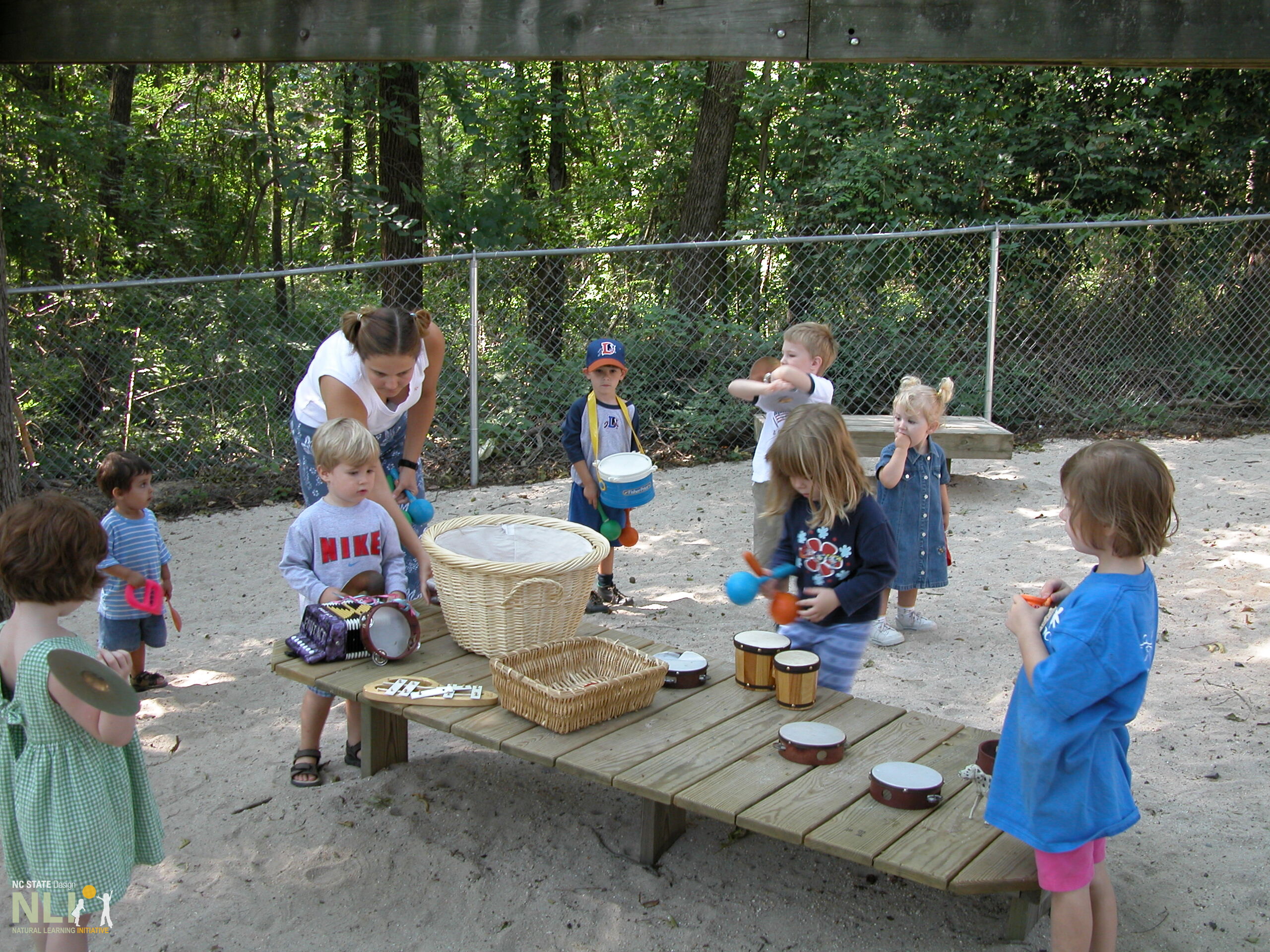
Multi-purpose, open-sided bench/low table affords sitting and a defined, clean place for learning activities—in this case, examining musical instruments and preparing for a parade.
Stone circle of large river rocks, provides a miniature “council ring.”
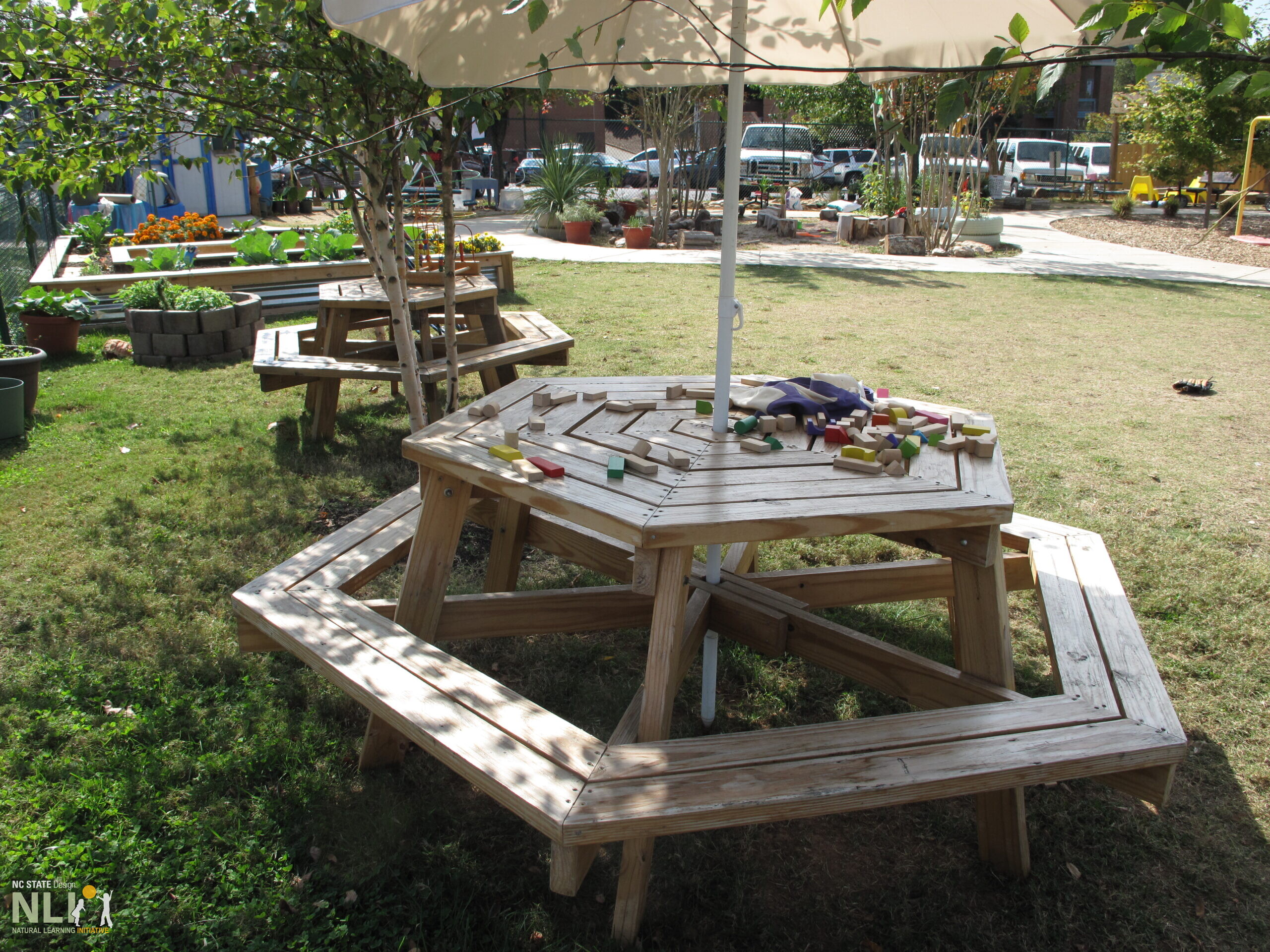
Hexagonal tables with umbrellas in quiet corner of preschool OLE support peaceful, afterschool social setting for school-aged children. Hexagonal shape works better socially than rectangular.
Bamboo teepee created from lengths of giant bamboo loosely tied together up against a fence.
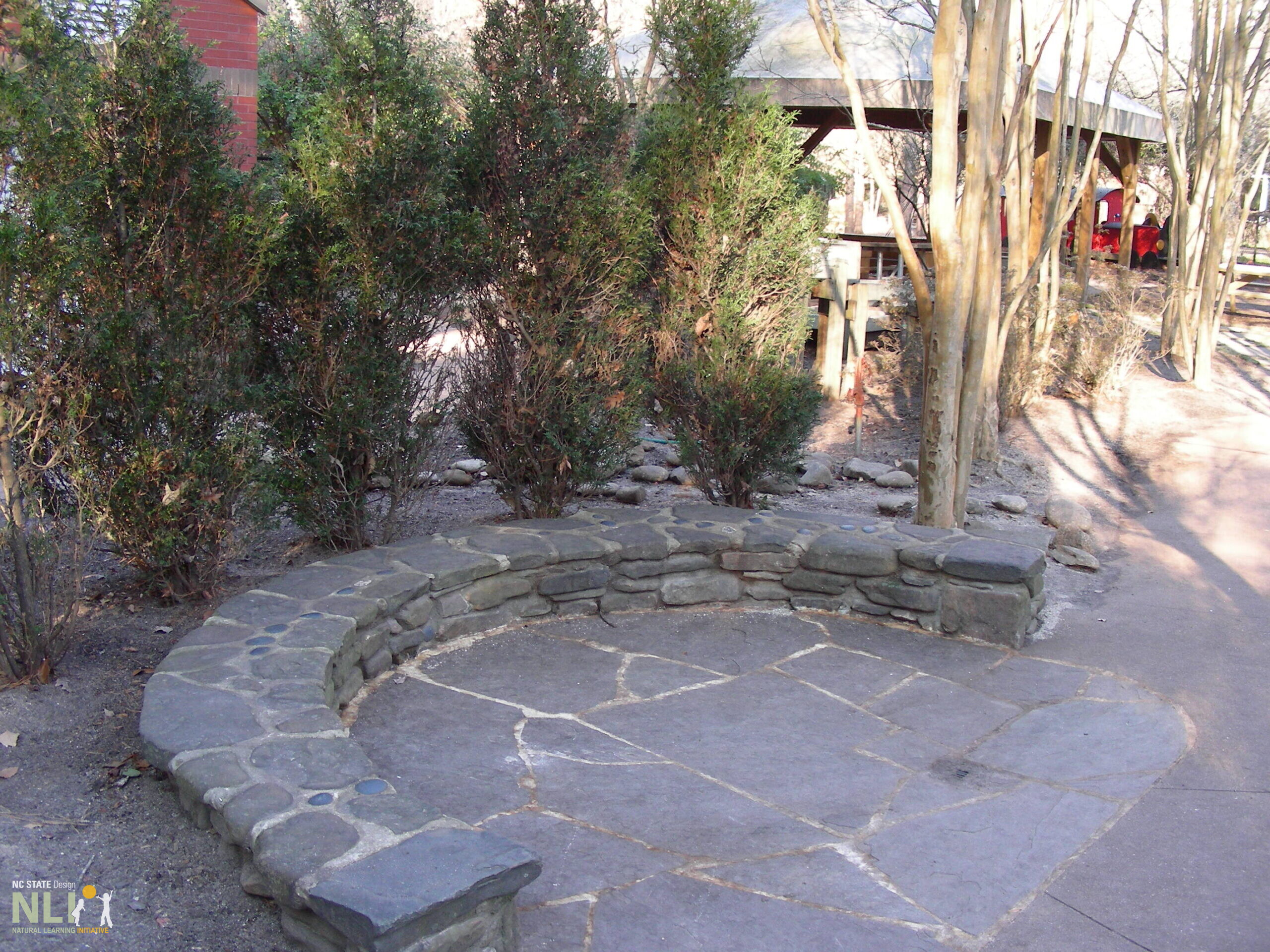
Semi-circular sitting/balancing wall backed by conifers invites social interaction and adds play value to the primary pathway.
Bench between planter boxes offers a colorful, fragrant resting spot. Logs under can be rolled out for group activity.
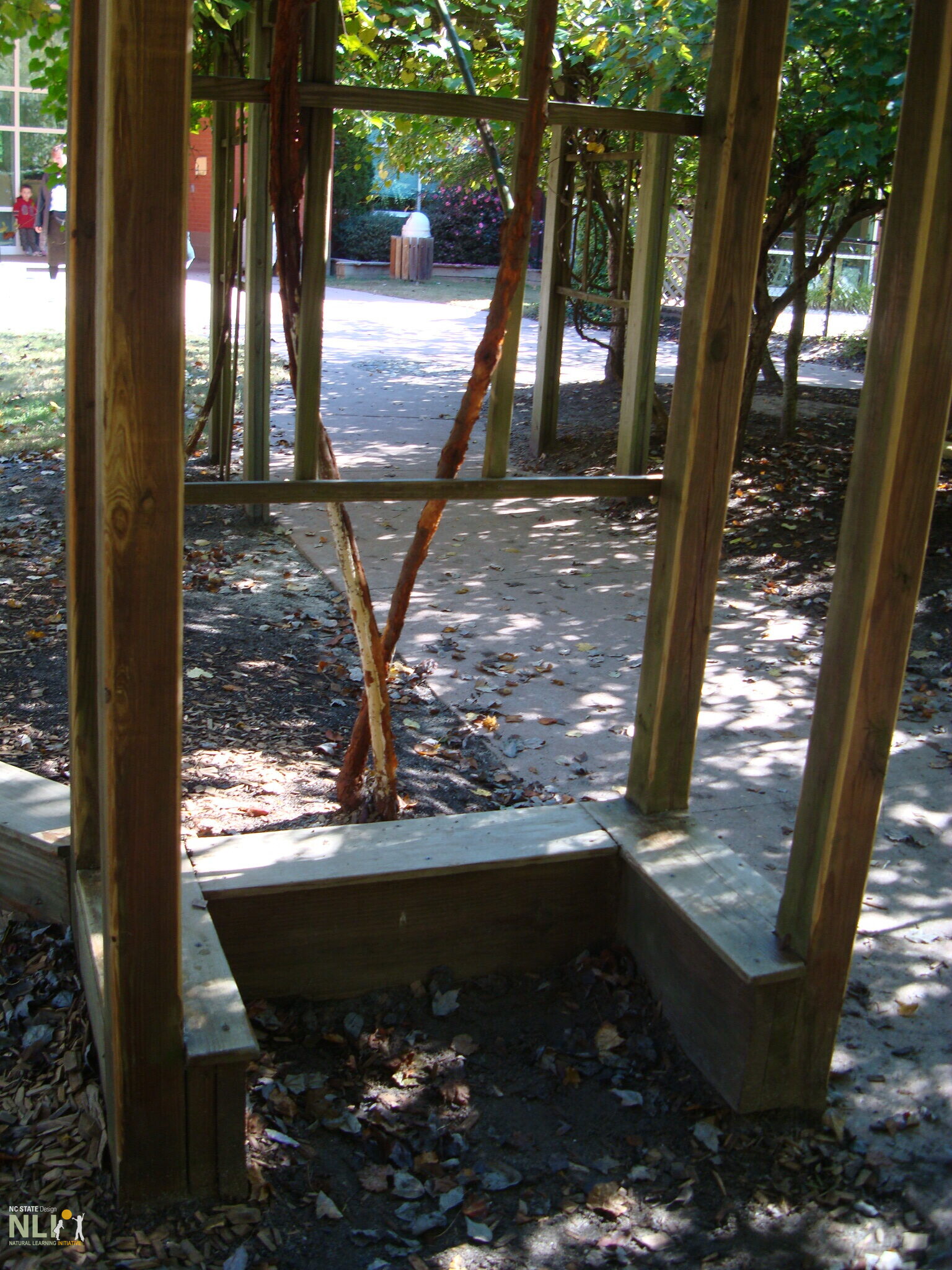
Benches integrated into arbor offer an intimate social space for a pair or trio of preschoolers.
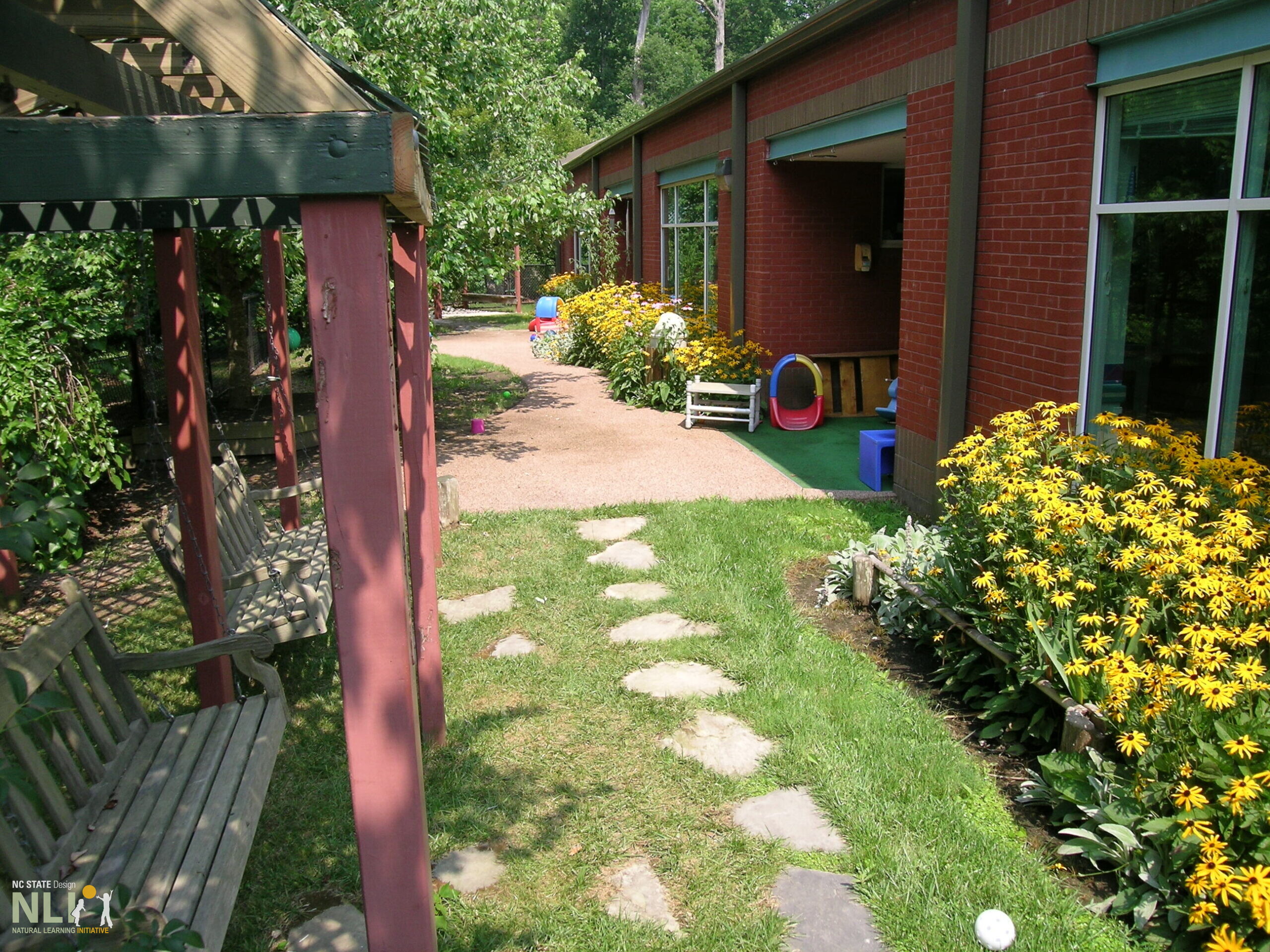
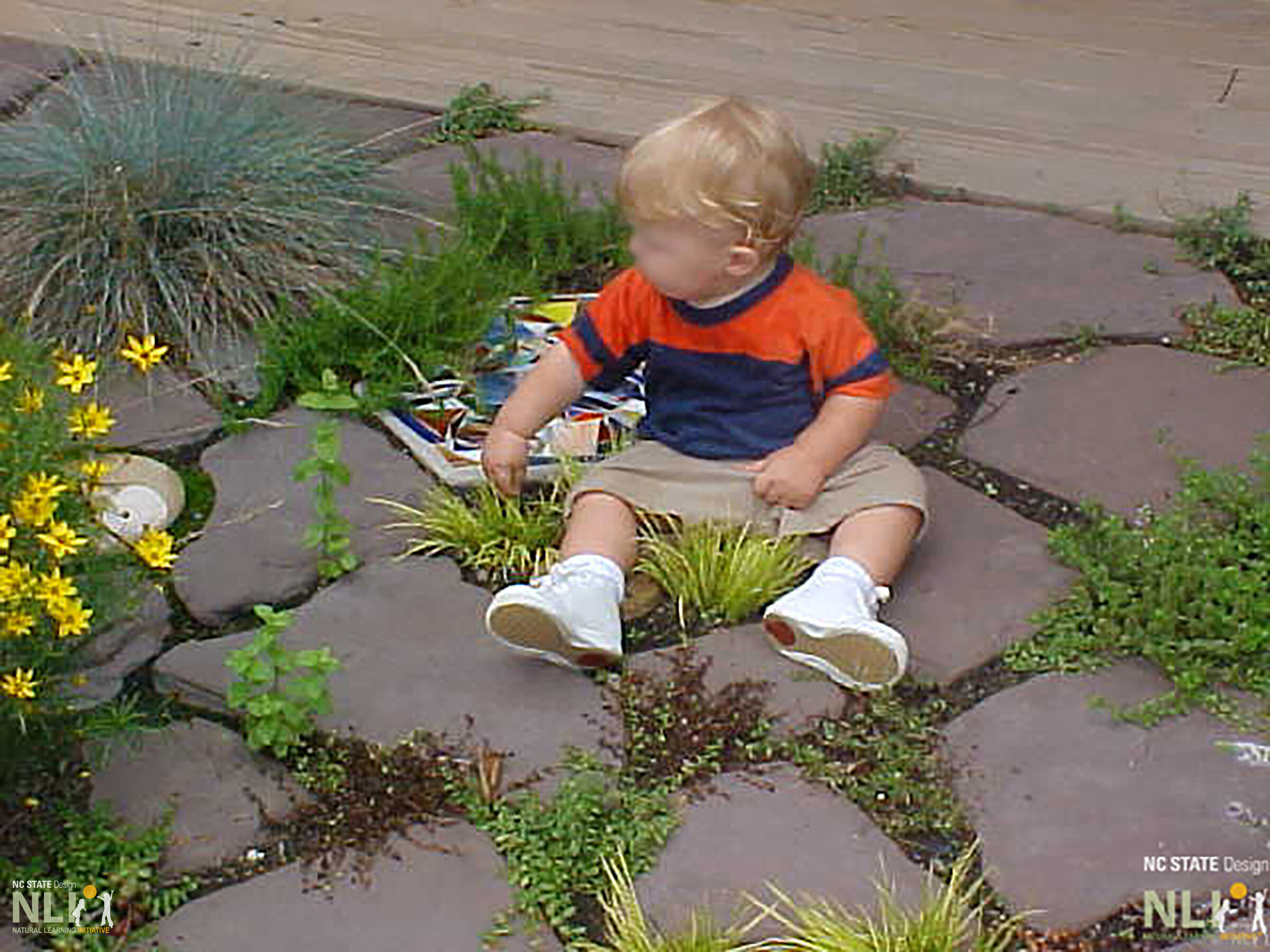
Stepping stones are versatile and durable ground surface components used to create outdoor play and learning settings. They can be installed linearly as secondary pathways in sensory gardens. Wide stepping stone pathways with fragrant, “stepable” plants between the stones create sensory pathways for crawling infants. Select durable stones and, if possible, from a local quarry to represent local geology and reduce expense. Stones should be smooth and flat to avoid becoming tripping hazards, and 1–2 inches thick (depending on the stone) to prevent cracks.
Types of Stone
Flagstone is highly recommended for stepping stone pathways because it is generally smooth and appropriately sized. Flagstone typically comes in a variety of thicknesses, from 1–4 inches. Soft and porous stone, such as sandstone and limestone, is better suited to warm areas. If working in an area that regularly freezes, select a dense stone, such as granite or bluestone. These stones are less likely to crack as they freeze and thaw with winter temperatures.
Steps
Layout the stones along the desired path based on your design. Make sure they are closely spaced (12–18 inches on center) so that a child can easily step from one to the next.
Use a garden trowel or shovel to cut and mark the soil around the edge of each stone.
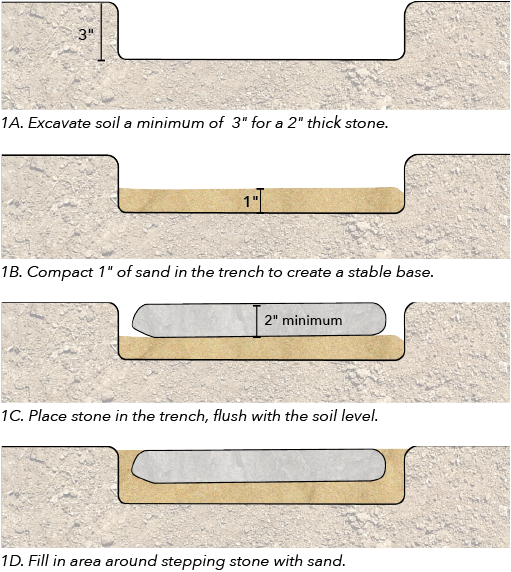
Remove the stone. Excavate as deep as the stone is thick, plus one inch to allow for the sand base. For example, if the stone is 2 inches thick, excavate 3 inches (Figure 1A).
Level and compact the existing earth where the stone will be placed.
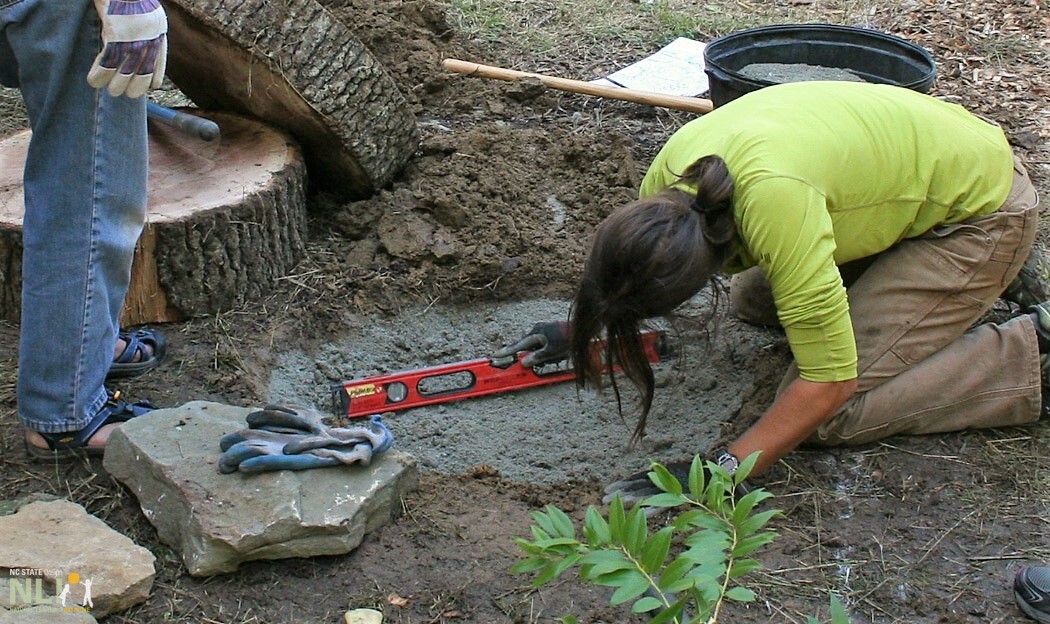
Spread, level, and compact 1 inch of sand to create a stable base (Figure 1B).
Place the stone back in place. The top of the stone should be flush with the surrounding lawn, mulch, or soil (Figure 1C).
Fill between existing soil and stepping stone with sand and compact to create an even surface (Figure 1D).
Spread grass seed or install small plants between stepping stones for added sensory value.
Installing a Small Patio To broaden the pathway into a small patio, space stepping stones 12-18 inches apart on center and follow steps 2-8 (p1).
Health and Safety
Before digging on-site, call 811 to check for underground utilities. The service is free but can take several days, so call in advance before starting a project.
Wear sturdy boots and gloves during installation.
Materials & Tools:
Flat stones, 2 inches thick
Garden trowel or shovel
Leveling tool
Sand for leveling
Grass seed or small, durable plants
Work gloves
Stepping stone pathway in an infant outdoor play and learning space.
Checking sand to ensure it is level.
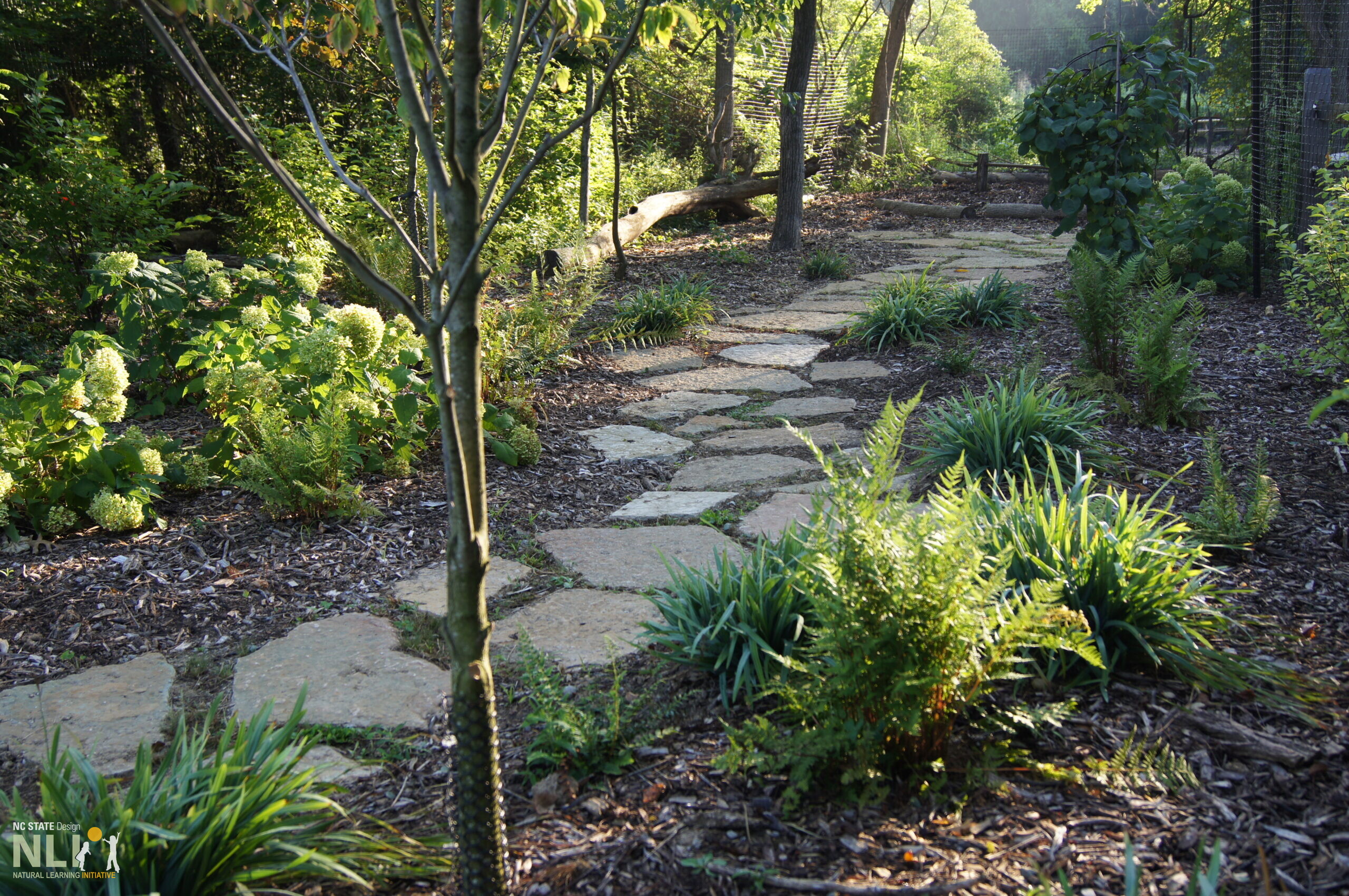
Stone pathway through a garden provides close contact with plants.
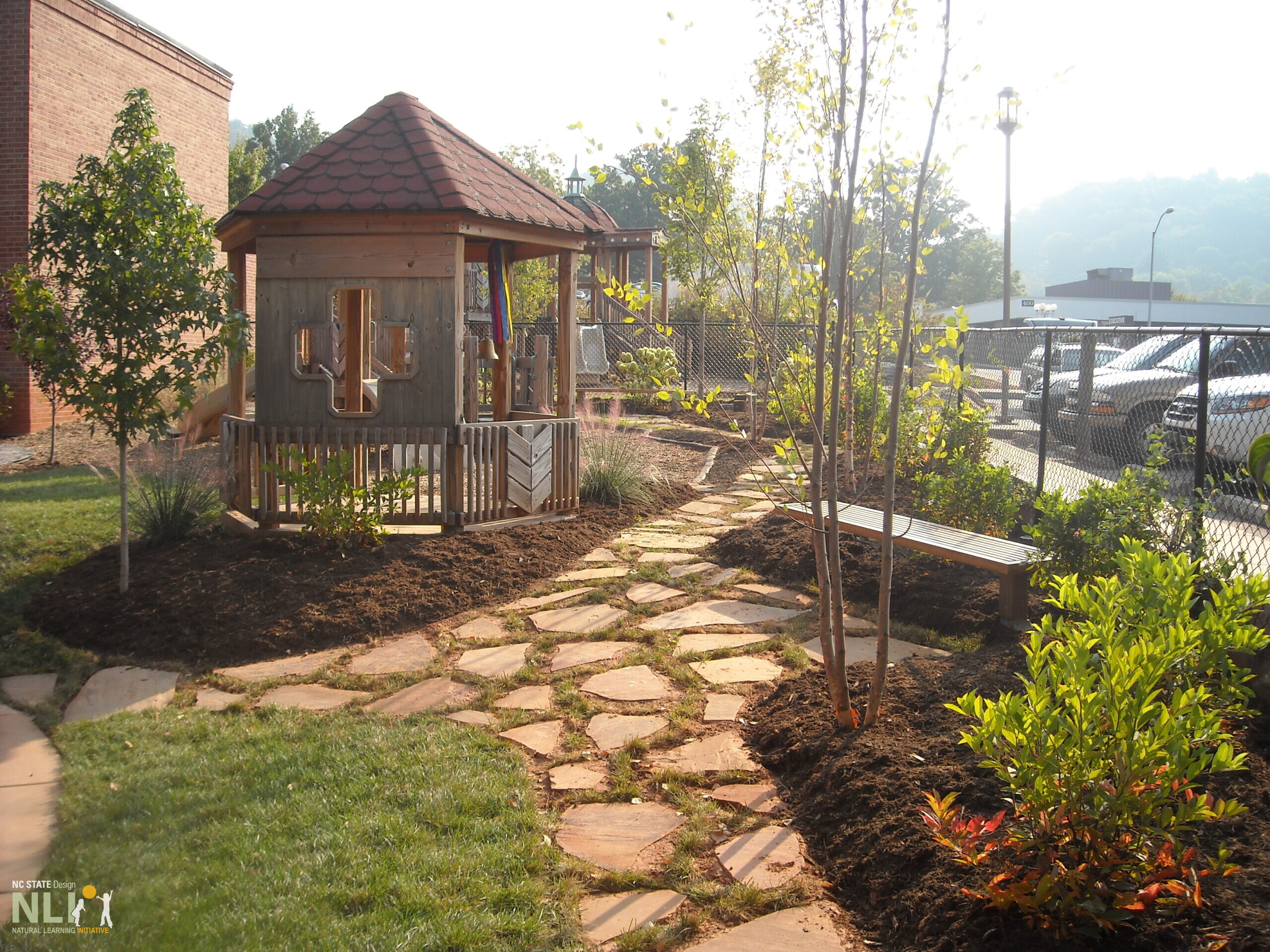
Flagstone secondary pathway creates a small patio suitable for crawling infants and a bench for caregiver comfort.
Stone patios provide textured, multi-sensory play for infants.
Flagstone patio connects adjacent settings.
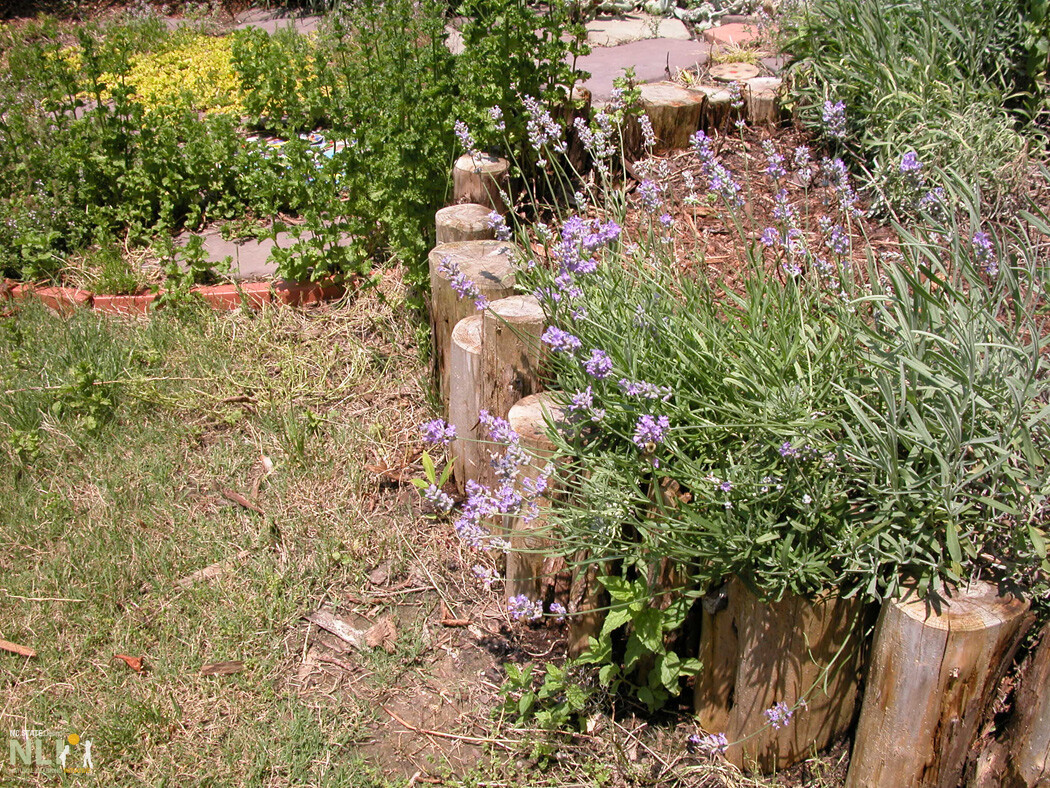
Log edging slows the migration of weeds, lawn turf, and mulch.
Figure 1: Installation diagram for stepping stones.