Blog

  • Planning and Planting

    The Green Desk

    Planning and Planting

    Guide to Developing a Planting Plan and Purchase List

    This article explains how to develop a detailed planting plan and plant purchase list from a schematic design. NLI provides schematic designs that do not indicate exact quantities, species, or spacing of plant material.

    There are 3 simple steps to developing a planting plan from a schematic design:

    1. Select plant species.
    2. Draw a scaled plan showing each plant.
    3. Create a list of plants including plant names, quantities, and container sizes.

    How to draw a scaled planting plan

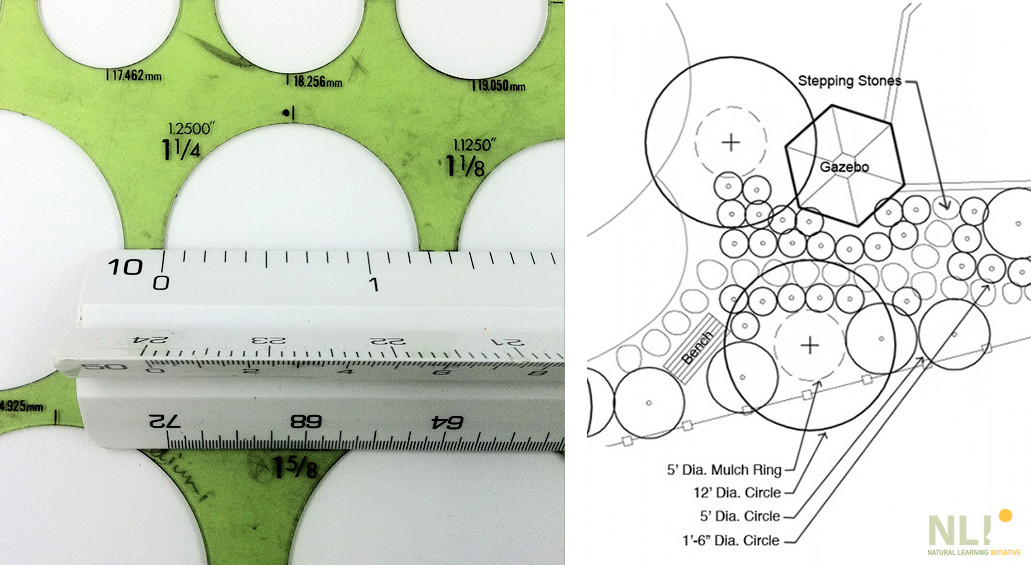
    Begin by printing your schematic design to a known scale. Using an engineer’s scale, find the side that has the number 10 on it (assuming your design is at 1″=10′). Each tick mark represents one foot in real life. Now that you have the plan and scale you will need a circle template with large and small circles. Use the scale to find circles that represent the mature size of the plants you have selected. Draw circles to represent each plant. Do not overlap circles and draw them in staggered rows (see examples below). To fill in a large area with small plants start by outlining the edge and then fill in the area using the staggered row pattern. Once you have filled in all of the planting regions in the schematic design you will need to count each circle to determine the quantity of plants needed. Use different colored highlighters to check plants that have been counted so that you do not miss anything.

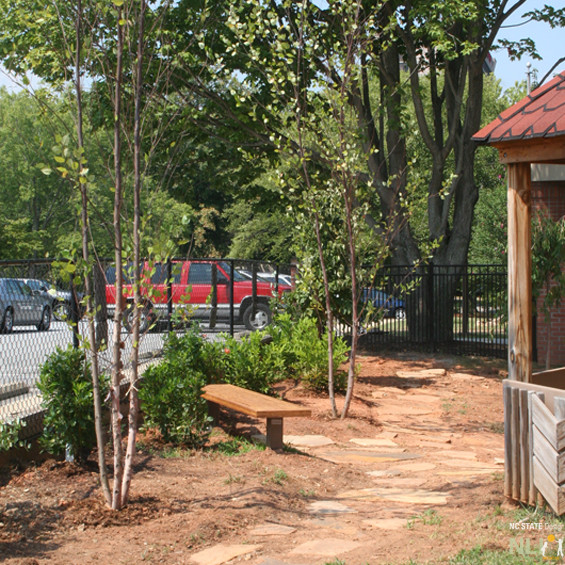
    gif overlaying the design plan with the sketch
    example of implementing the design plan into the environment
    example of a circle template geometry tool matching up to design plans

    Download Plant List

  • Growing IN Place Symposium 2018

    Growing IN Place Symposium 2018

    Greening Urban Childhood by Design

    Human development as a biophilic design benefit. Creating play and learning opportunities for children and youth through eco-conservation, restoration, and urban natural infrastructure management.

    Program

    The approximately 74 million children and youth living in the U.S. account for just a quarter of the total population (lowest % ever); however, 85% inhabit urban areas. How can built environments be designed to engage children and youth with urban nature equitably? How can nonformal education contribute to urban learning in the arts and sciences? How can urban design and programming become an educational resource? How can urban design offer natural learning environments close at hand, to inspire young people to acquire a pro-nature ethic?

    Growing IN Place 2018 emphasizes urban planning and design policies that support play and learning in nature, that conserve and restore natural infrastructure in green pathway networks connecting homes to schools, parks, community gardens, and cultural institutions — places that can help young people connect with urban ecosystems. It is designed to inform landscape architects, architects, urban designers, planners, parks and recreation professionals, teachers, environmental educators, citizen activists, elected officials, and all professionals working to create urban environments that support children’s natural curiosity and learning.

    Speakers

    Symposium Organizer

    Robin Moore, Dipl.Arch, MCP, Hon.ASLA; Professor of Landscape Architecture, NC State University. Introduction: Nature, childhood, and urban design.

    Speakers & Provisional Titles

    Stephen Bentley, Assistant Director, City of Raleigh, Parks, Recreation & Cultural Resources Dept. Creating a Big Urban Park: Strategies for long-term success.

    Kofi Boone, MLA, ALSA; Associate Professor of Landscape Architecture, NC State University. Design for bio-social diversity: Inclusive community processes and outcomes.

    Nilda Cosco, PhD, ASLA; Research Associate Professor, Director of Programs, Natural Learning Initiative, NC State University. Nature: Children’s constant, reliable friend.

    Kevin Coyle, JD; VP, Education and Training, National Wildlife Federation. Creating a conservation ethic for the Anthropocene Age: Turning 74 million kids on to nature!

    Karen Firehock, BS, MCP, Executive Director and co-founder, Green Infrastructure Center; Adjunct Faculty, Department of Urban and Environmental Planning and Landscape Architecture, University of Virginia. Green Infrastructure Planning: Engaging Children, Youth, and Families.

    Daniel Iacofano, PhD, FAICP, FASLA; CEO, MIG. Engaging communities in urban greening: Innovative planning, design, and management policies.

    Chris Moorman, PhD, Professor of Forestry and Environmental Resources, NC State University. Conserving, creating, and managing urban habitats in today’s world.

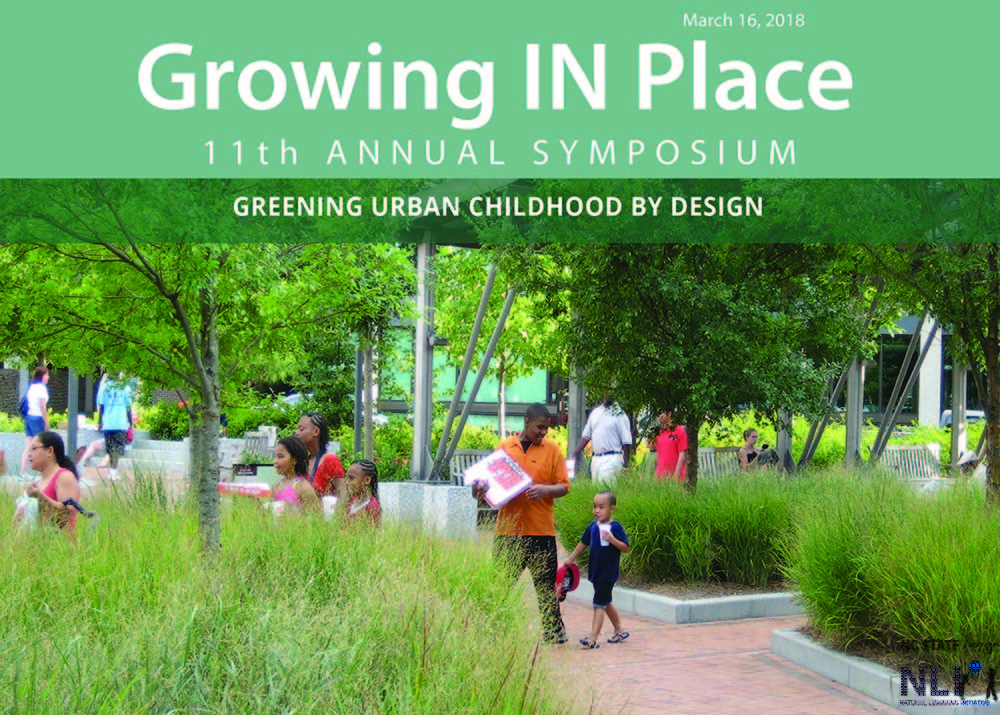
    growing in place symposium cover 2018

    March 16, 2018

    Sponsors

    play core logo
    american society of landscape architects logo
    triangle greenways council logo
  • 9th Annual NLI Design Institute

    9th Annual NLI Design Institute

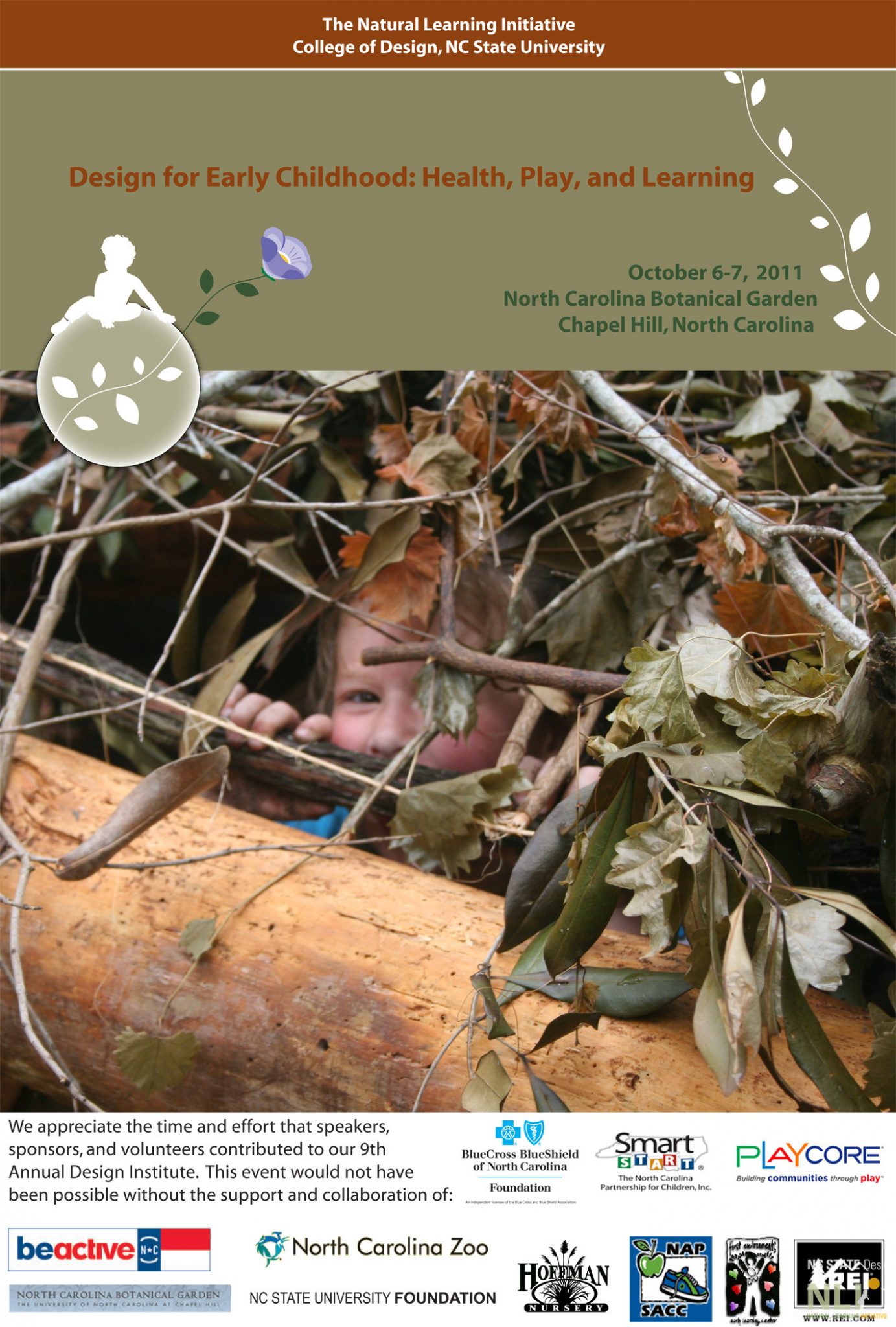
    Design for Early Childhood: Health, Play, and Learning

    This year’s Institute is focused on early childhood. The goal is to raise awareness about the role of the outdoors for early childhood healthy development and to offer innovative ideas and concepts for participants to implement.

    Program

    The 9th Annual Design Institute combined presentations by leading professionals in the fields of early childhood and design, and outdoor hands-on activities. The program offered innovative ideas and concepts for participants to implement in their own child care settings.

    Outdoor, hands-on activities were organized on the grounds of the NC Botanical Garden on Thursday and Friday afternoons. Participants learned innovative ways to entice preschool physical activity, to see examples of how the designed environment engages children in outdoor play, and to see the many ways outdoor activity supports healthy development.

    Speakers

    Rebecca Brouwer, MS, Project Director, Dept. of Community and Family Medicine, Duke University Medical Center. Watch Me Grow.

    Nilda Cosco, PhD, Education Specialist, The Natural Learning Initiative. Preventing Obesity By Design: Lessons Learned.* (lecture video not given for online use)

    Diane H. Craft, PhD, Professor of Physical Education, State University of New York. Purposeful Play – Early Childhood Movement Activities on a Budget.

    David Gardner, D.A., Executive Director, N.C. Center for Health & Wellness. The Importance of Statewide Initiatives.* (lecture video not given for online use)

    Teri Hendy, President, Site Masters, Inc (design and safety consultants). Safety Versus Play Value?* (lecture video not given for online use)

    Elizabeth Lake, Executive Director, First Environments Early Learning Center. Play Around the World Panel.* (lecture video not given for online use)

    Dona McNeill, MPA, Employee Services Manager, National Institute of Environmental Health Sciences. Play Around the World Panel.* (lecture video not given for online use)

    Robin Moore, Dipl.Arch, MCP, Director, Natural Learning Initiative. Welcome

    Richard Rairigh, Director of Programs and Early Childhood Development, BeActive North Carolina, Inc. Play Around the World Panel.* (lecture video not given for online use)

    Debbie Roos, NC Agricultural Extension Agent, Chatham County Cooperative Extension Center. Please Design My Garden with Flowers, but No Bees.* (lecture video not given for online use)

    Philip Waters, Play Program Coordinator, the Eden Project, Cornwall, UK. Muddy Shorts – Supporting Disabled Children in Adventurous Play

    Comments and Discussion on Morning Presentations
    from College of Design @ NCSU.

    Preventing Obesity by Design (POD) Project Showcase.
    Smart Start of Buncombe County
    Children and Youth Partnership for Dare County
    Randolph County Partnership for Children

    9th Annual NLI Design Institute flyer

    October 6-7, 2011

    Sponsors

    Bak Shape
    first environments early learning center logo
    hoffman nursery logo
    north botanical garden banner
    smart start logo
    nap sacc logo
    REI logo
    Tributary
  • Growing IN Place Symposium 2011

    Growing IN Place Symposium 2011

    Creating environments for healthy human development and a healthy biosphere for generations to come.

    Program

    Restrictions on children’s independent mobility are having an increasingly negative impact on their healthy development. Many children are not allowed to venture out alone or even with their friends as the previous generations did. This pressing issue must be addressed by rethinking the design of the urban public realm to better serve the needs of children and families; ultimately, to create a new, inclusive culture of place.

    The aim of the Growing In Place Symposium is to stimulate discussion about how planners and designers can enhance the health and well-being of urban families in North Carolina, across the nation and world. As urban growth increases, new urban design policies are required to support the needs of citizens across the life span. The Growing In Place Symposium will explore these themes.

    Speakers

    Mitchell Silver, AICP, Director of the Department of City Planning, Raleigh, NC. Welcoming remarks.

    Robin Moore, MCP, ASLA, Director, Natural Learning Initiative, NC State University, Raleigh, NC. Permeable urban neighborhoods: Designing shared feet and bike “flow space” for children and families.

    Perry Bigelow, Bigelow Homes, Aurora, IL. Designing neighborhoods for children and families: How can we get the development community on board?

    Jason Gilliland, PhD, University of Western Ontario, London, ONT. Creating urban design policy for healthy childhood neighborhoods: What does built environment behavioral science tell us?

    Michael Wallwork, Alternate Street Design, P.A., Orange Park, FL. Balancing motorized and nonmotorized transportation in favor of independent mobility for children: Design solutions that work.

    John Ackerman, CEO, Occoneechee Council, Boy Scouts of America, Raleigh, NC. Motivating kids to get outdoors in search of adventure: Managing the inherent risk.

    Abby Ehrlich, Director of Parks Programming, Battery Park City Parks Conservancy, NYC. Animating the urban public realm: Programming urban play.

    Panel discussion. Moderated by Robin Moore. Creating healthy urban environments that motivate kids to get outdoors. What critical policy changes are required?

    Growing IN Place Symposium 2011 flyer

    February 11-12, 2011

  • 8th Annual NLI Design Institute

    8th Annual NLI Design Institute

    Growing Outdoors: A Healthy Start for Early Childhood

    Innovative ideas and concepts for participants to implement in their own child care settings.

    Program

    The 8th Annual Design Institute combined presentations by leading professionals in the fields of early childhood and design, and outdoor hands-on activities. Outdoor, hands-on activities were organized on the grounds of the NC Botanical Garden on Thursday and Friday afternoons. Participants learned innovative ways to entice preschool physical activity, to see examples of how the designed environment engages children in outdoor play, and to see the many ways outdoor activity supports healthy development.

    Presentation Videos (Part 1)

    Presentation Videos (Part 2)

    Presentation Videos (Part 3)

    Speakers

    Anna Carter, Assistant Section Chief, NC Division of Child Development.

    Randy Fulk, PhD, Linda Kinney, Jessica Hoffmire, NC Zoo, Asheboro.

    Beth Lake, Sue Espersen, Ken Williams, First Environments Early Learning Center, EPA-NIEHS.

    Dona McNeill, NIEHS liaison.

    Jani Kozlowski, Policy Unit Manager, NC Division of Child Development.

    Ed Norman, NC Division of Environmental Health.

    Rich Rairigh and team, Senior Program Manager, Early Childhood Development, Be Active North Carolina, Inc.

    Betsy Thigpen, MS Child Development, Early Childhood Consultant.

    Robert C. Whitaker, MD, MPH, Professor of Public Health and Pediatrics, Center for Obesity Research and Education, Temple University.

    Philip Waters, Play Project Coordinator, Eden Project, Cornwall, UK.

    Robin Moore, DiplArch, MCP, Director.

    Brad Bieber, Design Associate.

    Nilda Cosco, PhD, Education Specialist.

    Michele Rivest, Project Associate, Smart Start Liaison.

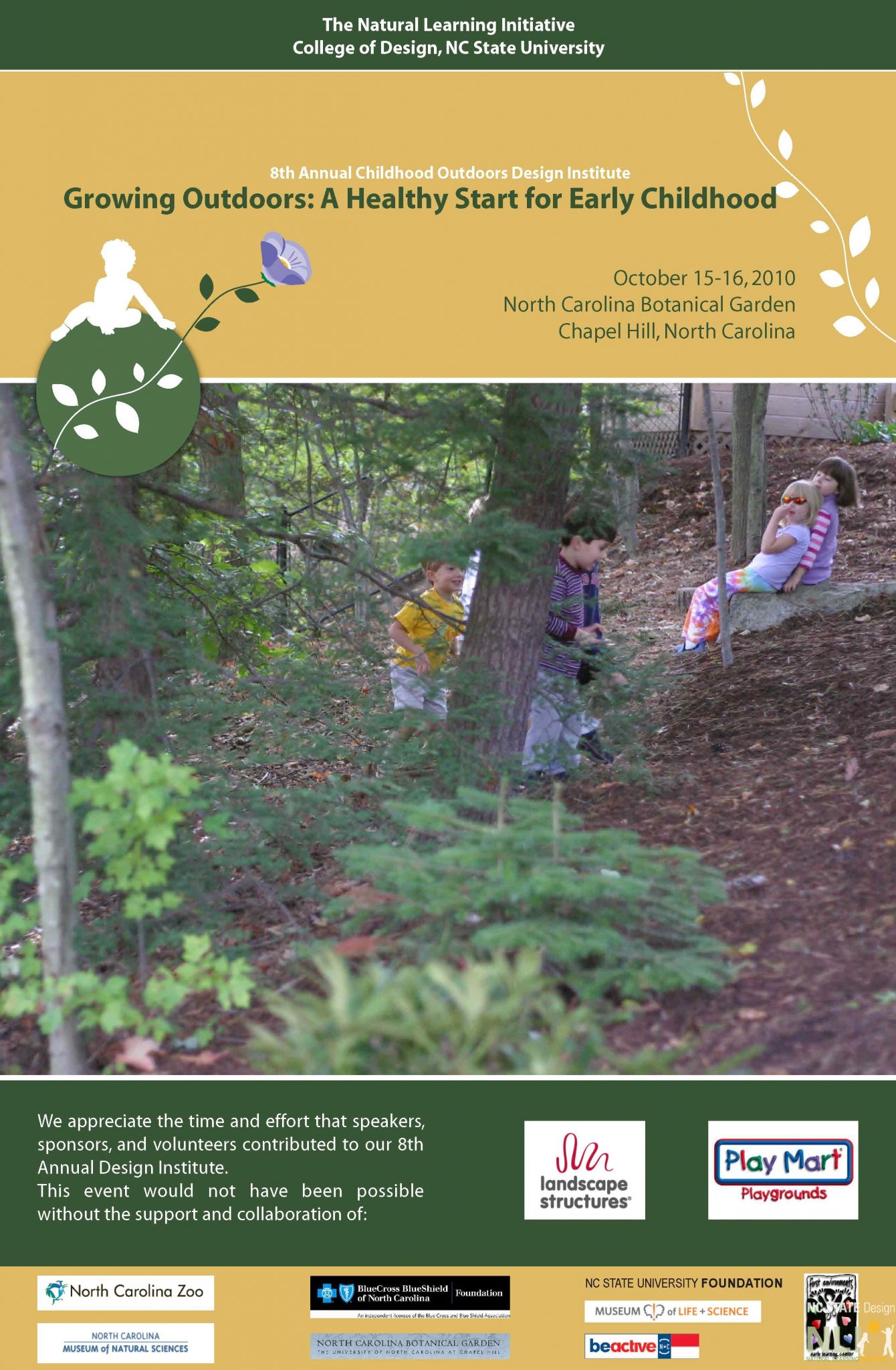
    8th Annual NLI Design Institute poster

    October 15-16, 2010

    Sponsors

    museum of natural sciences logo
    north botanical garden banner
    blue cross blue shield be active kids logo
    first environments early learning center logo
  • Growing IN Place Symposium 2010

    Growing IN Place Symposium 2010

    Sustainable Urban Design for Children & Families

    Urban landscape planning and design policies needed to facilitate independent mobility of children. Strategies for managing pedestrian and bicycle routes and the quality of the places of everyday life they connect—especially parks, but also museums, libraries, stores, social services, so that families are motivated to be outdoors engaged with the natural environment.

    Program

    The aim of the symposium is to stimulate discussion about how planners and designers can meet the challenge of enhancing the well-being of urban families in North Carolina, across the nation, and the world. As cities grow and develop, opportunities to support family life in a healthy public realm should multiply. European design innovations such as “home zones” together with community participation processes and design guidelines will serve as triggers for discussions about how cities can grow in harmony with the needs of their citizens across the life span.

    Speakers

    Mitchell Silver, PP, AICP Director Raleigh Department of City Planning, NC

    Robin Moore, Dipl. Arch, MCP, Hon.ASLA, Director, Natural Learning Initiative NC State University, Raleigh, NC. Why Growing In Place? The new imperative: Intentional design for children’s access to diversity and independent mobility at neighborhood level. Balancing new parameters: housing form, housing density, limiting the private automobile, non-motorized travel, and space for diverse nature.

    Dee Merriam, FASLA Community Planner, Healthy Communities Program National Center for Environmental Health Centers for Disease Control, Atlanta, GA. Why is the CDC concerned about the built environment? What are health implications of community design? What are strategies for progress? What part do urban parks play?”

    Tim Beatley, PhD & Teresa Heinz Professor of Sustainable Communities School of Architecture, University of Virginia, Charlottesville, VA. Case examples of child and family sustainable development from Europe and elsewhere. Measures of success. What can we learn from international practice.

    Cynthia Hoyle, AICP Transportation Planning Consultant Champaign-Urbana Mass Transit District, IL. Designing mixed-use, child-friendly streets. Changing traditional traffic engineering concepts and practice. Retrofitting urban neighborhood streets. Case examples.

    Joseph ‘Joe’ Wynns, MS, CPRP Director Emeritus Indiana Department of Parks and Recreation, Indianapolis, IN. New policies for urban play. Supporting urban childhood through innovative parks and recreation programming. US case examples.

    Steve Nygren Co-founder of Serenbe, GA. New, sustainable models for dense urban forms that support children’s health, independent mobility and social development, while conserving the natural environment. The Serenbe story.

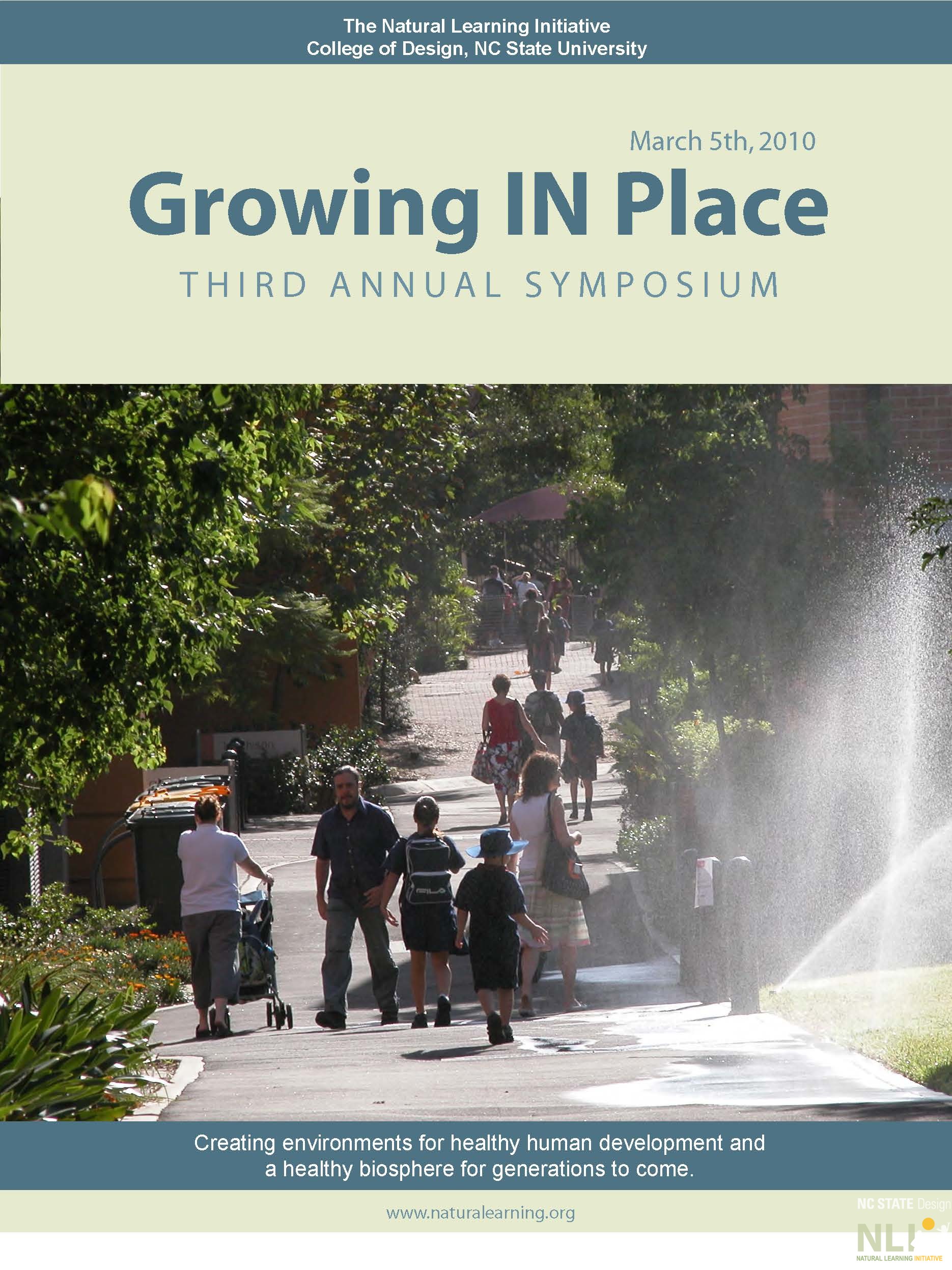
    Growing IN Place Symposium 2010 poster

    March 5, 2010

  • 7th Annual NLI Design Institute

    7th Annual NLI Design Institute

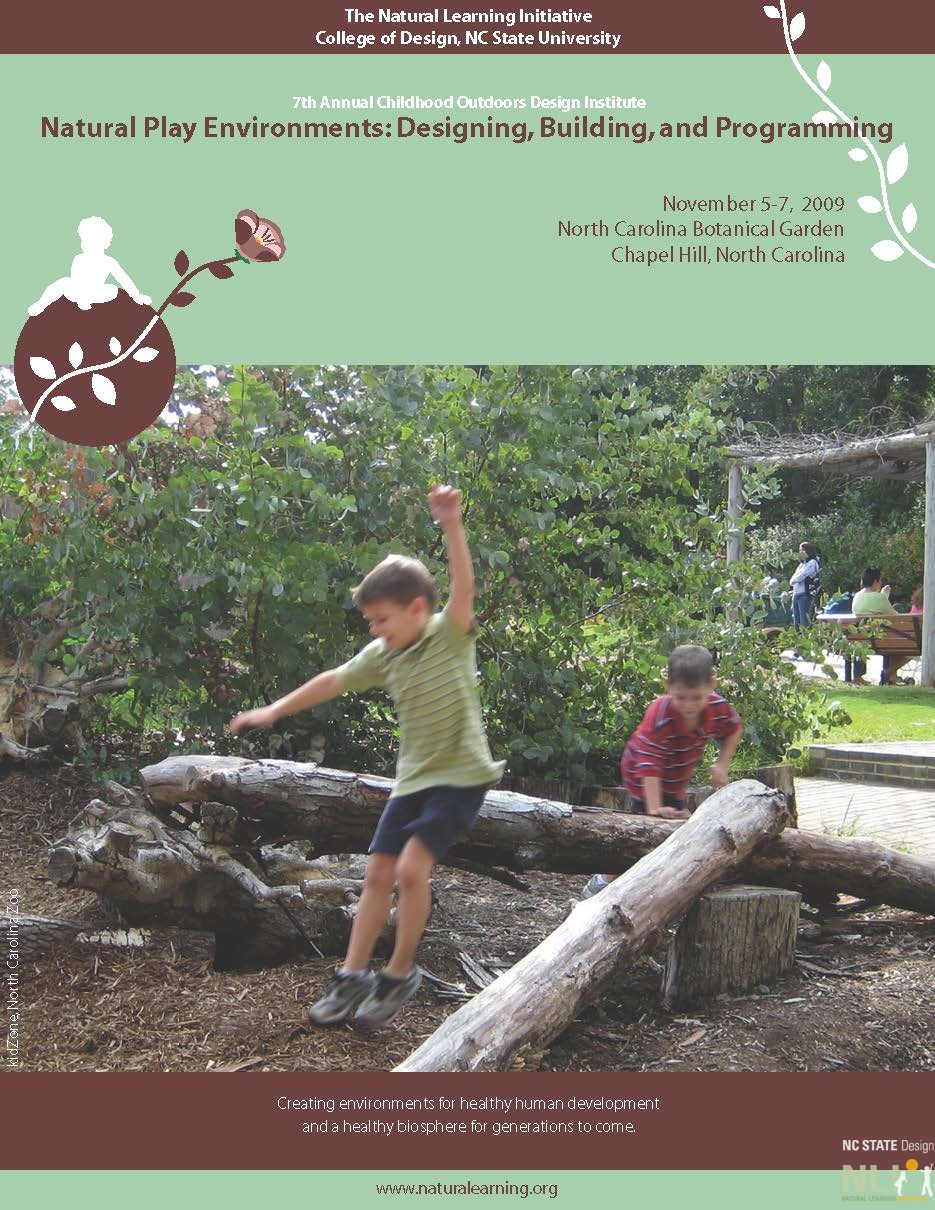
    Natural Play Environments: Designing, Building, and Programming

    Think back to when you were a child… It is likely some of your fondest memories are of the outdoors. Do you still remember what you used to do outside? Do you remember yourself actively exploring the outdoors, picking summer blackberries, playing with mud, building a fort in the woods, climbing trees, or playing with water? Research (and personal experience) tell us that the outdoors has a strong impact on physical activity of children. But today’s children have far less opportunities to enjoy themselves in the fresh air.

    Program

    The goal of the 7th Annual Design Institute was to raise awareness about the role of the outdoors for healthy development and to offer innovative ideas and concepts for participants to implement back home. The two day and a half event included presentations, discussions, and interactive hands-on outdoor activities.

    Speakers

    Robin Moore, Professor of Landscape Architecture and Director of the Natural Learning Initiative, NC State University. Creating Natural Play Environments. Creating a Successful Natural Play Project. The Importance of Phasing.

    Elizabeth Goodenough, PhD, a scholar, author and activist, Wayne State University Press. Thresholds of Play.

    Ken Finch, Founder and President of Green Hearts Institute for Nature in Childhood. Restoring the Nature of Childhood.

    Phil Waters, Play Project Coordinator, the Eden Project, Cornwall, UK. Play Installations.

    Nilda Cosco, PhD, Education Specialist, Natural Learning Initiative and Research Associate Professor, College of Design, NC State University. The Importance of Phasing. Creating a Successful Natural Play Project.

    Brad Bieber, MLA, Design Associate, Natural Learning Initiative. The Importance of Phasing. Creating a Successful Natural Play Project.

    Annie Nashold, Director of Children’s Education and Family Programs. Nature Art, Sarah P. Duke Gardens. Nature Art, Sarah P. Duke Gardens.

    Beth Lake, Director. Healthy Outdoors, First Environments Early Learning Center.

    Sue Espersen, Coordinator. Healthy Outdoors, First Environments Early Learning Center.

    Dona McNeill, NIEHS Day Care Liaison. Healthy Outdoors, First Environments Early Learning Center.

    Randy Fulk, Curator of Education, North Carolina Zoo. KidsZone, NC Zoo.

    Linda Kinney, Education Public Programs Coordinator, North Carolina Zoo. KidsZone, NC Zoo.

    Jessica Hoffmire, Visitor Educator, North Carolina Zoo. KidsZone, NC Zoo.

    Betsy Grant, CEO. The Edible Schoolyard at the Greensboro Children’s Museum. The Edible Schoolyard at the Greensboro Children’s Museum.

    Sharon Bright, Exhibits and Core Initiatives. Castaway Cove Kids Garden, Marbles Kids Museum.

    Pam Hartley, VP. Exhibits and Core Initiatives. Castaway Cove Kids Garden, Marbles Kids Museum.

    Nancy Easterling, Associate Director for Education, NC Botanical Garden. Nature Play at the NC Botanical Garden.

    7th Annual NLI Design Institute poster

    November 5-7, 2009

    Sponsors

    REI logo
    north botanical garden banner
    Bak Shape
    Kaplan
  • Growing IN Place Symposium 2009

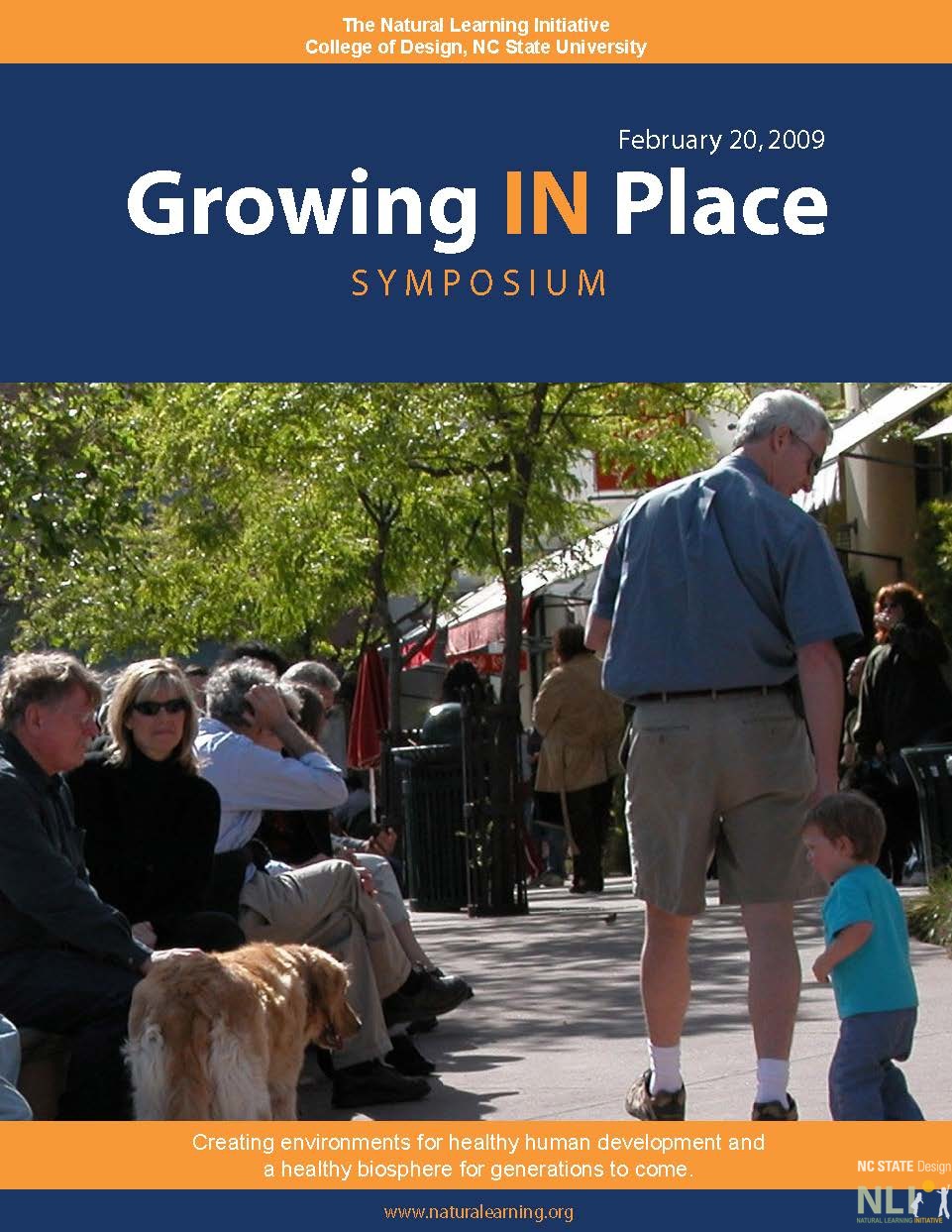
    Growing IN Place Symposium 2009

    The restricted life of children is negatively impacting their healthy development. Children are not allowed to venture out into streets and parks alone, even with their friends as previous generations did. How can the urban public realm be planned and designed so that children find the physical and social stimulation necessary for healthy development and re-engage with the culture and ecology of the place?

    Program

    The aim of the symposium is to stimulate discussion about how planners and designers can meet the challenge of enhancing the well-being of urban families in North Carolina, across the nation, and the world. As cities grow and develop, opportunities to support family life in a healthy public realm should multiply. European design innovations such as “home zones” together with community participation processes and design guidelines will serve as triggers for discussions about how cities can grow in harmony with the needs of their citizens across the life span.

    Speakers

    Simon Atkinson, PhD, Professor in Community and Regional Planning, University of Texas, Austin; Adjunct Professor, School of Architecture, NC State University. Designing Cities: When will the child become important?

    Cheryl Charles, PhD, President and CEO of the Children & Nature Network. The Ecology of Hope: Building a movement to reconnect children and nature.

    Allen Cooper, Esq., Senior Manager, State Education Policy Initiatives, National Wildlife Federation. Putting Policy into Action: Strategies for implementing child-friendly urban design policies.

    Dan Douglas, AICP, Director, Raleigh Urban Design Center. Raleigh’s Child and Family Friendly Initiatives.

    Tim Gill, UK, leading writer and thinker on childhood. Unleashing Childhood: How we can overcome our anxieties and design towns and cities that give children the freedom to learn and grow.

    Robin Moore, Dipl.Arch, MCP, Director, Natural Learning Initiative, NC State University. The Time is Now: Implementing a child and family urban design agenda.

    Richard Rairigh, Senior Program Manager – Early Childhood Development, Be Active NC. Short presentation and physical activity energizer.

    Ian Simkins, PhD, Leverhulme Research Fellow, University of Sheffield, Landscape Architect, UK. Existing and aspirational neighborhood place experiences of primary school aged children.

    Interactive Group Session: Creating policy and guideline strategies for sustainable urban design for children and families.

    Growing IN Place Symposium 2009 poster

    February 20, 2009

  • 6th Annual NLI Design Institute

    6th Annual NLI Design Institute

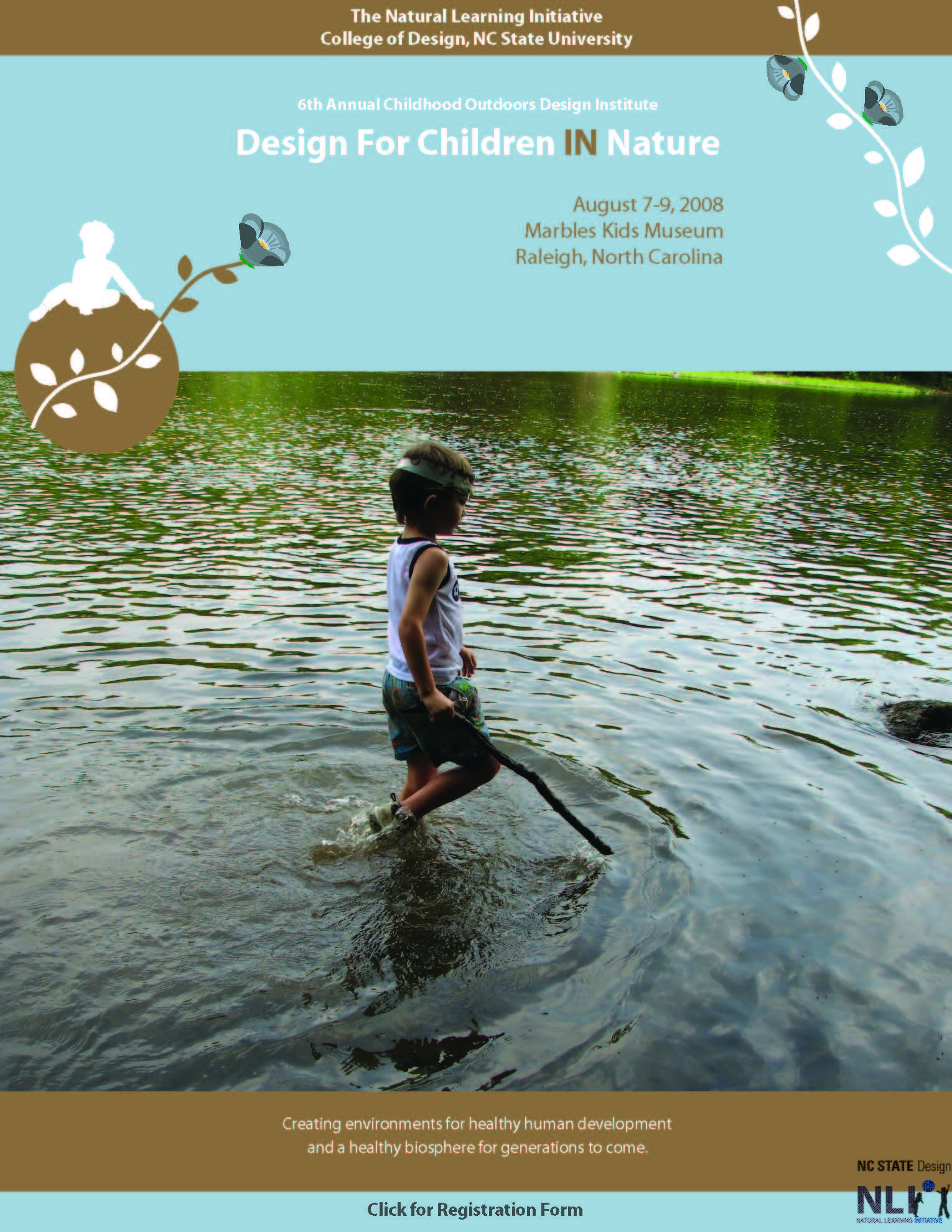
    Design for Children IN Nature

    Focusing on the importance of contact with nature, design implications, and innovative solutions that help participants take information and new skills back home to change their spaces.

    Program

    The Natural Learning Initiative (NLI) held it’s 6th Annual Design Institute, Design for Children IN Nature, on August 7-9, 2008. The Institute was hosted by the Marbles Kids Museum in downtown Raleigh. Participants included landscape architects, designers, public health professionals, childcare providers, educators, extension agents, master gardeners, parks and recreation professionals, horticultural therapists, and others.

    Outdoor activities were held at Prairie Ridge Ecostation for Wildlife and Learning, North Carolina Museum of Natural Sciences, which focused on hands-on Playwork training. Dr. Martin Maudsley, Leonie Labistour, and Daniel Rees-Jones (UK) helped us rediscover the magic of being in nature. As experts in playwork, they lead two sessions of hands-on play and reflection at Prairie Ridge.

    Speakers

    Cam Collyer, Director, Learning Grounds, Evergreen, Toronto, Ontario. Challenges and Opportunities for Creating Green School Grounds.

    Nilda Cosco, PhD, Education Specialist, Natural Learning Initiative, College of Design, NC State University, Raleigh, NC. The Benefits of Playing in Nature.

    Martin Maudsley, PhD, Coordinator, Wild About Play, United Kingdom. Playing on the Wildside.

    Robin Moore, Professor of Landscape Architecture; Director, Natural Learning Initiative, College of Design, NC State University, Raleigh, NC. Landscape Design for Healthy Child Development.

    Julie Sherk, RLA, Adjunct Assistant Professor of Landscape Architecture; Landscape Architect, Natural Learning Initiative, College of Design, NC State University, Raleigh, NC. Participatory Design Processes.

    Nancy Wells, PhD, Environmental Psychologist, Associate Professor, Cornell University, Ithaca, NY. Does Nature Matter? The Natural Endowment and Children’s Well-being.

    Nancy Easterling, MSW, HTM, Coordinator of Horticulture Therapy and Children’s Programs, North Carolina Botanical Garden, Chapel Hill, NC. Public Gardens: Growing Healthy Children.

    6th Annual NLI Design Institute flyer

    August 7-9, 2008

    Sponsors

    Kaplan
  • Growing IN Place Symposium 2008

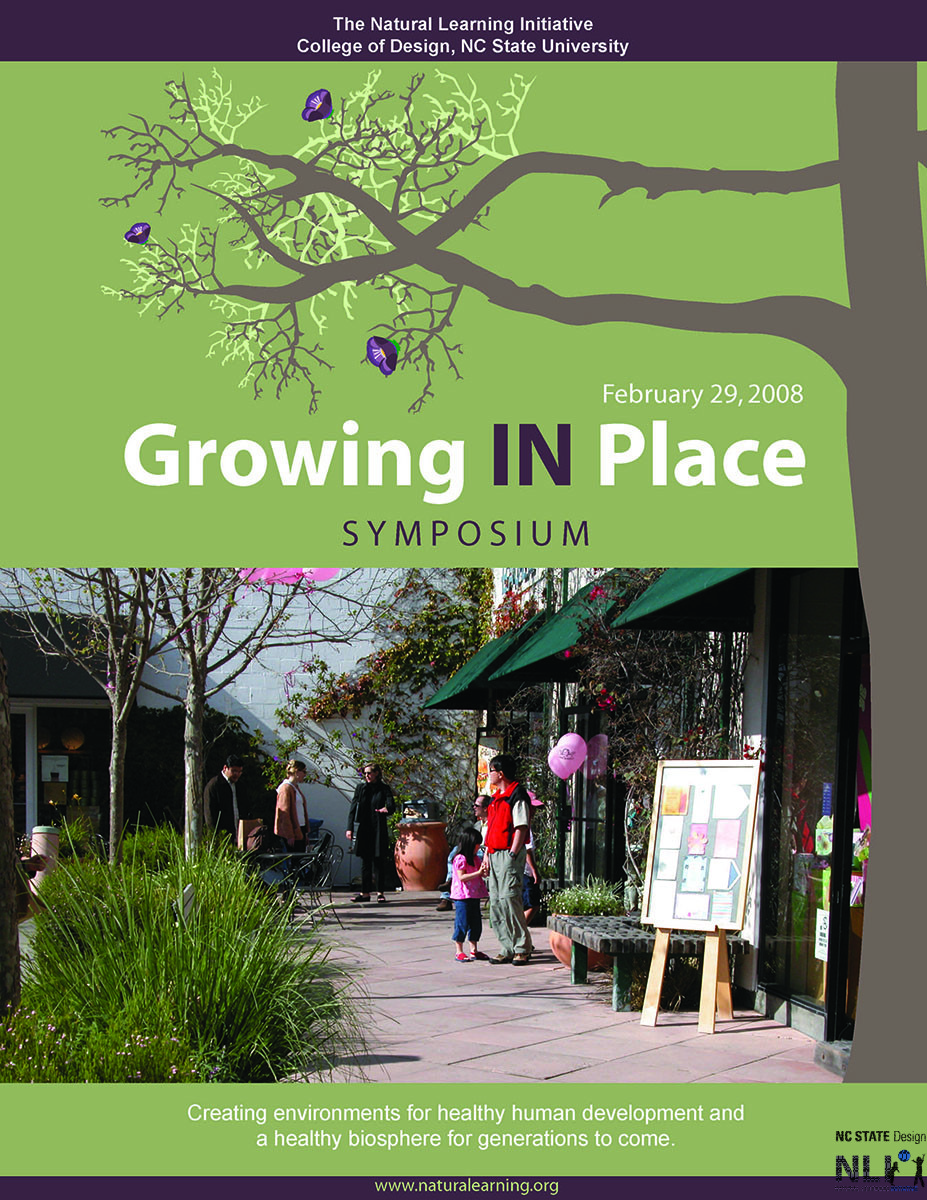
    Growing IN Place Symposium 2008

    How can urban planning and design support active use of the public realm by children and families?

    The restricted life of children is having an increasingly negative impact on their healthy development. Many children are not allowed to venture out alone or even with their friends as the previous generations did. How can we plan and design a public realm where children find the physical and social stimulation necessary for healthy human development in consonance with the culture and ecology of the place?

    Program

    As cities in North Carolina grow and develop, multiple opportunities are needed to support healthy human activity in the public realm. The aim of the symposium is to start a discussion about how planners and designers can face the challenge of maintaining and enhancing the well-being of urban families across the state.

    European design innovations such as home zones together with community participation processes and design guidelines will serve as triggers to discuss potential next steps for Raleigh and similar cities desiring to grow in harmony across the life span.

    Speakers

    Robin Moore, Director, Natural Learning Initiative. Designing urban environments for healthy child development.

    Dan Douglas, Division Manager, City of Raleigh Urban Design Center. Child-friendly neighborhoods and downtowns.

    Russ Stephenson, AIA, Raleigh City Council. Complete Streets: Bringing city streets back to life.

    Rodney Swink, FASLA, NC Office of Urban Development. Growing in Place: How to make downtowns generation-friendly.

    Gregg Warren, President, DHIC Inc. Strengthening Urban Low-Income Family Communities.

    Growing IN Place Symposium 2008 poster

    February 29, 2008